But Mr. Adee, who said he had long scorned environmentalists’ hand-wringing about such issues, said he was starting to wonder whether they had a point.As they say, Nature always bats last. Environmentalists are the catchers.
Of the “environmentalist” label, Mr. Adee said: “I would have been insulted if you had called me that a few years ago. But what you would have called extreme — a light comes on, and you think, ‘These guys really have something. Maybe they were just ahead of the bell curve.’”
Friday, March 29, 2013
As They Say, Nature Always Bats Last
Did you catch this quote at the end of today's NYT story on colony collapse disorder?

More About Stossel's Set-Up
Watching the Stossel show again, I have to say, I thought both scientists did a good job of explaining where they're coming from.
Gavin Schmidt clearly had the tougher job, and knew he was going to be attacked from t=0 in a way that Roy Spencer never would be.
So this, from Gavin, was spot-on:
Like I said, this is a very good example of why scientists routinely decline these kind of "debates" (quote-unquote). Stossel's biases were very, very clear, and the scientist who appears gets bombarded with a series of interrupting, staccato questions -- what about India? What about hurricanes? What about the economy?? -- that simply do not allow for reasoned discussion.
They're only about, as Gavin said, "good TV." And TV has (sadly) never had anything to do with the scientific debates of our time.
Gavin Schmidt clearly had the tougher job, and knew he was going to be attacked from t=0 in a way that Roy Spencer never would be.
So this, from Gavin, was spot-on:
"I'm not interested in doing this because it's good TV.... I don't need to be arguing with people just to make good TV."Good TV, of course, is really all Stossel cares about. (And isn't his faux 'astonished-that-anyone-could-ever-disagree-with-me' schtick pretty old by now?)
Like I said, this is a very good example of why scientists routinely decline these kind of "debates" (quote-unquote). Stossel's biases were very, very clear, and the scientist who appears gets bombarded with a series of interrupting, staccato questions -- what about India? What about hurricanes? What about the economy?? -- that simply do not allow for reasoned discussion.
They're only about, as Gavin said, "good TV." And TV has (sadly) never had anything to do with the scientific debates of our time.
Spencer/Schmidt Not-a-Debate on John Stossel's Show
If you're looking for it, here is video of the Gavin Schmidt/Roy Spencer debate/not-a-debate on John Stossel's show.
Stossel really exploited Gavin's desire not to make it a debate.
Stossel's biases are crystal clear. With a treatment like that, you easily can see why no scientists want any part of such a circus.
Stossel really exploited Gavin's desire not to make it a debate.
Stossel's biases are crystal clear. With a treatment like that, you easily can see why no scientists want any part of such a circus.
The Answer 'Science Friday' Should Have Given
Science Friday had some interesting segments today, including "The Secret Life of the Sonaran Desert."
It was live before an audience at (I think) Arizona State University, with Q&A, and one woman asked (paraphrasing): "I moved here in '93, and the amount of expansion into the desert is astonishing. What can we do about it?"
One of the scientists gave a rather bland answer, agreeing with her and discussing urban sprawl, etc., but I think he should have simply said, "Lady, it's expanding because you and I moved here!"
People think it's always the other guy.
The Australian: How to Lie With(out) Statistics
 This "haitus" business is really getting ridiculous.
Graham Lloyd at The Australian has now put it at 20 years:
DEBATE about the reality of a two-decade pause in global warming and what it means has made its way from the sceptical fringe to the mainstream.This is flat-out wrong -- warming over the last 20 years has been about 0.3°C.
- Over the last 20 years, GISS shows a warming trend of 0.15 ± 0.02 C/decade, or 0.30°C for two decades.
- HadCRUT4 has it at 0.136 ± 0.014 C/decade, or 0.27°C for two decades.
Can anyone stretch this lie out to 25 years?
P.S.: Yesterday HadCRUT4 just reported their surface anomaly for February: the 9th-warmest February in 165 years. Some haitus. Even their 15-yr trend is 0.05 ± 0.02 C/decade, and rising fast as the 1997-98 El Nino falls out the back-end of the 15-yr interval, and it's for suckers.
Wednesday, March 27, 2013
A Jane Goodall & Gary Larson Story
Jerry Coyne has a nice story (via Wikipedia) about the primatologist Jane Goddall, and the (loved by many scientists) cartoonist Gary Larson:
One of Larson’s more famous cartoons shows a chimpanzee couple grooming. The female finds a blonde human hair on the male and inquires, “Conducting a little more ‘research’ with that Jane Goodall tramp?” The Jane Goodall Institute thought this was in bad taste and had their lawyers draft a letter to Larson and his distribution syndicate, in which they described the cartoon as an “atrocity”. They were stymied by Jane Goodall herself, who was in Africa at the time. When she returned and saw the cartoon, she stated that she found the cartoon amusing and later personally met Larson. Since then, all profits from sales of a shirt featuring this cartoon go to the Goodall Institute. Goodall wrote a preface to The Far Side Gallery 5, detailing her version of the “Jane Goodall Tramp” controversy. She praised Larson’s creative ideas, which often compare and contrast the behavior of humans and animals. In 1988, Larson visited Gombe Streams National Park and was attacked by Frodo, a chimp described by Goodall as a “bully.” Larson sustained cuts and bruises from the encounter.


US 2012 CO2 Emissions Down Almost 4%
Today the U.S. Energy Information Agency put out final energy numbers for 2012.

U.S. CO2 emissions continued to drop, down 205 million metric tons from 2011, or -3.7%.
Per capita emissions dropped from 17.6 tonnes of carbon dioxide in 2011 to 16.8 metric tonnes in 2012, or -4.4%.
Total energy consumption dropped by 2.3 Quads, or -2.3%.
In terawatts it went from an average of 3.26 TW in 2011 to 3.17 TW last year.
Per capita, it dropped by 353 Watts, or -3.4%.
The C/E ratio of carbon emissions to energy consumption went from an average of 140.5 t CO2/MW to 138.9 t CO2/MW.

(But still a total of 5.29 Gt CO2/yr.)
Per capita emissions dropped from 17.6 tonnes of carbon dioxide in 2011 to 16.8 metric tonnes in 2012, or -4.4%.
(But still about 4 times higher than the world average.)
Total energy consumption dropped by 2.3 Quads, or -2.3%.
(1 Quad = 1015 BTU = 1.06 × 10¹⁸ Joules)
In terawatts it went from an average of 3.26 TW in 2011 to 3.17 TW last year.
Per capita, it dropped by 353 Watts, or -3.4%.
The C/E ratio of carbon emissions to energy consumption went from an average of 140.5 t CO2/MW to 138.9 t CO2/MW.
The Building of Momentum on the Climate Issue
I keep seeing things that look to me like many are finally starting to take climate change seriously. There was the letter from the Oregon and Washington governors I wrote about yesterday, and now the state of New York is putting a warning on its bond offerings, "warning that climate change poses a long-term risk to the state’s finances."
Roadside litter wasn't reduced quickly, or completely or by fiat, but by lots of small decisions to run advertisements and install public trash cans and of people deciding it was unnecessary and calling out those who did it. Same with outlawing pubic smoking (in Oregon the Senate just passed a bill outlawing it in cars that carry kids), or with same-sex marriage, or many other big issues.
Change happens slowly, but the momentum is building -- and it's certainly not going the other direction.
The caution, which cites Hurricane Sandy and Tropical Storms Irene and Lee, is included alongside warnings about other risks like potential cuts in federal spending, unresolved labor negotiations and litigation against the state.Then last week German scientists withdrew from a research project looking to curtail environmental damage from the Alberta tar sands:
“The state determined that observed effects of climate change, such as rising sea levels, and potential effects of climate change, such as the frequency and intensity of storms, presented economic and financial risks to the state,” the spokesman, Richard Azzopardi, said on Tuesday.
German scientists have pulled out of an international research project with Canada that was attempting to find ways to minimize the environmental damage caused by exploiting Alberta's oil sands. The move comes after political pressure forced Germany's largest scientific organization, the Helmholtz Association of German Research Centres, to rethink its connections with an industry that many consider to be environmentally destructive.To be sure, putting a warning on bonds or withdrawing from a project isn't the same as shutting down the tar sands or actually reducing global CO2 emissions. But change rarely comes all at once, and on this issue never would have anyway -- it's just too big and too entrenched.
The scientists who are part of the Helmholtz-Alberta Initiative (HAI) will no longer be involved in developing technologies that improve Alberta's crude oil or treat the toxic effluent from the oil sands projects. Instead, the scientists will focus their efforts on the initiative's remaining research avenues, such as carbon capture and storage and mine site reclamation.
Roadside litter wasn't reduced quickly, or completely or by fiat, but by lots of small decisions to run advertisements and install public trash cans and of people deciding it was unnecessary and calling out those who did it. Same with outlawing pubic smoking (in Oregon the Senate just passed a bill outlawing it in cars that carry kids), or with same-sex marriage, or many other big issues.
Change happens slowly, but the momentum is building -- and it's certainly not going the other direction.
Tuesday, March 26, 2013
Governors Cite Climate Change for Coal Export Review
It's hard to imagine this happening even five years ago: the governors of Oregon and Washington have cited climate change as a reason for the federal government to more closely examine the proposed export of Powder River basin coal through the Pacific Northwest and onto China.
In a letter to the President's Council on Environmental Quality, John Kitzhaber (D-OR) and Jay Inslee (D-WA) wrote:
 Carbon dioxide emissions from the exported coal would total about 250 million tonnes a year.
They also scolded the government for giving the coal away cheaply:
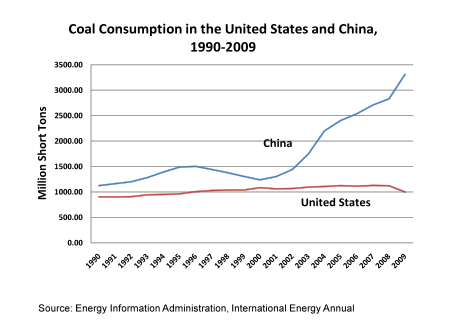
 These proposed coal exports, which are very controversial here -- the Northwest's equivalent of the fight over the Keystone XL pipeline -- are about one thing: coal companies looking at declining U.S. coal consumption and seeing how they can keep their profits up.
U.S. coal production recently dropped below the milestone mark of 1,000,000 K short tons annually, and on a per capita basis has dropped 20% from its peak in just six years:
(A short ton is the old 2,000 lbs = 0.908 metric tons. When the hell is the U.S. finally going to get with the rest of the entire world on this?)
In a letter to the President's Council on Environmental Quality, John Kitzhaber (D-OR) and Jay Inslee (D-WA) wrote:
Increasing levels of greenhouse gases and other pollutants resulting from the burning of coal, including pollutants other than CO2, are imposing direct costs on people, businesses and communities in the U.S. and around the world. These costs include the public health costs of increased atmospheric deposition of mercury in drinking water sources, as well as costs resulting from ocean acidification, rising sea levels, wildfires, and shrinking snow packs that are key sources of water for the western U.S....
We believe the federal government must examine the true costs of long-term commitments tosupply coal from federal lands for energy production, whether that production occurs domestically or in Asia. We cannot seriously take the position in international and national policymaking that we are a leader in controlling greenhouse gas emissions without alsoexamining how we will use and price the world's largest proven coal reserves.
 Carbon dioxide emissions from the exported coal would total about 250 million tonnes a year.
They also scolded the government for giving the coal away cheaply:
As the major owner of coal reserves in the western U.S., the federal government must consider whether it has appropriately priced the coal leases that it continues to grant, including the practice of granting non-competitive leases. Senators Ron Wyden and Lisa Murkowski recently asked the U.S. Department of the Interior for information concerning alleged industry practicesusing in-house trading affiliates to avoid paying royalties that reflect actual export sales. These issues raise significant concerns that we are subsidizing the export of coal at the same time we are winding down domestic consumption due to serious environmental and health concerns.
 These proposed coal exports, which are very controversial here -- the Northwest's equivalent of the fight over the Keystone XL pipeline -- are about one thing: coal companies looking at declining U.S. coal consumption and seeing how they can keep their profits up.
U.S. coal production recently dropped below the milestone mark of 1,000,000 K short tons annually, and on a per capita basis has dropped 20% from its peak in just six years:
 |
| U.S. per capita coal production (short tons/yr) |
(A short ton is the old 2,000 lbs = 0.908 metric tons. When the hell is the U.S. finally going to get with the rest of the entire world on this?)
Monday, March 25, 2013
NASA Suspends All Public Outreach
In response to the budget sequester, NASA has suspended all education and public outreach programs.
Not only can't the U.S. get back to the moon, we can't even tell you about it.
Not only can't the U.S. get back to the moon, we can't even tell you about it.
Sunday, March 24, 2013
"Oregon...Ought to Play a Little Hard to Get"
 |
| Flowers on a Camellia Tree in my sister's backyard, Portland Oregon |
"Oregon is demure and lovely, and it ought to play a little hard to get. And I think you'll be just as sick as I am if you find it is nothing but a hungry hussy, throwing herself at every stinking smokestack that's offered."
-- former Oregon Governor Tom McCall
(I recounted a good Tom McCall story here.)
Saturday, March 23, 2013
Missing Energy Claimed to be Found
A paper just out in GRL by Balmaseda, Trenberth and Källén claims to have affirmed the location of the "missing energy" in the climate system -- it's (as suspected) in the deep ocean (the 300-2000 m layer, and especially below 700 m).
You can read the abstract here; this is from the paper's conclusion:


Finally, here is their summary of trends for the different layers over different times, which makes it clear why the surface temperature jumped up so much in the 1990s -- the ocean was actually losing energy (heat), mostly because of the big 1997-1998 El Nino -- and why it's been on "haitus" during the last decade -- the ocean took up a huge amount of heat, at a rate far higher even than in the 1980s, with most of it going below 700 meters.

(The number 0.708 is simply the total surface area of all the planet's oceans divided by the planet's total surface area, viz. 70.8% of the surface is ocean.)
You can read the abstract here; this is from the paper's conclusion:
The deep ocean has continued to warm, while the upper 300 m OHC appears to have stabilized. The differences in recent trends among the different ocean layers are profound. The small warming in the upper 300 m is belied by the continuing warming for the ocean as a whole, with considerable warming occurring below 700 m. However, this raises the question of whether this result is simply because of the new Argo observing system? The results shown here suggest otherwise, although Argo clearly is vitally important quantitatively. Instead changes in surface winds play a major role, and although the exact nature of the wind influence still needs to be understood, the changes are consistent with the intensification of the trades in subtropical gyres. Another supporting factor is the uniqueness of the radiative forcing associated with global warming.Here are some figures from the paper:
The magnitude of the warming trend is consistent with observational estimates, being equivalent to an average 0.47 ± 0.03 W m-2 for the period 1975–2009. There is large decadal variability in the heat uptake, the latest decade being significantly higher (1.19 ± 0.11 W m-2) than the preceding record. Globally this corresponds to 0.84 W m-2, consistent with earlier estimates [Trenberth et al., 2009]. In an observing system experiment where Argo is withdrawn, the ocean heating for the last decade is reduced (0.82 ± 0.10 W m-2), but is still significantly higher than in previous decades. The estimation shows depths below 700 m becoming much more strongly involved in the heat uptake after 1998, and subsequently accounting for about 30% of the ocean warming.


(The number 0.708 is simply the total surface area of all the planet's oceans divided by the planet's total surface area, viz. 70.8% of the surface is ocean.)
Thursday, March 21, 2013
How Deniers Enfore Solidarity
Here's what you get for trying to comment at Watts:

See how easy it is to enforce unanimity of thought?Stalin Lysenko would be proud.

See how easy it is to enforce unanimity of thought?
New GISS Data Just In
We are in trouble -- GISS just posted their new anomaly numbers for February -- +0.49°C.
That makes the past 12 months 0.06°C warmer than the previous 12 months.
People, that's a warming rate of 11°F per century.
We are doomed (according to people like this)!
Seriously: the 15-yr trend -- which, remember, is for suckers -- is +0.07 ± 0.04°C/decade (2σ), which is totally significantly significant and not all that small.
Just 5 months ago it was +0.05°C/decade.
I told you it would be increasing as the 1997-98 El Nino slides out the back end of the 15-year window.
Live by crappy insignificant trends, die by crappy insignificant trends.
A climatologically relevant trend -- say, 30-years, in case anyone still cares about actual climate science anymore and not just point-scoring -- is still 0.17 ± 0.02°C/decade(*).
*Uncertainties are 2-sigma basic OLS statistical uncertainties. Autocorrelation increases them; see here for more details, but certainly not all of them. Or even half of them. Use the SkS trend calculator if you need to.
That makes the past 12 months 0.06°C warmer than the previous 12 months.
People, that's a warming rate of 11°F per century.
We are doomed (according to people like this)!
--
Seriously: the 15-yr trend -- which, remember, is for suckers -- is +0.07 ± 0.04°C/decade (2σ), which is totally significantly significant and not all that small.
Just 5 months ago it was +0.05°C/decade.
I told you it would be increasing as the 1997-98 El Nino slides out the back end of the 15-year window.
Live by crappy insignificant trends, die by crappy insignificant trends.
A climatologically relevant trend -- say, 30-years, in case anyone still cares about actual climate science anymore and not just point-scoring -- is still 0.17 ± 0.02°C/decade(*).
*Uncertainties are 2-sigma basic OLS statistical uncertainties. Autocorrelation increases them; see here for more details, but certainly not all of them. Or even half of them. Use the SkS trend calculator if you need to.
First they Came for the Political Scientists....
...and I didn't speak out
because I wasn't a political scientist.
Yesterday the U.S. Senate voted to restrict NSF funding for political science. An amendment that was submitted by Tom Coburn (R-OK) reads:
In a March 12th letter to NSF, Colburn wrote:
After the voice vote approving the amendment, Colburn said in a statement:
 To me it looks like Colburn is attacking knowledge itself? (To you?) If it were just about the budget, he's issue a statement saying something like "we regret our inability to fund the valuable work of the many dedicated scholars across our nation, but these are dire times for the federal government and we must cut back where we can."
Even if federal receipts are at a 60-year low (because, you know, we can't fairly tax millionaires).
But Colburn isn't saying that, is he? No, he's saying the very essence of their scholarship isn't valuable.
And that's dangerous. What will he next decide isn't worth it? Theoretical physics? Mathematical biology? Climate science?
This is how nations decline, people. It's exactly how they decline.
because I wasn't a political scientist.
(H/T/ Martin Niemöller)
Yesterday the U.S. Senate voted to restrict NSF funding for political science. An amendment that was submitted by Tom Coburn (R-OK) reads:
Purpose: To prohibit the use of funds to carry out the functions of the Political Science Program in the Division of Social and Economic Sciences of the Directorate for Social, Behavioral, and Economic Sciences of the National Science Foundation, except for research projects that the Director of the National Science Foundation certifies as promoting national security or the economic interests of the United States.Of course, "the economic interests of the United States" is a nebulous, undefined term, which is perhaps the way Coburn prefers it.
In a March 12th letter to NSF, Colburn wrote:
"Studies of presidential executive power and Americans' attitudes toward the Senate filibuster hold little promise to save an American's life from a threatening condition or to advance America's competitiveness in the world." Coburn wrote in a letter to NSF director Subra Suresh last week explaining his proposal.Of course, that's true of much of the research intended to develop pure knowledge. Do grants to differential geometers promise to save anyone's life or advance America's competitiveness in the world? They do, but not perhaps for decades, but the likes of people like Colburn cannot see that far.
After the voice vote approving the amendment, Colburn said in a statement:
"I’m pleased the Senate accepted an amendment that restricts funding to low-priority political science grants. There is no reason to spend $251,000 studying Americans' attitudes toward the U.S. Senate when citizens can figure that out for free."Yes, Americans are certainly serious students of the intracicies of Congress, the shifts in Executive power, the knowledge of other political systems (especially "American Idol"). Aren't they?

Even if federal receipts are at a 60-year low (because, you know, we can't fairly tax millionaires).
But Colburn isn't saying that, is he? No, he's saying the very essence of their scholarship isn't valuable.
And that's dangerous. What will he next decide isn't worth it? Theoretical physics? Mathematical biology? Climate science?
This is how nations decline, people. It's exactly how they decline.
More Properties of Your Universe
Here's just one of the papers containing the Planck results, with more authors than there stars in some globular clusters.
The Hubble constant, describing the expansion of the universe:
P.S.: See, there is more to life than AGW.
Besides the results I mentioned earlier, here are some of the big ones:
No evidence of cosmic strings
No evidence for more than three families of neutrinos: Neff = 3.30 ± 0.27 families, as are in the Standard Model.
Upper limit on the sum of neutrino masses is 0.23 eV.
The Hubble constant, describing the expansion of the universe:
H0 = 67.3 ± 1.2 km/s/Mpc
More detailed results than you probably want to know about can be found here.
You can't help but be really impressed about how far cosmology has come and how much it's been able to tell about not just the overall structure and history of the universe, but about the parameters of elementary particles and their interaction. The last 35 years or so, since the dawn of cosmic inflation -- the exponential expansion of the very early universe -- have been a true scientific revolution. Alan Guth (at least) really ought to win a Nobel Prize now (in 2006, in the wake of the WMAP results, Sean Carrol said it was a little early still).
More: Cosmologist Richard Easther, who live-blogged NASA's announcement, has much more here.
P.S.: See, there is more to life than AGW.
Universe Older, Less Frightening Than it Was Yesterday
 The Universe just got 100 million years older -- or, rather, it's 100 Myr older than previously thought -- according to the Planck satellite results released today.
That makes it 13.8 billion years instead of 13.7 Byr.
There's also a little less dark energy (68.3%, compared to the previous 71.4%) and a little more dark matter (26.8%; was 24.0%). Since no one has a clue what dark energy is, that makes the Universe just a little less scary than it was yesterday. Of course, no one knows what the dark matter is either, but it's matter, which is somehow less intimidating than some invisible spooky energy field that repels and reaches everywhere.
But normal matter is now known to comprise 4.9%, up from 4.6%. (That rumor that the difference is due to terrestial carbon emissions is untrue.)
Still, we don't know what 95% of the Universe is composed of. It's astonishing if you think about it, especially at night if you look up at the stars. I really don't think this has sunk into the public conscoiusness yet, who fret about more prosaic concerns like American Idol or health care.
(I wrote about the Planck mission, before it was launched, for Scientific American.)
Here's a nice comparison showing the progress in satellite measurements of the temperature fluctuations in the cosmic microwave background:

Still no evidence of any gods, though (unless they're made of dark energy).
Wednesday, March 20, 2013
The Greening Arctic
Here's a map from NASA that shows the amount of vegetative growth in the western hemisphere of the Arctic over the past 30 years. (The eastern hemisphere is even more impressive.)

 It's mostly tundra and tiaga.
These images accompany a new paper in Nature Climate Change, that says latitudinal shifts in vegetation in the Arctic -- essentially, how fast the greening is moving north -- is 4-7° in 30 years. If I figured correctly, that's 445-778 km in 30 years, or about 50 meters a day, or about 2 meters an hour.
The paper says climate models predict the shift will be 20° more by the end of the century. That's about 1400 miles.
Denver will move to Mexico City. Saskatchewan will move to Houston. Fairbanks, Alaska will move to Portland, Oregon, and Portland will move somewhere equivalent to Miami's latitude. Unless someone can find a way to alter the molecular properties of carbon dioxide. I hope someone, somewhere, is working on that.
It's mostly tundra and tiaga.These images accompany a new paper in Nature Climate Change, that says latitudinal shifts in vegetation in the Arctic -- essentially, how fast the greening is moving north -- is 4-7° in 30 years. If I figured correctly, that's 445-778 km in 30 years, or about 50 meters a day, or about 2 meters an hour.
The paper says climate models predict the shift will be 20° more by the end of the century. That's about 1400 miles.
Denver will move to Mexico City. Saskatchewan will move to Houston. Fairbanks, Alaska will move to Portland, Oregon, and Portland will move somewhere equivalent to Miami's latitude. Unless someone can find a way to alter the molecular properties of carbon dioxide. I hope someone, somewhere, is working on that.
Who Cares What Daily Mail Readers Think?
Maybe we have entered an era where scientists have to write an op-ed or FAQ every time they are misrepresented by a journalist or blogger. (That is, you know, going to but into their time doing science.)
Which is what Myles Allen did today in The Guardian, after being misrepresented by David Rose. You can read Allen's specific response to Rose's characterization of his views, but what I find more interesting is the near the end of his column:
Conservatives/feptics can only put their fingers in their ears for so long -- CO2 isn't going to stop absorbing infrared radiation, and the Earth isn't going to stop emitting it. Meanwhile their explanations look increasingly absurd, and the world will move on without them. Which is too bad, because the problem is so huge and so hard it needs all the brains it can get, and if a (so-called) free market can do that best, so much the better.
Which is what Myles Allen did today in The Guardian, after being misrepresented by David Rose. You can read Allen's specific response to Rose's characterization of his views, but what I find more interesting is the near the end of his column:
Many Guardian readers might be inclined to shrug "who cares what Mail readers think, anyway?" Well, I care. We all deserve an informed and democratic discussion about what to do about climate change, whatever our political persuasion. How many Mail readers realise that one of our government's top climate policy advisers, Dieter Helm, is recommending what, to them, would be an eye-wateringly high carbon tax. This might do wonders for the deficit (interested, George?) but, I would argue, won't solve the problem (we didn't save the ozone layer by taxing CFCs).This is the same message Scott Denning told a Heartland Conference audience.
This is an interesting discussion: subsidies for renewables versus carbon tax versus (my personal preference) upstream regulation of the fossil fuel industry to drive the development of carbon capture. Mail readers should be part of it. But they are firmly excluded by headlines dismissing the whole of climate science as a "great green con" – despite their correspondent certainly giving me the impression he understands the problem better than that....
Conservatives/feptics can only put their fingers in their ears for so long -- CO2 isn't going to stop absorbing infrared radiation, and the Earth isn't going to stop emitting it. Meanwhile their explanations look increasingly absurd, and the world will move on without them. Which is too bad, because the problem is so huge and so hard it needs all the brains it can get, and if a (so-called) free market can do that best, so much the better.
Subscribe to:
Posts (Atom)