Monday, June 26, 2006
101

Supreme Court and CO2
The Supreme Court agreed Monday to consider whether the Bush administration must regulate carbon dioxide to combat global warming, setting up what could be one of the court's most important decisions on the environment.(AP)
Sunday, June 25, 2006
US GHG emissions
Stephen Johnson
"The Bush administration has an unparalleled financial, international and domestic commitment to the reduction of greenhouse gas emissions."Supply your own sarcasm; I'm speechless. Black is indeed white.
Space Shuttle
The decision to proceed with the launch anyway — made by Michael Griffin, the administrator of NASA — was a gutsy call. It even seems reasonable, if you accept the constraints he was operating under. But if you believe, as we do, that the benefits to be gained from further shuttle flights are minimal, this looks like an unnecessary risk to the spacecraft and to the astronauts who will be riding in it.16 more shuttle flights will be needed to complete the International Space Station.... Which seems like a waste. What's it doing up there? I mean, do you know how many astronauts are currently living in the station? Can you name them, or name any experiment now taking place on it, or any scientific result that has come from it? Cost: $125B, according to this ESA site. For what, a few studies on extended weightlessness? And we can't find $5-7B for the Next Linear Collider?
Saturday, June 24, 2006
Kos
Really QuickThis is getting all too messianistic for my tastes. Kos and company clearly now think they command the netroots, when in fact the potentiality (and actuality) of the Web is far bigger than they are. Kos has, what, backed 19 losers in his last 19 endorsements? Something like that.
by kos
Sat Jun 24, 2006 at 04:45:20 PM PDT
Just a quick reminder as the media nip at our heels --
We didn't get here because of them.
They can praise us, they can trash us, they can ignore us, and ultimately none of that will matter as long as we keep doing what we've been doing.
Whether we succeed or not will depend on our own efforts. Not those of anyone else.
If you want to be another drone--if, in other words, you want to be another party loyalist, scum who believe whatever your party tells you to believe--you'll fall for this kind of shit. If you instead inspire to be an independent thinker, you'll follow your own path. Kos is just another charasmatic manipulator trying to manipulate. Don't fall for it.
Neither, fall for the attempt by his friends to out whoever forwarded a Townhouse email to Jason Zengerle. Kos and his cheap friends have the sharp knives out for Zengerle and his publication of a Kos+Friends email where Kos is trying to manipulate the backstory. I trust Zengerle's reporting more than I trust Kos's clear behind-the-scenes manipulation of the facts. Zengerle has much more to lose by faking an email than Kos+Friends has to lose by denying it. So I'm believing Zengele. Kos is just another activist, and I trust him about as much as I trust Grover Norquist. Which is to say, not very much at all.
Immigration
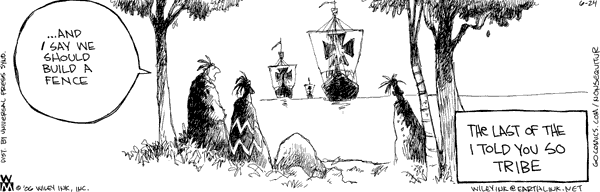
Redstate links to this cartoon.
Some people are simply too stupid for words.
UPDATE: Yes, I realize this is a subtle cartoon. I even realize that it is, in fact, unclear on what it assumes is implied by foreign immigration. I don't for a minute, however, believe that Redstate.com gets the nuances. I'm not even sure the cartoonist gets the nuances.
World Cup
UPDATE: Think I'm kidding about the nationalism? This is from today's Boston Globe:
But in the bright sunlight of this World Cup season, the flags, cheers, and robust singing of the national anthem by the buoyant crowds have become something else -- a resurgence of unbridled patriotism on a scale unseen in Germany since World War II, according to historians, political scientists, and other analysts."It's really without precedent in our democratic [postwar] history," said Manfred Hettling, professor of modern history at Germany's University of Halle. "We've had soccer championships before. We've had proud moments, like the fall of the Berlin Wall. But never have we had so many Germans so publicly celebrating their country."
Einstein: "Nationalism is an infantile disease. It is the measles of mankind."
Einstein: "Nationalism, on my opinion, is nothing more than an idealistic rationalization for militarism and aggression."
Einstein: "He who joyfully marches to music rank and file, has already earned my contempt. He has been given a large brain by mistake, since for him the spinal cord would surely suffice. This disgrace to civilization should be done away with at once. Heroism at command, how violently I hate all this, how despicable and ignoble war is; I would rather be torn to shreds than be a part of so base an action. It is my conviction that killing under the cloak of war is nothing but an act of murder."
String Theory
The article highlights two physicists (Peter Woit and Lee Smolin) who have books coming out in September, and who both believe that string theory--which everyone admits has yet to produce a prediction that can be tested by experiment--is taking physics in a very wrong direction. The WSJ article only interviews one pro-string physicist, and if you want to fault the article you can use this ratio as evidence.
All of the cool crowd in physics works on string theory. But you'd never know it by this WSJ article or by the blog of the most prominent string theorist on the Web, Lubos Motl of Harvard. Motl is a different sort of physicist in that he's not reserved about expressing his opinion about string theory, or anything else for that matter, including your manhood and your mother's manhood.
Lubos goes to bat for string theory's case and against the WSJ's point of view, but it's not a very strong turn at bat because mostly instead of making counterarguments against the points raised in the article he goes about questioning people's sanity and, seemingly, their very right to walk upon this earth while holding the opinions they do. He would have made a better case if he'd stuck to the physics. But such is not his way.
This is all just a way for me to say that I've been reading Leonard Susskind's new book, The Cosmic Landscape: String Theory and the Illusion of Intelligent Design. The picture of the universe that string theorists are painting lately is a strange and bizarre one that, if only it were true, would be perhaps the most amazing thing you could imagine: that we live in a universe that is a mere bubble in a much more immense sea of bubbles, in each of which the laws of physics are profoundly different than they are here.
Why do we live here? Because the laws of physics allow it. That's not the complete answer, but it's close.
The problem is, as I understand it, that string theory (or, more generally, the theory that physicist call "M-theory") seems to allow a very large number of possible solutions, or as the physicists call them, vacuua (as in the plural of "vacuum"). In fact, there are roughly 10-to-the-500th-power vacuua. That's an immense number that I don't even know how to describe except by using scientific notation. It's much more than a googol, or even a googol of googols. But it's less than a googolplex.
So rather than asking "how do we manipulate the mathematics to choose the one vacuum that represents our universe?" string theoriests like Susskind are saying, all these vacuums are allowed and all describe possible universes. In one or two of them the photon mass is zero and the electron has a mass of 0.511 MeV (and...), but in others the graviton is massive and quarks can be light-years apart and atoms can't even form and nothing is the way it seems here. And in still others..., well, you get the picture, times 10^500.
The universe in which we happen to find ourselves is distinguished as the one whose fundamental constants and particle masses are such that everything combines to produce life (at least, as we know it).
It's pretty weird, wild stuff, and if you want to know more you should read Susskind's book as best you can. Despite the WSJ article, string theory doesn't appear to be going away anytime soon, though maybe a few more people will start jumping on the Woit/Smolin bandwagon. If two people can comprise a bandwagon. I'm not sure.
Ethanol
Long, interesting article in the NY Times about ethanol and the gold rush now underway in the midwest. Most interesting statistic:
So much for that savior. Next?For all the interest in ethanol, however, it is doubtful whether it can serve as the energy savior President Bush has identified. He has called for biofuels...to replace roughly 1.6 million barrels a day of oil imported from the Persian Gulf.
To fill that gap with corn-based ethanol alone, agricultural experts say that production would have to rise to more than 50 billion gallons a year; at least half the nation's farmland would need to be used to grow corn for fuel.
UPDATE: Of course, I'm being (somewhat) flip in my last comment there. There are other kinds of cellulosic biofuels, for example. The Brazilians use sugar cane. But this is a Big Problem, and ethanol doesn't appear to be a Big Solution. So maybe it's just part of the solution.
Portland and Peak Oil
GW and Hurricanes
Global warming accounted for around half of the extra hurricane-fueling warmth in the waters of the tropical North Atlantic in 2005, while natural cycles were only a minor factor, according to a new analysis by Kevin Trenberth and Dennis Shea of the National Center for Atmospheric Research (NCAR)....They have some hard data behind them:
"The global warming influence provides a new background level that increases the risk of future enhancements in hurricane activity," Trenberth says....
The study contradicts recent claims that natural cycles are responsible for the upturn in Atlantic hurricane activity since 1995. It also adds support to the premise that hurricane seasons will become more active as global temperatures rise.
By analyzing worldwide data on sea-surface temperatures (SSTs) since the early 20th century, Trenberth and Shea were able to calculate the causes of the increased temperatures in the tropical North Atlantic. Their calculations show that global warming explained about 0.8 degrees F of this rise. Aftereffects from the 2004-05 El Nino accounted for about 0.4 degrees F. The Atlantic multidecadal oscillation (AMO), a 60-to-80-year natural cycle in SSTs, explained less than 0.2 degrees F of the rise, according to Trenberth. The remainder is due to year-to-year variability in temperatures.
Black is White
Electricity Daily: The NAS report casts serious doubts on the conventional scientific wisdom of man-made climate warming, particularly as described by political advocates such as former Vice President Al Gore.... Those who argue that solar activity drives global climate, not CO2, will take heart.
Sen. James Dumkoff Inhofe (R-OK):
Today’s NAS report reaffirms what I have been saying all along, that Mann’s ‘hockey stick’ is broken.(Via Think Progress). Asked about these, Al Gore said (and I swear I headlined this post before I read Gore's remarks)
...global warming skeptics "will seize on anything to say up is down and black is white." Gore explained that science, by nature, thrives on uncertainty and tries to eliminate it; politics, on the other hand, is vulnerable to being paralyzed by uncertainty. When science and politics converge, Gore argued, the chance for "cowardice is high."
Space Shuttle
A letter writer to the Boston Globe concerned about NASA's upcoming shuttle launch puts it succinctly:
IT IS with a sense of dread that I greet the news that NASA is determined to blast another of its aging shuttles into space ("NASA sets shuttle launch for July 1; dissent reported," Page A5, June 18). Given the astronomical cost, obvious danger, and meager scientific benefit, we must ask ourselves whether it is really worth it to replicate a feat first seen in 1981. For most, the only suspense or excitement associated with this latest mission will be to see whether the astronauts make it back alive....
MICHAEL C. CASCIO, Medfield
The launch of the shuttle is one week from today.
Friday, June 23, 2006
Hansen Book Reviews
Fumento
I assumed the same was true for Michael Fumento.... So I was running around town this morning doing some errands and listening to Al Franken's radio show. They had Fumento was on -- he just returned from an embedding in Iraq. My God, he is even worse on the radio! You'd think he was the only journalist who ever went to Iraq. I only caught his segment for about two minutes, but during that time he was pompous, combative, egotistical, and simply an all around jerk to his hosts. It was like getting smacked in the face, he was trying so hard to be forceful. It's not easy to make such a strong impression in a mere two minutes, but he succeeded in spades.
Oh yeah, he also has a funny, high voice, kind of like a cartoon character.
I can't imagine why Al Franken thought he needed to have someone like him on his show.
Oregon Emissions Standards
- new car and truck prices will go up by over $1,200 by 2016. 2009 models, when the program starts, will go up an average of $200.
- savings of 1.7 MMT/yr in transportation GHG emissions by 2020. That will be down 18% by 2020 and 27% by 2030. That comes to a savings of 9,000 t/day by 2020 and 16,000 t/day by 2030. The state's total emission of GHGs, all sectors, is about 70 MMT/yr. So this saves about 2% of Oregon's total GHG emissions in 2020.
- savings of $25/mth in gas for the average car (assumes $3/gal gas).
- 165,000/yr new passenger cars are sold.
This is a big win for Governor Ted Kulongowski, who has made global warming a priority of his administration.
Naturally, the national auto industry is sueing. The Oregon Auto Dealers Association is naturally opposed. One backward-looking auto dealer said, "He's [Kulongowski] going to cost consumers unnecessarily at the end of the day because they'll be paying roughly $1,000 more a vehicle to comply with these emissions requirements, when it will affect a minuscule amount of our air quality."
I bet the cost per new car ultimately ends up being significantly less than ~$1000.
Coal
One interesting sidebit: while I know carbon sequestration had the potential to leak CO2 and threaten life, I didn't realize it had already once happened:
In 1986, at Lake Nyos in Cameroon, 300,000 tons of naturally occurring carbon dioxide that had been trapped in the lake suddenly rose to the surface and formed a misty cloud, suffocating 1,700 people.