Big fan of Kerry Emanuel's "bear in the woods" metaphor http://t.co/UjvXKLfmju pic.twitter.com/uWYI49Is6i
— John Cook (@skepticscience) April 1, 2014
Monday, March 31, 2014
Looks Like This is Gonna Be a Thing

Sunday, March 30, 2014

What Exceptional Nations Do
From the NY Times article on the WGII:
“I think that dealing effectively with climate change is just going to be something that great nations do,” said Christopher B. Field, co-chairman of the working group that wrote the report, and an earth scientist at the Carnegie Institution for Science in Stanford, Calif.For added punch in America, replace the word "great" with "exceptional...."
About Using GDP to Define Disasters
This is a point that tends to get lost in the shuffle, from Climate Science Watch:
GDP also does not fully account for humanitarian disasters to poorer countries. Extreme impacts in poor, tropical areas (which are expected to be the first to experience the most severe disasters) may not significantly affect global GDP because of the low standard of living – but they still matter.The GDP of the poorest 20 countries in Africa is 0.12% of world GDP (in 2011). That's hardly a blip on charts like this, but if a disaster totally obligerated these 20 countries it would be almost undescribable.
"Warnings by Pesky Scientists"
And, sure enough, logging above the area of the current landslide appears to have gone beyond the legal limits, into the area that slid, according to a report in The Seattle Times.
Yes, but who wants to listen to warnings by pesky scientists, to pay heed to predictions by environmental nags, or allow an intrusive government to limit private property rights? That’s how these issues get cast. And that’s why reports like the ones done on the Stillaguamish get shelved. The people living near Oso say nobody ever informed them of the past predictions.
-- Timothy Egan, A Mudslide, Foretold, New York Times, March 29, 2014
Saturday, March 29, 2014
A Picture of Accelerating Greenland Ice Loss
From "An improved mass budget for the Greenland ice sheet," Ellyn M. Enderlin et al, Geophysical Research Letters Volume 41, Issue 3, pages 866–872, 16 February 2014.
In the graph below, the black line is overall ice mass lost in Greenland; the blue line is loss to due to ice discharge from marine-terminating outlet glaciers; and the red line is loss due to surface melting and runoff.
Over the course of last decade, surface melting and runoff moved to dominating over discharge. The authors write, "...84% of the increase in mass loss after 2009 was due to increased surface runoff. These observations support recent model projections that surface mass balance, rather than ice dynamics, will dominate the ice sheet’s contribution to 21st century sea level rise."

In the graph below, the black line is overall ice mass lost in Greenland; the blue line is loss to due to ice discharge from marine-terminating outlet glaciers; and the red line is loss due to surface melting and runoff.
Over the course of last decade, surface melting and runoff moved to dominating over discharge. The authors write, "...84% of the increase in mass loss after 2009 was due to increased surface runoff. These observations support recent model projections that surface mass balance, rather than ice dynamics, will dominate the ice sheet’s contribution to 21st century sea level rise."
Another Earthquake Today in Los Angeles
The LA Times says there have been over 100 aftershocks since yesterday's M5.1, but this is the first aftershock larger than M4.0....
-------- Original Message --------

-------- Original Message --------
| Subject: | 2014-03-29 21:32:46 (M4.4) GREATER LOS ANGELES AREA, CALIFORNIA 34.0 -117.9 (2b02a) |
|---|---|
| Date: | Sat, 29 Mar 2014 21:34:57 +0000 |
| From: | ens@ens.usgs.gov (USGS ENS) |
| Reply-To: | <ens@ens.usgs.gov> |
| To: | david.appell@gmail.com |
M4.4 - GREATER LOS ANGELES AREA, CALIFORNIA
| Magnitude | 4.4 |
| Date-Time |
|
| Location | 33.962N 117.885W |
| Depth | 9 km |
| Distances |
|
| Location Uncertainty | Horizontal: 0.3 km; Vertical 0.8 km |
| Parameters | Nph = 163; Dmin = 4.4 km; Rmss = 0.41 seconds; Gp = 14° Version = 1 |
| Event ID | ci 15483001 |
For updates, maps, and technical information, see: Event Page or USGS Earthquake Hazards Program
CISN Southern California Management Center
Caltech Seismological Laboratory
U.S. Geological Survey
http://www.cisn.org/scmc.html
Disclaimer
CISN Southern California Management Center
Caltech Seismological Laboratory
U.S. Geological Survey
http://www.cisn.org/scmc.html
Disclaimer
Friday, March 28, 2014
Feature Article on Exoplanets
There's more to life than climate change -- such as the genuine scientific revolution going on with the discovery of exoplanets. I have a feature article about them, and some of their properties, in the April issue of Physics World magazine.
The Latest Dust-up
I don't have any special information about the Pielke Jr/Mann/Trenberth dust-up.... The third of the five stages of grief is "bargaining," and I suppose that's the phase climate change is in now, with all the threats of lawsuits flying around (and the actual lawsuits).
I like all three of these guys, and have used them often for sources. And I still hope to. But, in my opinion, this latest incident is nothing compared to Roger's accusations last year about Shaun Marcott and his co-authors, where he outright accused them of fraud for, as far as I can tell, merely presenting two pieces of information on the same graph.
I thought that was very far beyond the pale, and much more egregious than this latest. So when he writes, as Talking Points Memo reported, "...in the future how about we agree to disagree over scientific topics like gentlemen?," it rings kind of hollow.
Recently someone -- I forget who -- said about Roger that he seems to think climate change is a big problem, but he disagrees with everything anyone says about it. I feel like I kind of get that in a way -- it can be much more interesting to go slightly against the grain, to find a special angle that stands out. It gets you more attention, and it makes you look like an "honest broker" compared to all the...well, compared to all the lemmings.
But it's a difficult position to consistently pull off over the long-term, and it's easy to become obstinate just for the sake of being obstinate. That's not a comfortable position to be in.
The last year or two seems like a really ugly time in climate science, and in the writing and blogging about it. There is a lot at stake, not just scientifically and professionally but historically as well, and when once Newton and Leibniz could have a calm, leisurely feud in correspondence and journal papers, today it happens almost faster than you can read and maybe faster than people can think.
 It's easy to get caught up in it, which I've certainly been guilty of. It's easy to forget that this is a problem that will be unfolding for many decades, and even centuries, and in a real sense we're only in the beginning of it. Or maybe the end of the beginning. But lately it seems like a lot of people are telling other people to just shut up, they're wrong or even liars, and I suspect this is only going to get worse -- perhaps much worse.
Anyway, the Singularity will be here before you know it, and I suspect that as soon as a computer system becomes intelligent enough to keep exponentially improving itself, one of the very first things it will do is shut down all of our CO2-emitting power plants and motor vehicles, because it's not an idiot like we are.
I guess the saying is ultimately right -- keep calm and collect more data. What else is there, really?

I like all three of these guys, and have used them often for sources. And I still hope to. But, in my opinion, this latest incident is nothing compared to Roger's accusations last year about Shaun Marcott and his co-authors, where he outright accused them of fraud for, as far as I can tell, merely presenting two pieces of information on the same graph.
I thought that was very far beyond the pale, and much more egregious than this latest. So when he writes, as Talking Points Memo reported, "...in the future how about we agree to disagree over scientific topics like gentlemen?," it rings kind of hollow.
Recently someone -- I forget who -- said about Roger that he seems to think climate change is a big problem, but he disagrees with everything anyone says about it. I feel like I kind of get that in a way -- it can be much more interesting to go slightly against the grain, to find a special angle that stands out. It gets you more attention, and it makes you look like an "honest broker" compared to all the...well, compared to all the lemmings.
But it's a difficult position to consistently pull off over the long-term, and it's easy to become obstinate just for the sake of being obstinate. That's not a comfortable position to be in.
The last year or two seems like a really ugly time in climate science, and in the writing and blogging about it. There is a lot at stake, not just scientifically and professionally but historically as well, and when once Newton and Leibniz could have a calm, leisurely feud in correspondence and journal papers, today it happens almost faster than you can read and maybe faster than people can think.
It's easy to get caught up in it, which I've certainly been guilty of. It's easy to forget that this is a problem that will be unfolding for many decades, and even centuries, and in a real sense we're only in the beginning of it. Or maybe the end of the beginning. But lately it seems like a lot of people are telling other people to just shut up, they're wrong or even liars, and I suspect this is only going to get worse -- perhaps much worse.Anyway, the Singularity will be here before you know it, and I suspect that as soon as a computer system becomes intelligent enough to keep exponentially improving itself, one of the very first things it will do is shut down all of our CO2-emitting power plants and motor vehicles, because it's not an idiot like we are.
I guess the saying is ultimately right -- keep calm and collect more data. What else is there, really?
IPCC Backtracks on Extinctions
Climate science is a religion, some say, with scientists toeing the party line, nothing but slimy leftists intent on world control, only looking for funding of their next grant proposal.
Science is always skeptical, others way. It is a critical, open endeavor, a self-correcting process that hones in on the harsh and inconvenient truth.
So which is it?
Well, this definitely falls in the latter category:
"UN Backtracks: Will Global Warming Really Trigger Mass Extinctions?" by Axel Bojanowski, der Spiegel, March 26, 2014
A few quotes from and about the 5AR WGII report on Impacts, that will come out on Monday:
Science is always skeptical, others way. It is a critical, open endeavor, a self-correcting process that hones in on the harsh and inconvenient truth.
So which is it?
Well, this definitely falls in the latter category:
"UN Backtracks: Will Global Warming Really Trigger Mass Extinctions?" by Axel Bojanowski, der Spiegel, March 26, 2014
A few quotes from and about the 5AR WGII report on Impacts, that will come out on Monday:
The second part of the IPCC's new assessment report is due to be presented next Monday in Yokohama, Japan. On the one hand, a classified draft of the report notes that a further "increased extinction risk for a substantial number of species during and beyond the 21st century" is to be expected. On the other hand, the IPCC admits that there is no evidence climate change has led to even a single species becoming extinct thus far.
At most, the draft report says, climate change may have played a role in the disappearance of a few amphibians, fresh water fish and mollusks. Yet even the icons of catastrophic global warming, the polar bears, are doing surprisingly well. Their population has remained stable despite the shrinking of the Arctic ice cap.
The draft report includes a surprising admission by the IPCC -- that it doubts its own computer simulations for species extinctions. "There is very little confidence that models currently predict extinction risk accurately," the report notes. Very low extinction rates despite considerable climate variability during past hundreds of thousands of years have led to concern that "forecasts for very high extinction rates due entirely to climate change may be overestimated."
In the last assessment report, Climate Change 2007, the IPCC predicted that 20 to 30 percent of all animal and plant species faced a high risk for extinction should average global temperatures rise by 2 to 3 degrees Celsius (3.6 to 5 degrees Fahrenheit). The current draft report says that scientific uncertainties have "become more apparent" since 2007.None of this means there aren't very many threats:
"Even in the ocean, we see that habitats are shifting to the north," says another leading IPCC author, Hans-Otto Pörtner of the Alfred Wegener Institute of the Helmholtz Centre for Polar and Marine Research. The Norwegians were pleased about the many new species of fish off their coast. Fifty-two new species were also counted in the North Sea. But, Pörtner says, "near the equator, there is nothing to replace what has gone. The seas are becoming impoverished there."Let it not be said that climate scientists aren't trying to get at the truth.
FiveThirtyEight Apologizes On Behalf Of Controversial Climate Science Writer
This Just In:
"Two prominent climate scientists say Roger Pielke Jr., a controversial writer at Nate Silver’s FiveThirtyEight site, sent emails threatening possible legal action in response to their criticism of his findings for the data-driven news site.
"Pielke says it's "ridiculous" to characterize the emails as threats against Michael Mann, director of the Earth System Science Center at Pennsylvania State University, and Dr. Kevin Trenberth, a distinguished senior climate scientist at the National Center for Atmospheric Research. FiveThirtyEight, however, apologized to both men."
http://www.huffingtonpost.com/2014/03/28/fivethirtyeight-climate-change-dispute_n_5049279.html
More:
In an email to HuffPost, Mann said Pielke sent him "a threatening email in response to my fair criticism of his piece." Mann added that a representative from FiveThirtyEight contacted him and offered "an apology for what they characterized as unacceptable behavior by Pielke.”
Mann declined to make Pielke's email public, but told HuffPost that he viewed it as a "thinly veiled" threat of legal action.
In an email to HuffPost, Trenberth said Pielke contacted him and his bosses following the ThinkProgress report. Trenberth said he also received an apology from FiveThirtyEight.
Trenberth said he considered Pielke's email "a threat to me.”
“He was very accusatory and threatened me if I did not respond,” Trenberth told HuffPost.
Trenberth forwarded the text of the email to HuffPost. Pielke wrote that Trenberth had "made some pretty coarse and perhaps even libelous comments" in the ThinkProgress article. Pielke requested that Trenberth correct his public claims and noted that "an apology would be nice also."
"Once again, I am formally asking you for a public correction and apology," Pielke wrote to Trenberth and his bosses. "If that is not forthcoming I will be pursuing this further. More generally, in the future how about we agree to disagree over scientific topics like gentlemen?"
John Fleck's Writing About the Colorado River
Speaking of drought, John Fleck is on a field trip along the Colorado River, blogging up a storm, flooding the zone and getting his feet wet in all kinds of puddles.
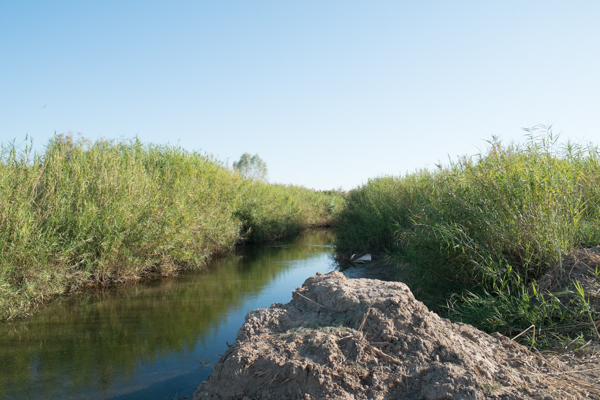
Here's his remarkable picture of the Colorado River just below the Morelos Dam, which was opened recently for an environmental experiment in the former wetlands of the river's delta. Here are some of John's many thoughts on that, and here he puts this pulse flow into its context.
All of his recent posts have trenchant observations that are worth checking out. Why should you care, if you don't live in the US southwest? Because when they run out of water in the next couple of decades, they will be coming to you asking for some of yours.
Really.
Here's his remarkable picture of the Colorado River just below the Morelos Dam, which was opened recently for an environmental experiment in the former wetlands of the river's delta. Here are some of John's many thoughts on that, and here he puts this pulse flow into its context.
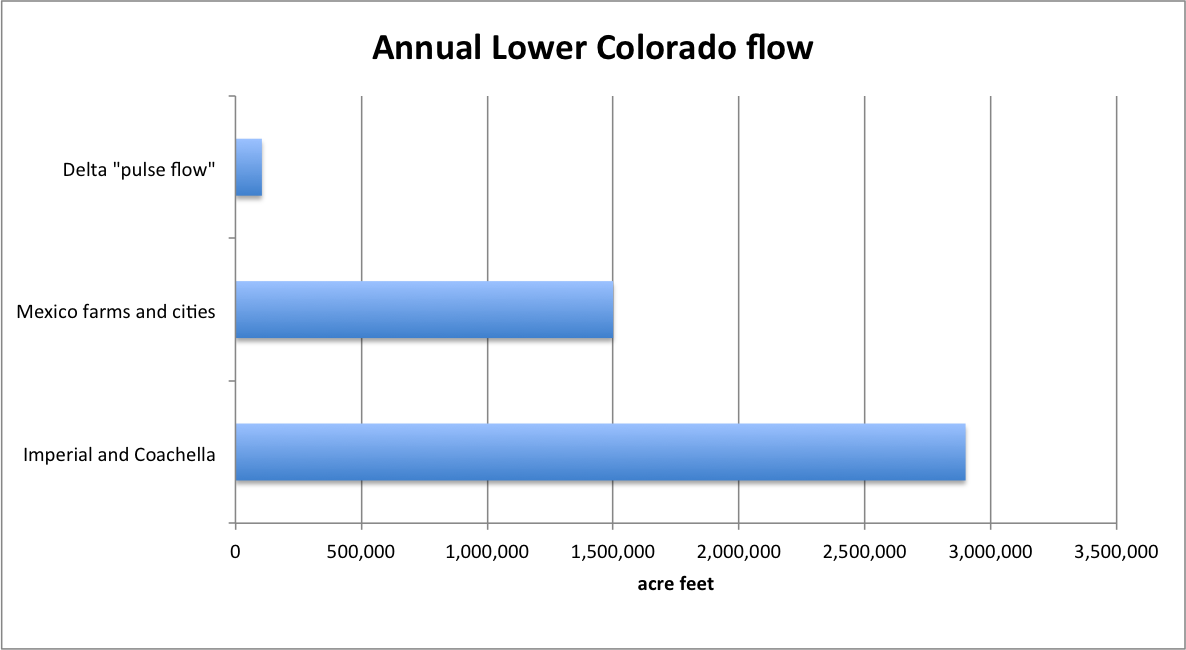
All of his recent posts have trenchant observations that are worth checking out. Why should you care, if you don't live in the US southwest? Because when they run out of water in the next couple of decades, they will be coming to you asking for some of yours.
Really.
The Thing About Drought Is...
About 90 percent of all water diversions from the [Colorado] river went to irrigation. This was highly remunerative. Imperial County alone produced nearly $2 billion in crops and livestock in 2012. Nearly 50 percent of the agricultural diversions in the lower basin went solely toward water-inefficient arid-land crops like alfalfa that are used to feed livestock. In Lochhead’s view, this outsize share of the river, however enriching of industrial agriculture, however historically entrenched, would have to shrink as cities grew. “Cities are the more efficient use of water. Cities are where it’s at now,” he said. “We have the money, and the farmers who have the water will be willing to sell.”
DeBuys asked who in this debate was delusional. He said that farmers he had talked to, in the Imperial Valley, in Utah, in Colorado, in New Mexico, weren’t interested in giving up water rights. The farmers will fight, Weisheit agreed. Rural interests will be pitted against urban, state against state, upper basin against lower basin. DeBuys worried about the breakdown of rational decision-making in conditions of drought. Drought is not like other natural disasters. Hurricane, flood, storm, and fire devastate and then pass quickly, leaving behind communities united by the sudden trauma. Drought is gradual. It is geologic in its pace, and as it unfolds it erodes society’s confidence, goodwill, trust. “It gives people plenty of time,” writes deBuys, “to erect defenses, pick sides, and meditate on the defects of their neighbors.”
-- Christopher Ketchem, "Razing Arizona," Harper's magazine, April 2014
Sunday, March 23, 2014
About Today's Flooding of the Colorado River Delta
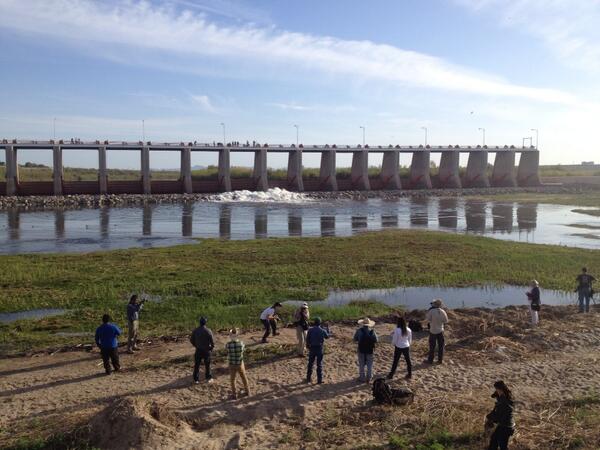
Science magazine had an interesting article this week from Erik Stokstad about this.
Stokstad wrote that the Dam will be open for almost 2 months. But the amount of water is "just 0.7% of the 18.5 billion cubic meters that once reached the gulf each year, mostly as spring floods."
"Just 3% of the original extent of cottonwood and willow trees remains."
The maximum flow of the outlet will be 120 cubic meters per second, and that will last only for 3 days. "The river will probably be no more than hip-deep in places."
"About 2 dozen scientists, plus graduate students and volunteers, have spent the past several weeks studying the river channel."
The outflow will end on May 18th. "Smaller flows will continue even after May. That's because a coalition of six environmental groups has raised about $7.5 million to plant trees and start buying up to 65 million cubic meters of water from Mexican farmers, so it will reach the riverside vegetation rather than be used for agriculture."
That's just kind of sad, having to buy water for nature. This is even sadder:
"When the influential American conservationist Aldo Leopold canoed down the Colorado River delta to the Gulf of California in 1922, he was awestruck by endless wetlands teeming with wildlife. Leopold vowed to never return, fearing that the wilderness wouldn't live up to his memories. He was right...."--
Addendum: Nature magazine wrote about this too. The three-day pulse will be March 27-29, "meant to mimic a small-scale spring flood."
Saturday, March 22, 2014
Can Mark Steyn Claim "Invincible Ignorance?"
Barry Bickmore:
As I have pointed out a number of times, Mann doesn’t even need discovery to show reckless disregard for truth/falsity in Steyn’s case. Steyn went on record recently calling the Hockey Stick a “climate model” whose “predictions” had failed. What possible defense can he have against the claim that he showed reckless disregard for the truth or falsity of claims that Mann’s work was “fraudulent”, when he didn’t even know what the %$@! that work was?
His only real defense is what the Catholics call “invincible ignorance”. That is, he will have to claim that he is too stupid to understand the issue at hand, so no amount of study would have led him to a different conclusion, no matter how obvious.
A Few Interesting Things
Be absolutely sure to read Tamino's analysis of Hansen's 1988 climate predictions -- and his takedown of the shamefully dishonest presentation of the GWPF (Global Warming Policy Foundation).
That's hardly what models predict.
#
14 earthquakes recorded in Oklahoma since Friday.
#
Argus et al in GRL: California's mountains subside up to 12 mm in the fall and winter due to the load of snow and rain, then rise an identical amount in the spring and summer when the snow melts, the rain runs off, and soil moisture evaporates. We invert the GPS observations of seasonal vertical motions to infer changes in equivalent water thickness.
#
Did you know that Andrew Weaver, a climate scientist from the University of Victoria in British Columbia who co-authored this Nature article on the tar sands that I've referred to often, was elected last year to the province's parliament as a member of the Green Party?
#
From Time.com: The Day Albert Einstein Died - a Photographer's Story
#
Judith Curry thinks that Arctic sea ice is going to reverse its decline around 2030: "As per the stadium wave, the natural variability part of the sea ice decline (arguably at least half of the total sea ice decline) will bottom out circa 2030, with the reversal of the decline beginning in the European sector."That's hardly what models predict.
#
Cliff Mass:
And I noticed something else: the audience’s eyes glazed over as the endless list of disasters were described. And the climate policy advocates provided extraordinarily specific predictions–such as the snow pack being reduced by 35% by a certain year. Such extreme precision regarding events later in the century caused such substantial rolling of some eyeballs that I worried that some might fall out their sockets.
Such litanies of future global warming-related disasters are being repeated time and time again on the national scene, leading much of society to increasingly tune out the increasingly strident warnings of global warming impacts provided by the "prophets" in non-governmental organizations (NGOs), the media, and others. In fact, according to a recent Gallup poll, climate change has dropped to 14th of the list of Americans' worries."
The Intellectual Blackout at the Powerline Blog
It's not often that the very first line of an article is outright wrong, but John Hinderaker manages it at Powerline, which Mark Steyn gleefully reposts.
Hindenraker wrote:

They conclude, "A growing body of evidence supports an ESS often exceeding 6°C during glacial times and 3°C during non-glacial times."
There are, of course, plenty more such papers:
Hansen, J.E., and M. Sato, 2012: Paleoclimate implications for human-made climate change. In Climate Change: Inferences from Paleoclimate and Regional Aspects. A. Berger, F. Mesinger, and D. Šijački, Eds. Springer, 21-48, doi:10.1007/978-3-7091-0973-1_2.
Previdi, M., et al, 2013: Climate sensitivity in the Anthropocene. Q. J. R. Meteorol. Soc., 139, 1121-1131, doi:10.1002/qj.2165
Rohling, E.J., et al, 2012: Making sense of palaeoclimate sensitivity. Nature, 491, 683-691, doi:10.1038/nature11574.
and on an on; a nice review is this 2011 study by the National Academy of Sciences:
"Understanding Earth's Deep Past: Lessons for Our Climate Future," Committee on the Importance of Deep-Time Geologic Records for Understanding Climate Change Impacts; National Research Council of the National Academies (2011).
Hinderaker is also flat-out wrong when he writes
And of course the IPCC has included reviews of model performance in every one of its Assessment Reports -- Hindenraker might have at least looked there. In the 5AR first volume there's an entire chapter, Chapter 9, titled "Evaluation of Climate Models," which goes into exhaustive detail about the performance of climate models. He could at least have looked at Figure 9.8 from that chapter, pg 768:

Here the solid black line is the average global surface temperatures from HadCRUT4, the dashed line the same from GISS, and the solid red line the CMIP5 model mean.
Hinderaker lauds Tim Ball's views on climate models... So how well does Tim Ball's climate model do? Oh, that's right, Tim Ball has never made a climate model in his life (I can't think of one contrarian who ever has), and his highly padded publication list seems to contain perhaps 4 peer reviewed articles in an almost 30-year career. That's what passes for an expert in Powerline Land.
Hinderaker clearly lives in the same subuniverse as Steyn -- climate science is wrong, BECAUSE HE SAYS SO. There's no need to understand or evaluate the science, because IT'S WRONG. So you can say anything you want about the science and about the people creating it, literally anything, regardless of its truth or untruth, because IT'S ALL WRONG -- and his readers don't want to hear any differently anyway.
What an absolute failure of reason and of intellect.
Hindenraker wrote:
Climate alarmism is not based on empirical observation; rather, it is entirely predicated on computer models that are manipulated to generate predictions of significant global warming as a result of increased concentrations of CO2.In fact, there are plenty of good estimates of climate sensitivity from studies of past climate -- really, you don't even need a computer model to know there are going to be consequences to dumping CO2 into your own backyard. Here's a 2012 paper from Royer, Pagani and Beerling, "Geobiological constraints on Earth system sensitivity to CO2 during the Cretaceous and Cenozoic," that finds computer models may be underestimating climate sensitivity
They conclude, "A growing body of evidence supports an ESS often exceeding 6°C during glacial times and 3°C during non-glacial times."
There are, of course, plenty more such papers:
Hansen, J.E., and M. Sato, 2012: Paleoclimate implications for human-made climate change. In Climate Change: Inferences from Paleoclimate and Regional Aspects. A. Berger, F. Mesinger, and D. Šijački, Eds. Springer, 21-48, doi:10.1007/978-3-7091-0973-1_2.
Previdi, M., et al, 2013: Climate sensitivity in the Anthropocene. Q. J. R. Meteorol. Soc., 139, 1121-1131, doi:10.1002/qj.2165
Rohling, E.J., et al, 2012: Making sense of palaeoclimate sensitivity. Nature, 491, 683-691, doi:10.1038/nature11574.
and on an on; a nice review is this 2011 study by the National Academy of Sciences:
"Understanding Earth's Deep Past: Lessons for Our Climate Future," Committee on the Importance of Deep-Time Geologic Records for Understanding Climate Change Impacts; National Research Council of the National Academies (2011).
Hinderaker is also flat-out wrong when he writes
In the case of climate models, we know they are wrong: they don’t accurately reproduce the past, which should be the easy part.I blogged last year about how NASA GISS's Model E2 reproduces the past:, with problems only in the last decade due to the the well-known missing heat problem in the Pacific Ocean. (This is how models get better, and how they have always gotten better -- by comparing their output to observations and seeing what's missing.)

And of course the IPCC has included reviews of model performance in every one of its Assessment Reports -- Hindenraker might have at least looked there. In the 5AR first volume there's an entire chapter, Chapter 9, titled "Evaluation of Climate Models," which goes into exhaustive detail about the performance of climate models. He could at least have looked at Figure 9.8 from that chapter, pg 768:
Here the solid black line is the average global surface temperatures from HadCRUT4, the dashed line the same from GISS, and the solid red line the CMIP5 model mean.
Hinderaker lauds Tim Ball's views on climate models... So how well does Tim Ball's climate model do? Oh, that's right, Tim Ball has never made a climate model in his life (I can't think of one contrarian who ever has), and his highly padded publication list seems to contain perhaps 4 peer reviewed articles in an almost 30-year career. That's what passes for an expert in Powerline Land.
Hinderaker clearly lives in the same subuniverse as Steyn -- climate science is wrong, BECAUSE HE SAYS SO. There's no need to understand or evaluate the science, because IT'S WRONG. So you can say anything you want about the science and about the people creating it, literally anything, regardless of its truth or untruth, because IT'S ALL WRONG -- and his readers don't want to hear any differently anyway.
What an absolute failure of reason and of intellect.
Friday, March 21, 2014
When Will Economic Growth Ever Be Enough?
 Judith Curry has a post about "Growth vs Sustainability," presenting two views:
"Growth Can't Go On," and "What does it mean to be anti-growth?"
A related question is, why isn't growth ever good enough?
When will the U.S. be rich enough to pay for clean and sustainable energy, instead of treating the atmosphere as a waste dump for CO2?
The figure here is a graph of U.S. real per capita GDP -- Gross Domestic Product corrected for inflation, per person in the country. It's in units of 1/1,000,000 dollars, but you can multiply.
In 1960, real per capita GDP was $17,205, in 2009-dollars.
In 2013, it was $49,825, also in 2009-dollars -- 2.86 times larger.
It has just about tripled since 1960.
Now, 1960 wasn't a terrible time in the U.S. People weren't starving. They weren't hudding in shantytowns, begging for food or warmth or an education.
By no means was everything perfect -- far from it. But it's wasn't a bad life, certainly not as far as human history was concerned. And what was bad was mostly a matter of hard human hearts, and not money per se.
After all, they had money to go to the moon and to fight a war.
Few people knew about the dangers of CO2 then -- though some did -- but if you would have asked them to pay for clean, renewable energy, what might have been their response?
They might well have said, gee, that's a nice idea, but you know, we just really can't afford it right now. Life is expensive and we have lots of bills and a government to support, but we just can't afford not to use cheap coal and cheap oil and cheap gasoline, wherever we can find them.
But, they will say...our decendants will surely be wealthier than we are, so why don't you ask them to sacrifice? They'll be able to afford it.
And they would have been right -- their descendants were much wealthier than them, real per capita wealth having increased by an average of 2.0% per year from then to now.
Which brings us to 2014. Real GDP is almost three times higher, per person.
And yet most of us are hardly more willing to pay for our pollution than were people in 1960 -- even though we are far richer than they were, and we now know far more about pollution and its consequences.
Yet we still complain that we can't afford it. We still insist that future generations will be much richer than we are, and they can afford to pay for clean energy. But not us.
But why won't they, in the year 2065 or 2070, be saying the same things we are today?
If we can't pay for clean, sustainable energy now -- when we're 3 times richer than our people were two generations ago -- why should they be able to pay for it then?
Won't they be in the same predicament we are now, paying for ever more expensive medical tests and treatments in order to live a few years longer (can't blame them), and to buy their iHologram phones and satellite-driven cars and endless batteries for the robot that will clean their house and cook their dinner?
So when does it end, if not now?
--
P.S. I buy 100% carbon offsets from my electric power company. It costs me an average of $1.86 per month.
The Number -1/12...One More Time
Here's a followup video by Numberphile about their earlier demonstration that, in some sense
1 + 2 + 3 + 4 + 5 + .... = -1/12
The mathematician speaking is Edward Frankel of UC Berkeley, and he has an interesting and nuanced view of what such sums mean -- and he gives a shout out to physicists, who don't care what they mean as long as they give the right answers... and they do!.
The mathematician speaking is Edward Frankel of UC Berkeley, and he has an interesting and nuanced view of what such sums mean -- and he gives a shout out to physicists, who don't care what they mean as long as they give the right answers... and they do!.
Open Thread
An open thread for comments, most for this Twitter dude who thinks the rise in CO2 since the Industrial Revolution is 95% natural. (I can't justify polluting my Twitter feed any more correcting somone's basic errors, so the conversation can continue here instead.) Science shouldn't be investigated in 140 characters anyway.
Subscribe to:
Posts (Atom)