
"In theory there is no difference between theory and practice. In practice there is."
-- Yogi Berra
The sea level was going up at about 3 mm per year. In the last year it fell about 6 mm. So that’s a change of about a centimetre of water that NASA says has fallen on land and been absorbed rather than returned to the ocean. But of course, the land is much smaller than the ocean … so for the ocean to change by a centimetre, the land has to change about 2.3 cm.As far as I can tell, no correction (let alone rethinking) has come forth.
To do that, the above map would have to average a medium blue well up the scale … and it’s obvious from the map that there’s no way that’s happening. So I hate to say this, but their explanation doesn’t ... hold water ...
The evidence causing great grief is the refusal of the global temperature to increase for the past 15 years. It sloshes back and forth as one would expect on a planet with vast oceans and atmosphere that are never in equilibrium, but does not warm as some claimed it would with slowly increasing atmospheric carbon dioxide. Consequently, cracks are developing in the scientific facade supporting the dogma.and the usual histrionics
Reading the Proceedings of the National Academy of Sciences is much like reading Pravda during the Cold War: You do not look for beliefs, but for hints of change.ending with the usual bullshit
Although the public has little knowledge of science and too easily falls for scams, scientists know that they cannot hold onto theories in the face of contravening evidence, even with vast government largess hanging in the balance. Those who have struck a Faustian bargain are beginning to worry that the devil may one day come to collect.Today's paper has a letter from Oregon State University climate scientist Andreas Schmittner that gives Fulks a failing grade in science:
As a climate scientist who actively works and publishes in this field, I know what most of my colleagues also know. Temperatures and sea levels are rising, glaciers and sea ice are melting, and man-made greenhouse gases are to blame.Schmittner is a climate modeler, and the lead author of this 2011 paper in Science that combined paleoclimate data with a climate model and found a lower than usual value (2.3 K) for climate sensitivity, with a lower uncertainty range (1.7 - 2.6 K, with 66% probability).
Gordon Fulks, however, in his Jan. 20 column ("The changing climate of climate change"), disagrees. Can he be right? Let's examine his arguments.
Fulks claims that global temperatures have not risen during the past 15 years. This is not true. Most heat trapped by carbon dioxide and other gases added to the atmosphere is absorbed by the oceans, as clearly seen in measurements available at the National Oceanic and Atmospheric Administration website. Could the warming observed during the past 100 years be from heat that "sloshes back and forth" between the oceans and the atmosphere, as Fulks claims, or changes in the sun? No.
Even former climate skeptic Richard Muller, who has recently re-examined the surface temperature measurements, comes to the same conclusions as other climate scientists before him: Humans are the main cause.
Fulks flunks climate science. He cherry-picks information that supports his conclusion and ignores the rest. That's not science. Could it be that Fulks is right and a new ice age is imminent and all the academies of sciences that predict further warming are wrong? Of course.
But it is similarly unlikely that smoking is healthy and all medical associations are conspiring to fool you with their "radical" views on tobacco.
ANDREAS SCHMITTNER
Corvallis
Schmittner is an associate professor in Oregon State University's College of Earth, Ocean, and Atmospheric Sciences.
But the current South is willing to cut off its own nose to show contempt for the government. Governor Rick Scott of Florida turned down more than $2 billion in federal funds for a high-speed rail system in Florida that would have created jobs and millions of dollars in revenues, just to show he was independent of the hated federal government. In this mood, his forebears would have turned down TVA. People across the South are going even farther than Scott, begging to secede again from the Union. Packer notes that the tea is cooling in parties across the rest of the nation, but seems to be fermenting to a more toxic brew in the South. No one needs better health care more than the South, but it fights it off so long as Obama is offering it, its governors turning down funds for Medicaid. This is a region that rejects sex education, though its rate of teenage pregnancies is double and in places triple that of New England. It fights federal help with education, preferring to inoculate its children against science by denying evolution.He ends with:
No part of the country will suffer the effects of global warming earlier or with more devastation than the South, yet its politicians resist measures to curb carbon emissions and deny the very existence of climate change—sending it to the dungeon with evolution and biblical errancy. One doesn’t need much imagination to see the South with lowered or swollen waters in its rivers and ports, raging kudzu, swarming mosquitos, and record-breaking high temperatures, still telling itself that global-warming talk is just a liberal conspiracy. But it just digs deeper in denial. The South has decided to be defeated and dumb.
This is the thing that makes the South the distillation point for all the fugitive extremisms of our time, the heart of Say-No Republicanism, the home of lost causes and nostalgic lunacy. It is as if the whole continent were tipped upward, so that the scattered crazinesses might slide down to the bottom. The South has often been defeated. Now it is defeating itself.
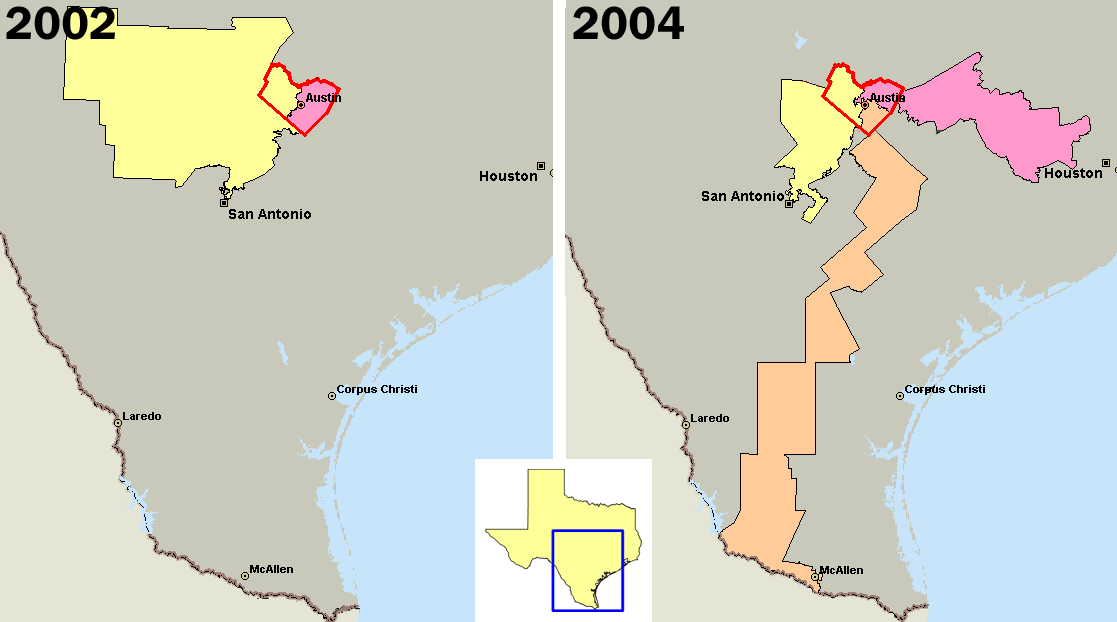 From a great comment on Krugman's blog:
"Republicans now must rely entirely on affirmative action for politicians, i.e., gerrymandering, to keep themselves in the game."(Republicans kept control of the House of Representatives, even though they collectively received about 1 million fewer votes than Democratic candidates in November.)

Gov. Rick Perry recommended prayer rather than changes in gun laws to combat violence in society, following President Obama’s call for increased gun control and enforcement.Just a year and a half ago, Rick Perry prayed for rain:
“Now, therefore, I, Rick Perry, Governor of Texas, under the authority vested in me by the Constitution and Statutes of the State of Texas, do hereby proclaim the three-day period from Friday, April 22, 2011, to Sunday, April 24, 2011, as Days of Prayer for Rain in the State of Texas.”And how did that work out? Not at all, of course -- 2012 was as a drought year in Texas.
"Climate change affects everything that you do," said report co-author Susan Cutter, director of the Hazards and Vulnerability Research Institute at the University of South Carolina. "It affects where you live, where you work and where you play and the infrastructure that you need to do all these things. It's more than just the polar bears."Frankly, I can't think of a single instance in my entire lifetime where I considered climate change in any of my decisions about anything. Anything.
The worst drought in 50 years could leave taxpayers with a record bill of nearly $16 billion in crop insurance costs because of poor yields....Given U.S. emissions, that works out to $5.20 per ton of CO2.
Separately, a record $11.4 billion in indemnities for crop losses has been paid out to farmers, and officials say that number could balloon to as much as $20 billion.
There are strong analogies between weather forecasting for a few days ahead and longer-term decadal forecasts for the next few years. When we make a weather forecast we are predicting what the likely evolution of the atmospheric circulation will be over the next few days; when we make a decadal forecast we are essentially predicting ocean 'weather' - in other words how the oceanic circulation will evolve over the next few years and its subsequent impact on the atmosphere. The different timescales for these forecasts reflects the differences in density and thermal capacity noted above.

The latest decadal forecast, issued in December 2012, show that the Earth is expected to maintain the record warmth that has been observed over the last decade, and furthermore a substantial proportion of the forecasts show that new record global temperatures may be reached in the next 5 years.That should keep the David Rose's of the world employed for a few more years, at least.
 Australians may be losing interest in their carbon tax -- or at least
THE number of complaints from consumers about the federal government's carbon tax dropped dramatically in the last three months, according to consumer watchdog figures.Maybe that it's just that their world hasn't come to an end with enactment of the tax, despite predictions.
The Australian reports that data obtained from the Australian Competition and Consumer Commission (ACCC) shows it received just three complaints a day about the tax between October and January.
That compares with 10 to 15 complaints at the beginning of October, and 60 complaints a day in the Gillard government's first 100 days in office, the newspaper reports.
The figures reportedly show that complaints related to the tax now make up just one per cent of total complaints received by the ACCC.
British Columbia collects about $1 billion each year from its carbon tax. The downside? Heating prices went up and gas is up 30 cents per gallon (or about 7 cents per liter). But the government takes the carbon tax revenue and then turns around and puts it towards lowering the income and corporate tax rates, as well as providing targeted rebates for low-income and rural citizens.Slowly but surely, a Pigovian carbon tax is coming everyone's way.... and perhaps someday people will wonder why there was ever any other kind of tax.
I have to admit that the cynic in me is concentrating upon this part:Time will tell, but would you bet against it?
"I published my first book on global warming in 2004,"
Which means that someone wishing to publish another book in the near future will need to have changed his public views in order to have something different to say in the new book. But that is me being horribly cynical.
 The standard story is that the Vikings, ferocious warriors all, settled in Greenland during the balmy Medieval Warm Period, and then bailed when the MWP ended and the weather turned colder.
The descendants of the Vikings had persevered in their North Atlantic outpost for almost 500 years, from the end of the 10th century until the mid-15th century. The Medieval Warm Period had made it possible for settlers from Norway, Iceland and Denmark to live on hundreds of scattered farms along the protected fjords, where they built dozens of churches and even had bishops.These scientists looked at the bones left on Greenland -- of the human inhabitants, of their lifestock, and of what they fished.
Their disappearance remains a mystery to this day. Until now, many experts had assumed that the cooling of the climate and the resulting crop failures and famines had ushered in the end of the Scandinavian colony. But now a Danish-Canadian team of scientists believes that it can refute this theory of decline.
The scientists suspect that a combination of causes made life there unbearable for the Scandinavian immigrants. For instance, there was hardly any demand anymore for walrus tusks and seal skins, the colony's most important export items. What's more, by the mid-14th century, regular ship traffic with Norway and Iceland had ceased.In the end, the inhabitants of Greenland just might have seen no future for themselves there, and returned "home." The lack of valuable tchotchkes suggests the departure was orderly, and not the result of disease or calamity, which you would expect if the climate were failing.
As a result, Greenland's residents were increasingly isolated from their mother countries. Although they urgently needed building lumber and iron tools, they could now only get their hands on them sporadically. "It became more and more difficult for the Greenlanders to attract merchants from Europe to the island," speculates Jette Arneborg, an archeologist at the National Museum of Denmark, in Copenhagen. "But, without trade, they couldn't survive in the long run."
The settlers were probably also worried about the increasing loss of their Scandinavian identity. They saw themselves as farmers and ranchers rather than fishermen and hunters. Their social status depended on the land and livestock they owned, but it was precisely these things that could no longer help them produce what they needed to survive.
"There is no harmony between religion and science. When science was a child, religion sought to strangle it in the cradle. Now that science has attained its youth, and superstition is in its dotage, the trembling, palsied wreck says to the athlete: “Let us be friends.” It reminds me of the bargain the cock wished to make with the horse: “Let us agree not to step on each other’s feet.”There's a new book coming out that looks good: The Great Agnostic: Robert Ingersoll and American Freethought, by Susan Jacoby.
-- Robert Ingersoll
 Awhile back I discussed, positively, Bob Reiss's book The Eskimo and the Oil Man. Chris Winter, a reader here, wrote his own review recently, and liked it as much:
"I recommend The Eskimo and the Oil Man with full marks and consider it a keeper. That said, however, I feel the author focuses too narrowly on Shell's representative Pete Slaiby. I have no doubt Slaiby is a good man, but his opinion on the concern for safety of the oil industry in general is suspect at best."He also writes, "I'll simply point out that, in the Arctic, Shell has performed poorly over the past two summers. It is not ready to begin drilling." Not only that, but Shell is having lots of problems with an towed drilling platform that has run aground south of Alaska. (Video here.) That's probably undoing much of the good word Slaiby has been working to gain in the the last several years. The platform is south of Alaska, but you have to wonder how, if they can't control a smaller platform there, they could handle a larger problem much further north in (now) total darkness.


