
Sunday, April 01, 2018

Tuesday, March 27, 2018
Will the Falling Chinese Satellite Hit Someone?
 As you probably know, the de-orbiting Chinese space station Tiangong-1 will soon fall to Earth.
This thing is 10.4 meters long and, on launch, weighted 8.5 tonnes.
What are the chances it will hit someone, or something important?
I don't know, and now that I'm reviewing this calculation I feel pretty sure I don't know, but here goes with my original idea.
The satellite will fall between the ± 43° latitude lines. But that's about all that seems known for sure right now.
That area constitutes 348 Mkm2, or 68% of Earth's surface area.
Much of this is ocean, but I don't know exactly how much. I'll assume, for better or worse, that it's the same percentage that the ocean makes up of Earth's total surface area, 70.8%, giving a potential land fall area of 102 Mkm2.
How many people are in this area? I don't know. All I know to do (without a lot of work) is assume it's the same percentage of the world population as is land, which, extrapolating this trend, was 7.46 B in 2017.
(Amazingly, 90% of the world's people live in the Northern hemisphere.)
When might a person be "hit" by a falling satellite? Let's say if it occurs within a 10 m radius of that person. Thus the danger zone around each person is 628 m2, and around all people living in the fall zone is (assuming independence) 3.20 Mkm2.
That's 3.1% of the satellite's potential landing zone. Small, but not tiny.
--
I suspect this number is an overestimate, because
(1) I've overestimated the number of people who live between -43 and +43 degrees latitude, since there's more ocean there than I've assumed, and
(2) I've assumed each person's "target zone" is independent of everyone else's (which is obviously not true in cities.)
Much of Europe and Russia lives above 43° N latitude, and all of Canada does -- and I do too, at 45-epsilon degrees. (I often drive past the a sign in North Salem announcing the 45° line, and based on my home's GPS coordinates I've calculated that I'm about 4.4 km south of this line, or at 44.960858° north latitude.)
So, there's a tiny chance of someone being hit by this satellite. 3% seems high -- but I doubt the chances are infinitesimal, even if I'm off by a factor of 10.
Still, good luck out there. Heads up.
Free, Online Climate Textbooks
I've recently come across a few free, online climate textbooks, and thought it worth mentioning here.
A great introduction to the basics:
Introduction to Climate Science, Andreas Schmittner, Oregon State University.
For more advanced students:
Introduction to climate dynamics and climate modeling, by Goosse H., P.Y. Barriat, W. Lefebvre, M.F. Loutre and V. Zunz, (2008-2010).
I guess I can mention Pierrehumbert's textbook Principles of Planetary Climate, though I'm not sure it's on the Web legally. I bought the hardback version and have learned a great deal from it. I heartily recommend it.
A great introduction to the basics:
Introduction to Climate Science, Andreas Schmittner, Oregon State University.
For more advanced students:
Introduction to climate dynamics and climate modeling, by Goosse H., P.Y. Barriat, W. Lefebvre, M.F. Loutre and V. Zunz, (2008-2010).
I guess I can mention Pierrehumbert's textbook Principles of Planetary Climate, though I'm not sure it's on the Web legally. I bought the hardback version and have learned a great deal from it. I heartily recommend it.
Sunday, March 18, 2018
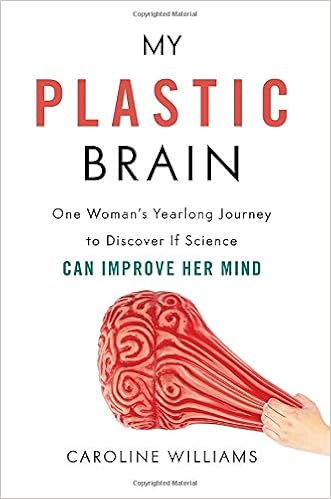
My Plastic Brain by Caroline Williams
 From my mailbox:
My Plastic Brain: One Woman's Yearlong Journey to Discover If Science Can Improve Her Mind by Caroline Williams.
Amazon
Barnes and Noble
Author's Web site
From Kirkus Reviews:
"Readers hoping to improve their own cognitive abilities may feel a bit of a letdown by the author’s old-fashioned, down-to-earth advice: exercise your body, preferably outdoors, learn mindful meditation but also allow your mind to wander, engage in a mentally challenging hobby, and pick the skill you want to improve and practice it in real life."
Valar morghulis.
Thursday, March 15, 2018
Monday, March 12, 2018
When the Statue of Liberty Gets Sea Walls
Last night I started watching The Expanse on Amazon Prime. It's been really good scifi so far, and has that nitty-gritty view of future space travel, more Firefly than Star Trek, but even grittier. It's set 200 years in the future, and in an early episode there was this short cut of the Statue of Liberty, with sea walls due to (presumably) global warming:

Another good idea (for the story, at least) was "gravity torture," where those who grew up off-Earth in a lower gravitational environment are tortured by being hung in Earth's gravity for hours:

In Kim Stanley Robinson's Mars Trilogy, kids born on Mars (where g = 38% of that of Earth) eventually become significantly taller than Earthlings.
I appreciate when writers think about the little things and subtly put them in their stories. It's fun to notice them. The Expanse does this very well, so far.

Another good idea (for the story, at least) was "gravity torture," where those who grew up off-Earth in a lower gravitational environment are tortured by being hung in Earth's gravity for hours:

In Kim Stanley Robinson's Mars Trilogy, kids born on Mars (where g = 38% of that of Earth) eventually become significantly taller than Earthlings.
I appreciate when writers think about the little things and subtly put them in their stories. It's fun to notice them. The Expanse does this very well, so far.
Sunday, March 11, 2018
Question About My Blog's Appearance
When you read this blog, is the page too wide for your screen?
Do you have to scroll right in order to see what's beyond the post itself -- the "About Me" module, "Blog Archive," "Good Links," etc.?
I do. So I'm wondering if everyone has the same problem. Other blogspot blogs read fine in my browser.
Thanks.
Do you have to scroll right in order to see what's beyond the post itself -- the "About Me" module, "Blog Archive," "Good Links," etc.?
I do. So I'm wondering if everyone has the same problem. Other blogspot blogs read fine in my browser.
Thanks.
Thursday, March 01, 2018
Equations That Changed the World
A few years ago, mathematician Ian Stewart published a book titled 17 Equations That Changed The World. It's an interesting list:

I would go beyond these 17 and add:
- 1+1=2, which some unknown someone realized long ago was profound and incredibly useful. The logical proof of this assertion, though, didn't come until Bertrand Russell and Alfred North Whitehead three-volume Principia Mathematica. It's a crazy book -- the text looks almost alien or elvish, and it took them several hundred pages of work before they could prove that 1+1=2. Russel said his work on this book "had actually damaged his brain." Here's an interesting discussion of the Principia Mathematica from NPR in 2010.
- Newton's second law of motion, F=ma (really, F=dp/dt, the time rate of change of momentum).
- Planck's Law of radiation (probably).
- The Lagrangian of quantum electrodynamics, because it changed how quantum physics was done ever afterward.
- Einstein's equations of general relativity, because they changed our view and understanding of the universe, and for their sheer elegance and sophistication.
Tuesday, February 27, 2018
Idiocy from Ed Berry, PhD
What can you even do when climate deniers won't agree to the basic rules of arithmetic??
Ed Berry is a physicist who earned his PhD back in the Mesozoic era. From Caltech, no less. He now lives in Montana as a mountain man, battling long-horned sheep for food, coming into town once a year for saltpeter and a ballot.
Ed is a hard core climate denier. (And, naturally, a hard core Trump supporter.) So hard core he doesn't care when he makes basic, boneheaded mistakes -- because, you know, one never admit error when a bear is charging at you, or someone who understands the science.
Q: How much has atmospheric CO2 increased since the pre-industrial era?
A: That's an easy calculation, right?
That's simple, clearly.... But not in Ed's denier-land. This is from Ed's blog:

30%?? Whoa.... That's just a dumb arithmetic error. It comes from calculating
which is obviously NOT how to calculate a percentage change. You and I learned this in 5th or 6th grade. So did Ed. It's a trivial, arithmetic error.
But one that mountain men will not admit to. Ed is so much of an uber denier that he can't even admit to a simple arithmetic error, can't say, Oops!, you're right, let me fix this and go on.
Now, what can you do when a denier won't accept arithmetic?? I have no idea.
It's all part of Ed's Big Misunderstanding -- he writes, "Why human CO2 does not change climate." He's so sure of this, of course, just as he's sure that the increase in atmospheric CO2 is 30%, even though every 6th grader knows better. He's submitted a paper somewhere (he won't say where), and is proud that after 4 months it hasn't yet been rejected. Remarkable!
Sorry, but I don't accept PhDs in physics misunderstanding the basic science behind global warming -- the Earth emits infrared radiation, and the atmospheric GHGs absorb it. Rejecting that is bad enough. But claiming that our HUGE emissions of CO2 aren't piling up in the atmosphere -- somewhere -- that's is just, I'm sorry, pure stupidity. Dumb. Ignorant. Idiotic.
But what can you do when deniers won't accept the basic rules of arithmetic? Where do you even start?? Beats me....
Ed Berry is a physicist who earned his PhD back in the Mesozoic era. From Caltech, no less. He now lives in Montana as a mountain man, battling long-horned sheep for food, coming into town once a year for saltpeter and a ballot.
Ed is a hard core climate denier. (And, naturally, a hard core Trump supporter.) So hard core he doesn't care when he makes basic, boneheaded mistakes -- because, you know, one never admit error when a bear is charging at you, or someone who understands the science.
Q: How much has atmospheric CO2 increased since the pre-industrial era?
A: That's an easy calculation, right?
That's simple, clearly.... But not in Ed's denier-land. This is from Ed's blog:

30%?? Whoa.... That's just a dumb arithmetic error. It comes from calculating
change/final_amount = (408 ppm - 280 ppm)/408 ppm = 31%
which is obviously NOT how to calculate a percentage change. You and I learned this in 5th or 6th grade. So did Ed. It's a trivial, arithmetic error.
But one that mountain men will not admit to. Ed is so much of an uber denier that he can't even admit to a simple arithmetic error, can't say, Oops!, you're right, let me fix this and go on.
Now, what can you do when a denier won't accept arithmetic?? I have no idea.
It's all part of Ed's Big Misunderstanding -- he writes, "Why human CO2 does not change climate." He's so sure of this, of course, just as he's sure that the increase in atmospheric CO2 is 30%, even though every 6th grader knows better. He's submitted a paper somewhere (he won't say where), and is proud that after 4 months it hasn't yet been rejected. Remarkable!
Sorry, but I don't accept PhDs in physics misunderstanding the basic science behind global warming -- the Earth emits infrared radiation, and the atmospheric GHGs absorb it. Rejecting that is bad enough. But claiming that our HUGE emissions of CO2 aren't piling up in the atmosphere -- somewhere -- that's is just, I'm sorry, pure stupidity. Dumb. Ignorant. Idiotic.
But what can you do when deniers won't accept the basic rules of arithmetic? Where do you even start?? Beats me....
Thursday, February 22, 2018


That Arctic Has Been Astonishingly Warm
This is an astonishing graph:


The Arctic is currently about 17°C (31°F) degrees above normal. The baseline (green line) is the 1958-2002 average.
If that were happening where I live, today's high would have been 86°F. Normal high (1981-2010) for Salem, Oregon today is 53°F.
Reflecting this, Arctic sea ice has already reached a record low for the year, 2.5% below last year's record low.
Saturday, February 17, 2018
Cool Integral
From KarlMagnus Petersson on Twitter:

In the same way, you can show (I think) that

which is also cool, but not as cool, since "3" is not as cool as "e."
Note: 1/3 < 1/e. This makes sense, since for 0 < x <1, sqrt(x) < cuberoot(x) < fourthroot(x), etc.
Note II: Speaking of e, one of my best friends, a colleague in graduate school (we had the same advisor, and have gotten even closer since), once wrote a paper that contained the number e^e, which I think is about the coolest thing ever published in physics. I wrote about it here for Physics World.

In the same way, you can show (I think) that

which is also cool, but not as cool, since "3" is not as cool as "e."
Note: 1/3 < 1/e. This makes sense, since for 0 < x <1, sqrt(x) < cuberoot(x) < fourthroot(x), etc.
Note II: Speaking of e, one of my best friends, a colleague in graduate school (we had the same advisor, and have gotten even closer since), once wrote a paper that contained the number e^e, which I think is about the coolest thing ever published in physics. I wrote about it here for Physics World.
Wednesday, February 07, 2018
Global Warming in Ursula Le Guin's 1969 Novel "The Left Hand of Darkness"
The science fiction writer Ursula Le Guin recently died (she lived in Portland, Oregon for decades), and since I hadn't read anything by her I thought I better get started. So I picked The Left Hand of Darkness, her breakthrough book published in 1969. She was on the ball, because even then she knew about CO2 and global warming. Here she writes about her fictional planet of Gethen.
Eskichwe rem ir Her hypothesized that the volcanic activity in N.W. Orgoreyn and the Archipelago has been increasing during the last ten or twenty millennia, and presages the end of the Ice, or at least a recession of it and an interglacial period. CO2 released by the volcanoes into the atmosphere will in time serve as an insulator, holding in the longwave heat-energy reflected from the earth, while permitting direct solar heat to enter undiminished. The average world temperature, he says, would in the end be raised some thirty degrees, till it attains 72°. I am glad I shall not be present. Ai says that similar theories have been propounded by Terran scholars to explain the still incomplete recession of their last Age of Ice. All such theories remain largely irrefutable and unprovable; no one knows certainly why the ice comes, why it goes. The Snow of Ignorance remains untrodden.It's interesting that she associated CO2 warming with the Ice Ages, as science did for a good while back then, I think, while it grappled with understanding the Pleistocene.
Saturday, February 03, 2018

Saturday, January 27, 2018
Ocean Heat Content Reaches Record Highs
We all know by now -- or should know -- that ocean heat content (OHC) is easily the best metric of a global energy imbalance -- about 93% of the trapped heat goes there.
At least, The Guardian has caught on.
The OHC data for 4Q17 are in, and it shows that in 2017, the OHC of the top sixth and the top half of the global ocean both reached record annual values:


In 2017, the heat uptake for the 0-2000 m region -- the top half of the ocean -- was 1.6 W/m2 relative to 2016, and its acceleration, in just 12 years of data recording, is 0.039 ± 0.018 W/m2/yr.
At least, The Guardian has caught on.
The OHC data for 4Q17 are in, and it shows that in 2017, the OHC of the top sixth and the top half of the global ocean both reached record annual values:


In 2017, the heat uptake for the 0-2000 m region -- the top half of the ocean -- was 1.6 W/m2 relative to 2016, and its acceleration, in just 12 years of data recording, is 0.039 ± 0.018 W/m2/yr.
Tuesday, January 23, 2018
Guesses for the New Doomsday Clock Setting?
Update 1/25: The Clock was set forward by half a minute, "amid increasing worries over nuclear weapons and climate change," so it's now at two minutes to midnight. Trump has at least 3 more years in office, so if this trend continues the Clock would be at a half a minute to midnight at the end of his first term. The fate of the world might hinge on defeating his bid for reelection (or on his impeachment and conviction -- one can always hope).
"'This is the closest the Clock has ever been to Doomsday, and as close as it was in 1953, at the height of the Cold War,'” said Rachel Bronson, president of the Bulletin of the Atomic Scientists."
I certainly worry about nuclear Armageddon -- though not as much when I was younger, where for a few years after graduate school I would sometimes wake up screaming in the middle of a night after a dream -- but I don't think climate change will be "catastrophic." Difficult, costly, tragic in some situations -- but not catastrophic. By the 22nd century humans will probably know enough to do responsible geoengineering and prevent the 40 to 60 meters of sea level rise that would otherwise be coming over several millennia. Half of Florida might be gone by then, though. That alone is gonna cost trillions.
The Doomsday Clock is currently set to 2.5 minutes before midnight. It's maintained by the Bulletin of the Atomic Scientists, and will be reset this Thursday at 10 am ET, 7 am PT, 15:00 GMT. (No adjustment is also possible, as was done last year.) Watch online.
Any guesses on the new setting? I'm guessing 1.5 minutes before midnight, based solely on the fool now in the White House. (He'll probably consider this a positive sign of his worldwide fame.) A substantial jump forward, but still not too close to pure panic.
1.5 minutes before midnight would be the Clock's more dire setting ever. Here's its history:

"'This is the closest the Clock has ever been to Doomsday, and as close as it was in 1953, at the height of the Cold War,'” said Rachel Bronson, president of the Bulletin of the Atomic Scientists."
I certainly worry about nuclear Armageddon -- though not as much when I was younger, where for a few years after graduate school I would sometimes wake up screaming in the middle of a night after a dream -- but I don't think climate change will be "catastrophic." Difficult, costly, tragic in some situations -- but not catastrophic. By the 22nd century humans will probably know enough to do responsible geoengineering and prevent the 40 to 60 meters of sea level rise that would otherwise be coming over several millennia. Half of Florida might be gone by then, though. That alone is gonna cost trillions.
--
The Doomsday Clock is currently set to 2.5 minutes before midnight. It's maintained by the Bulletin of the Atomic Scientists, and will be reset this Thursday at 10 am ET, 7 am PT, 15:00 GMT. (No adjustment is also possible, as was done last year.) Watch online.
Any guesses on the new setting? I'm guessing 1.5 minutes before midnight, based solely on the fool now in the White House. (He'll probably consider this a positive sign of his worldwide fame.) A substantial jump forward, but still not too close to pure panic.
1.5 minutes before midnight would be the Clock's more dire setting ever. Here's its history:

Monday, January 22, 2018
Climate Models Are Doing Great
After 2017's annual temperatures came in, Gavin Schmidt posted this on Twitter:
 Here, historical forcings are used prior to 2000 -- the actual GHG concentrations, volcanic eruptions, etc. After 2000 the comparison uses the old IPCC Scenario A1B -- "...very rapid economic growth, global population that peaks in mid-century and declines thereafter, and the rapid introduction of new and more efficient technologies." (Truth is, there isn't much of any difference in these old AR4 scenarios by this time.)
Looks equally good with the CMIP5 models.
The model/observation difference varies depending on the particular year (or couple of years), but over the long-term it's looking pretty good.
Certainly good enough to see that we have a big AGW problem on our hands.

Looks equally good with the CMIP5 models.
The model/observation difference varies depending on the particular year (or couple of years), but over the long-term it's looking pretty good.
Certainly good enough to see that we have a big AGW problem on our hands.
Saturday, January 20, 2018


Subscribe to:
Posts (Atom)