Saturday, December 10, 2011

The Coming Surge of Japanese Junk

The Harper's Index also has this item:
Estimated tons of debris from the Japanese earthquake headed for the West Coast of the United States: 5,000,000
Date by which the debris is expected to begin reaching shore: 10/1/2013
That came from this story from the University of Hawaii, which includes this nice animation of the expected debris track.

Another story gives a report from a Russian ship near the Midway Islands: “On September 22, in position 31042,21 N and 174045,21 E, we picked up on board the Japanese fishing boat. Radioactivity level – normal, we’ve measured it with the Geiger counter,” wrote Natalia Borodina, information and education mate of the Pallada. “At the approaches to the mentioned position (maybe 10 – 15 minutes before) we also sighted a TV set, fridge and a couple of other home appliances.”

A few days later they added, "we keep sighting everyday things like wooden boards, plastic bottles, buoys from fishing nets (small and big ones), an object resembling wash basin, drums, boots, other wastes. All these objects are floating by the ship.”

Free stuff! If a bit waterlogged.

The Good and Bad from the Harper's Index

Here are some of the best items from this month's Harper's Index in Harper's Magazine, which I've ordered from most- to least-heartening:
Amount employees of private-equity firm Bain Capital have donated to the campaign of its co-founder Mitt Romney: $69,500
To the Obama campaign: $119,900
Percentage of all Americans who consider themselves part of the top 1 percent of U.S. earners: 13
Percentage of Hispanic Americans who do: 28
Percentage of workers with only a high school diploma who received employer-based health insurance in 1979: 70
Percentage of workers with a bachelor's degree or higher who receive it today: 66

Friday, December 09, 2011

Newt Gingrich's Stupid Idea

According to David Brooks, Newt Gingrich has suggested that “a mirror system in space could provide the light equivalent of many full moons so that there would be no need for nighttime lighting of the highways.”

This is an idiotic idea that immediately qualifies him for President, if the other ten thousand reasons didn't already convince you that he is the devil incarnate. (I mean that with a level of seriousness greater than zero.) It might save, what, 1-2% off our national electricity bill? On the other hand, it's going to light up whole counties like two yokels with a spotlight looking for deer in a Pennsylvania hay field, and who can possibly sleep through that? (Really, people -- sleep is important.) You can't aim a space mirror so it just illuminates the 50 meter-wide slice of Interstate 70, and sleeping with your blinds down every night can get creepy real fast. What if you're camping? What about all the animals -- they need to sleep too. (Just ask my cats.) What about astronomy, for Christ's sake? You can't cut the James Webb telescope and ruin optical astronomy -- are we supposed to look at our feet all day long? The stars fascinate us, inspire us, even give some of us hope. Take that away and you might well stick a hose up our ass and drain the life out, which I sometimes think is the true goal of the Republican party anyway.

Just leave the night sky alone, OK? That isn't too much to ask from a presidential candidate, even if he is an irreducible representation of the end days of civilization. Jeez.

Research study shows link between earthquakes and tropical cyclones

Maybe here's a reason to think earthquakes might have a multi-stage link to climate change:

http://www.eurekalert.org/pub_releases/2011-12/uomr-rss120711.php

If AGW means more cyclones, and those mean more heavy rain events, and those mean more saturated hillsides, which means more landslides, which means (this paper says) more earthquakes.... Is there time series data for earthquakes somewhere? What's the EQ anomaly trend?


Thursday, December 08, 2011

How Air Pollution Has Cut PC Production

Here's another effect of an extreme weather event: The world will be short about 3.8 million hard-disk drives next quarter, because of flooding in Thailand (where many of the components are made).

That many are expected to be missing from an earlier forecast of 88 M. Another way to put it is that while the usual 4Q to 1Q end-of-year decline in such drives is 6%, this time it will be 11.5%.

And so growth in 2012 will only be an estimated 6.8% higher than 2011, instead of 9.5%.

2012 PC shipments will be down by 23 million units. (399 M were expected to be shipped.)

This may impact companies like Intel (and you if your 401K is invested there) which will affect Oregon. (Intel employs 15,000 in the state.)

The situation won't return to normal until the end of 3Q12. The World Bank has estimated the cost of the flooding in Thailand at $45 B, the 4th costliest disaster of all time. Rainfall in northern Thailand was 344% above average.

Scientists recently "linked the increase in the intensity of tropical cyclones over the Arabian Sea between 1979 and 2010 with a rise in soot and aerosol emissions over the Indian subcontinent."

I trust you can connect the dots here. But (apparently) until some super-duper fancy-schmancy climate model can predict the decline in hard-disk drives to the nearest 0.001 percent from hourly worldwide aerosol emissions, and a coupled economic model can forecast the impact on the price of butter in U.S. supermarkets to the nearest nanodime, there's just nothing we can do about it.

There's always the abacus to fall back on.

SoCal Trip

I was in southern California for the last several days -- an entirely different universe, as far as the weather goes. Beautiful sunny days with blue skies....

Best part of the trip was a Segway tour of the Gaslamp Quarter of San Diego, and seeing friends I hadn't seen for too long.

Pasadena had a huge windstorm the night before I landed, with winds up to 97 miles-per-hour. There were trees down on the streets and the NY Times said up to 40 buildings will need to be torn down. I took a few pictures of the mess at the Huntington Botanical Gardens:


Some pictures from the plane, of clear cuts in southern Oregon:


And some unusual ground features in southern Oregon or northern California, that I haven't yet figured out:


Why the Climategate 2.0 Emails are Devastating

I've started reading Mike Hulme's 2009 book, Why We Disagree About Climate Change: Understanding Controversy, Inaction and Opportunity. Hulme is, of course, a well-known climate scientist, founding Director of the Tyndall Centre for Climate Change Research, and now a professor of climate change at the University of East Anglia. I can't recommend this book highly enough.

Hulme has what seems a more balanced point-of-view than most, and recognizes that the debate over climate change is largely a proxy in the timeless war of larger ideas: about our values, about how society could/should/will be governed and the economy regulated. Hulme is a firm believer in man's influence on climate, but you can tell he's coming from a different place by his book's dedication on its very first page: "To my father, Ralph Hulme (1924-1989), who taught me that disagreeing was a form of learning," and by the quotation before the Table of Contents: "A good place to look for wisdom...is where you least expect to find it: in the minds of your opponents." (Jonathan Haidt, 2006)

In particular, the following passage struck me as a succinct summary of why I think the recently released batch of UEA emails are, as I first wrote, "devastating." It's from Hulme's sum-up of his chapter on "The Performance of Science" -- what I've highlighted in blue seems most relevant here (emphasis mine):
There are three limits to science that we must recognise. First, scientific knowledge about climate change will always be incomplete, and it will always be uncertain. Science always speaks with a conditional voice, or at least good science always does. Belief in the power of science requires a simultaneous doubt about the final and ultimate adequacy of any scientific knowledge claim. We must recognise that uncertainty and humility should always be essential features of any public policy debate which involves science, not least climate change-Certainty is the anomalous condition for humanity, not uncertainty

Second, we must recognise that beyond such 'normal' scientific uncertainty, knowledge as a public commodity will always have been shaped to some degree by the processes by which it emerges into the social world and through which it subsequently circulates. What will in the end count as scientific knowledge for public decision making is not necessarily the same knowledge that first emerged in the laboratory. In the production, or better still the co-production, of climate change knowledge for public policy, trust in the processes of science and participation in the social processes of co-production are essential. Without trust and/or participation, scientific knowledge about climate change is unlikely to prove robust enough to be put to good use. The separation of knowledge about climate change from the politics of climate change – a process that has been described as 'purification’ – is no longer possible, even if it ever was. The more widely this is recognised the better.

Third, we must be more honest and transparent about what science can tell us and what it can't. We should not hide behind science when difficult ethical choices are called for. We must not always defer to ‘science' or to the 'voices of scientists' when we need to make decisions about what to do. These are decisions that in relation to climate change will always entail judgements beyond the reach of science.

-- Mike Hulme, Chapter 3, Why We Disagree About Climate Change
So, the claims last month that 'the science is settled,' like this essay by John Abrahams and one by Scott Mandia, miss the point, I think. It would be great if humans were strictly rational animals who make decisions on nothing but the analytics, but that is not true, for any of us. This is no longer only about the science. To an extent this is unfair to climate scientists -- they should not have to operate in an environment like that of politicians, where every remark might be deeply scrutinized and exploited by enemies. Surely this is new territory for the enterprise of science, as is the climate change problem in general. One thing Hulme's book makes clear is that we will never attain a solution to this problem by somehow finally getting a thumbs-up or thumbs-down from "Science." And we should stop expecting one.

Wednesday, December 07, 2011

"Science Never Cheered Up Anyone"

"Science never cheered up anyone. The truth about the human situation is just too awful."

-- Kurt Vonnegut (as his alter-ego Kilgore Trout), Timequake

Wednesday, November 30, 2011

Gorgeous Picture of a Rocket Launch

This gorgeous picture is of a rocket launch this week from northern Sweden by the European Space Agency, for a propellant test. (Click to enlarge.)

My Article on Space Elevators

I have a feature article on space elevators in the December issue of Physics World -- here's a PDF:

http://home.comcast.net/~davidappell/PWDec11appell-space_elevators.pdf

Also, I'm taking a week off to go get some sunshine. Be good (more or less).

How Not to Report on Climate Change

This article might win an award for Worst Reporting on Climate Change (So Far): "Here’s A Reason to Care About Climate Change: It Could Ruin Texas Football," Matthew van Dusen, Txchnologist.

Who thinks football players -- Texan football players -- are going to be thwarted by more heat waves? These guys are into suffering. The game is about suffering. I went to the hospital twice during a football game, and I never played past 9th grade. Strap it up and bring it on.

With the popularity of football in Texas they will built domed air-conditioned practice facilities for even the 6-man squads out on the dry barren plains of West Texas before they will give up their football.

Catastrophists are going to have to try harder than this. Here's a suggestion:

Here's a Reason to to Care About Climate Change: 
Your Guns Might Jam 


That might be taken as a warning--to buy bigger guns.

Tuesday, November 29, 2011

On Open Minds


"You must keep an open mind, but not so open that your brains fall out." 

-- James Oberg, NASA engineer and science writer

When Elephants Fight

There is a African proverb that says, "When elephants fight, it is the grass that suffers." The Wall Street Journal does some reporting on the grass.

Climate Panel Cancelled For Lack of Balance

A few weeks ago I noted that an upcoming (tonight) panel on climate change lacked balance, heavily skewed towards the denialist position. Today the panel was cancelled for... lack of balance.

It was a presentation of the Oregon chapter of the American Meterological Society, to be held at OMSI (Oregon Museum of Science and History). OMSI said no.
...Mark Patel, OMSI's vice president of marketing, said the museum told organizers in early November that they needed a balanced panel and offered to move the meeting to its "science pub" event at the Bagdad Theater, picking up half the cost of the move. With no progress made, the museum cancelled the event last week.

"By the very fact that we're holding it here, people are going to assume it's OMSI's point of view," Patel said. "Our intention is far from trying to shut anybody up. We're trying to encourage proper debate, and not allow OMSI to be used as a mouthpiece for one group or another."
Last month Steve Pierce, a local meteorologist and president of OR-AMS, told me the group "takes no position on the subject of climate change" and they had hosted panels on the anthropogenic side in the past and wanted to provide "equal time for all."

Tonight's panel was to consist of:
  • George Taylor, a former manager of the Oregon Climate Service at OSU whom Oregon governor Ted Kulongowski asked that he stop using the title "state climatologist."
  • Chuck Wiese, a former TV weatherman who says he writes "papers" for Watts Up With That. I debated Wiese a few years ago at the Multnomah Athletic Club, where he presented this graph as proof of a cooling trend. (The graph is apparently generated by fitting 1980-2007 temperatures with a 6th-order polynomial, and screams JUST BECAUSE EXCEL LETS YOU DO IT DOESN'T MAKE IT RIGHT.) 
  • Gordon Fulks, a man who insists even his postman know he has a PhD and who writes inanities for the Oregonian like "All plants and animals owe their very existence to carbon dioxide." It has been alleged that he has connections to Americans for Prosperity, funded by the Koch Brothers. Fulks says he is part of something called "Gordon Fulks and Associates," but strangely the only place that  organization seems to appear is next to his signature on his climate denialism. 
OMSI was right to cancel this event -- they have a great place there (especially for kids), and a reputation to maintain. This panel would have been an insult to science and the true skepticism it honors and practices.

Monday, November 28, 2011

Who Knows How Deep This Goes?

Several months ago Christopher Monckton wrote:
I suspect that the Muller project - precisely because it will indeed be properly conducted and will produce results as fair as the group can make them, and precisely because it has obtained funding not only from the ClimateWorks Foundation etc. but also from the Koch Brothers – has been brought into being so that its results, broadly confirming the official record, can be trumpeted as showing how wrong the skeptics are, how pure the IPCC’s science is, how clear all the official conclusions are. This is a classic diversionary tactic: for, although Jones and his crooked crew were indeed remiss in trying to withhold and destroy data about the temperature record to prevent other scientists from coming to realize what a mess the record was in, the most revealing aspect of Climategate had nothing to do with the temperature record itself.
Surely no one is going to fall for that. I mean, Monckton has to be in on this too. His inane comments and unsupported speculations are clearly intended to divert attention away from the Muller diversion. Judith Curry has a role in this too, to occupy bloggers and readers as they try to figure out her role. (That was a clever choice.) I think it's clear what role Michael Mann and Christopher Horner are playing in all this, and surely Marc Morano is just playing Inhofe's monkey to take heat off Inhofe. When you think about it, Inhofe has to be at the center of this whole thing -- HAS to be -- because his belief that global warming is all a hoax is just too crazy to be anything but true. No one would believe it if it appeared in a novel. HE'S THE HOAX -- Inhofe is. Get it?

You can't make this stuff up. Who knows how deep this goes.

WHO Injected Politics into Science under Bush??

There's an interesting letter from writer Mark Bowen in the most recent issue of Science, where he calls b.s. on Ray Orbach for writing, in an obit of John Marburger, that it was the scientifically civilized people who "injected politics" into the Bush administration. Orbach was Under Secretary for Science at the U.S. DOE from 2006 to 2009.


Bowen wrote the book Censoring Science.

Sunday, November 27, 2011

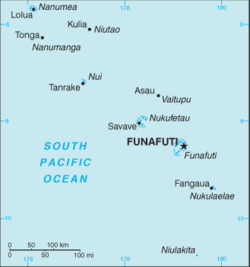
More on Tuvalu

By the way, that Harper's article on Tuvalu doesn't come to any firm conclusion--and certainly not the conclusion that Tuvalu is necessarily doomed. Actually the author seems to suspect Tuvalu might be playing the issue for all the foreign aid they can get, even as they might be going under. Or maybe not going under.

Reading it online requires a subscription (there's always the newsstand), but here are a few more excerpts:
The basic facts are these: Tuvalu’s average elevation is about three feet above sea level, and water expands as it gets warmer. If current global-warming trends continue, the National Research Council predicts, the sea will rise by at least two feet in the next ninety years. Even if industrialized countries drastically reduce carbon emissions in the near future—and there is little reason to think they will—Tuvalu is in serious trouble.

This is the story Tuvaluan officials like to tell. But as with any scientific story, even where there is broad consensus, the details are debatable. Global sea levels are rising, but not homogeneously. The fluid dynamics are too complex to model, but it’s theoretically possible that, as in a sloshing bathtub, some parts of the Pacific will rise sharply while others will fall. And even where waters do rise, some scientists think islands will adapt and accrete. In fact, the only study to measure Funafuti’s shoreline over time, published in June 2010, found that the atoll’s area has grown, not shrunk, over the past twenty years. Even the environmentalists who sounded the alarm—-Tuvalu will sink in fifty years!—-admit that fifty is, at best, a guess.
The author meets some foreign administrators of the Tuvalu Trust Fund, having dinner while on the island:
I asked them whether they thought global warming posed an imminent threat, and Abbott made a sour face. “Don’t ask me that,” he said. “I’m not going to give you the answer you’re looking for.”

“He’s a skeptic about that stuff,” Wrighton explained. “Me, I think global warming is real, but I do believe you can find science to support either side. And if you're one of these tiny countries, and this is the one issue that can get you traction internationally—‘We’re vulnerable, we’re sinking’—wouldn’t you use that to your advantage?”

“I agree with that,” Abbott said, “in the sense that it’s in the self-interest of Tuvalu to seem as pathetic as possible.”

“But isn’t there a contradiction?” I asked. “If you’re asking for money to build a new school, yet the claim is that your land will be submerged in fifty years—”

"You can't have it both ways," the American consultant agreed.
and
Most development consultants I spoke to sounded comparably cynical. Why shouldn’t the Tuvaluan government be complacent? Donors rewarded them for drawing attention to problems, not for finding solutions. Never mind that Tuvalu was staking its economic future on the claim that it had no future, or that Tuvaluans themselves did not seem truly convinced they were sinking. International aid was a marketing competition, and with sea-level rise, Tuvalu had found its niche."

Fred Singer's Silence on Request for Data

After Fred Singer's Nov. 4th op-ed in the Wall Street Journal titled "Why I Remain a Global-Warming Skeptic," I emailed him with two questions:
1) You wrote that "data from weather satellites show no atmospheric temperature increase over this period," which you defined as "the period between 1978 and 1997." What data (exactly) are you using, and what calculation (exactly) have you done?

2) You also wrote that "the Super El Niño of 1998 that had nothing to do with greenhouse gases or other human influences." What is your basis for this claim?
I never received a reply. I asked again on Nov 16th and didn't get a reply to that either.

Maybe openness and transparency only go in certain directions.

(By the way, the linear trend for UAH data over the period Jan-79 to Dec-96 is +0.034 ± 0.021 °C/decade, r2=0.012.)

In that vein, The Guardian reports that Benny Peiser isn't too keen on providing information either:
"The Guardian has also seen documents showing that GWPF director, Benny Peiser, declined to provide emails requested by at least four freedom of information requests, despite the GWPF's previous calls for openness from climate scientists.

"Until July 2010, Peiser was on staff at Liverpool John Moores University, which received several FoI requests for emails relating to the GWPF, which was founded in November 2009. The GWPF contracted high-profile law firm Farrers & Co to reply to the university and Peiser told a university official in March 2010: "We are concerned to avoid the disclosure of private foundation affairs."

"All the FoI requests to date have been rejected and there is no suggestion Peiser failed to comply with FoI rules. The university found that a number of emails had been deleted by Peiser, and that none remaining contain the phrase "global warming", according to the Information Commissioner's Office.

"Peiser told the Guardian: 'The Freedom of Information Act is clear. Both I and the GWPF have complied fully with the law, and I expect others to do the same.'"

Tuvalu Plans to Bring in a Mountain

This is from the delightful opening to a great article by Andrew Marantz on the threat to the Pacific island of Tuvalu due to rising seas from global warming. It's titled "A Rising Tide" and is in the December 2011 issue of Harper's Magazine (sub. req.). The author is talking to Maatia Toafa, Tuvalu's prime minister.
I asked what solutions he [Toafa] proposed to the issue that his entire country might be underwater in fifty years.

He said he would consider “bringing in some mountains from somewhere, so we can have a higher elevation.”

“Mountains?” I asked.

“Sure,” he said.

Where would the mountains come from?"

"Well," he said. "We'll ask around."
The rest of the article is just as good. It's in Harper's, after all.

Saturday, November 26, 2011

Is This Climate Science’s Thermidorian Reaction?

In historical analysis, a Thermidorian Reaction is the point in a revolt or revolution where the mob says: Hey, wait a minute, what exactly are we doing here? We have to live here after we smash this place up, so maybe we’d better take a deep breath and think this over again.

To me, at least, this past week feels like a Thermidorian Reaction in the climate change scene.

Obviously the first was the release of a new batch of emails. It doesn't show anything nefarious, but I think it does raise questions about how much purported unanimity has been artificially created by IPCC reports, and whether the full state of uncertainty is being communicated. And why are people talking about deleting emails? Why is Ms Kathryn Humphrey from UK's Defra saying the government wants a strong message? She wrote (email 2445):
"I cannot overstate the HUGE amount of political interest in the project as a message that the government can give on climate change to help them tell their story.

"They want their story to be a very strong one and don’t want to be made to look foolish."
I don't think they're trying to enslave their citizens under a New World Order, but why is a bureaucrat telling scientists what kind of message "they" want? And how are government-funded scientists not supposed to feel pressured by that?

The other thing that gives pause was the Schmittner et al Science paper that finds a lower value for climate sensitivity (2.3 K instead of 3.0 K), and, more importantly, a smaller range of possible warming, especially at the top end.

I'm also tired of the whipsaws. One month one side is buoyed because a journal editor resigns, then the next week the UAH anomaly is lower than last year and if you fit it with a 3rd-order polynomial is shows warming flattening out but don't take it seriously its for your entertainment only. Then climate sensitivity gets lowered and people who routinely disclaim the legitimacy of climate models suddenly find maybe now they're OK. And on and on.

I understand about the scientific difficulty of the problem and its scientific uncertainties. So let them exist and let the researchers keep chipping away at them. It's the world's problem about how to deal with that uncertainty, not theirs.

And I'm really fed-up with dishonest reporting everywhere, especially among bloggers. Some people are very wrapped up in this and, indeed, now have careers and a modicum of fame that depend on their extreme views. I'm not going to even mention some prominent deniers because they're clearly fools who say they will accept the results of a study but then find any reason, however slight, to change their mind. But, for example, Climate Progress didn't even mention this week's Science study, even though commenters there are asking for a reaction. That's just bullshit, particularly from someone who says we could get 10 F warming (5.6 C) by the end of the century and writes completely alarmist crap like this and this.

And from an organization who refuses to reveal who signs their paychecks.

Yesterday a cross-post on Romm's blog by NRDC president Frances Beinecke, about a study on medical costs due to global warming, simply asserts that the six climate events being studied were "climate-change related." There's no proof given. And the study was able to pin down the number of patients affected by these climate-change related events to the nearest integer!
"This group of events resulted in an estimated 1,689 premature deaths, 8,992 hospitalizations, 21,113 emergency room visits, and 734,398 outpatient visits...."
Not 21,114 ER visits, or 21,112 ER visits -- an estimate of exactly 21,113.

If it's an estimate why are you giving numbers to five significant digits? And can we please see the error bars on this?

The other thing I'm fed up with are the routine announcements like the IEA's recent 'unless we solve this problem in 5 years we can't avoid dangerous warming.' Who decided 5 C is "dangerous" but 1.9 isn't? Or that if we cut them in 7 years instead of 5 we're screwed? Come on.

Come back to me when you find the 30 thousand billion billion Joules that go missing every year. (And, no, I'm not blaming any scientist for this, because it's a very difficult problem and people are working hard on it and the energy accounting they've already done is amazing. The would-be policy makers need to stop getting ahead of the science.)

Look, we are not going to be cutting much CO2 anything soon. We should, but we won't. We all want to be warm and drive to the coast on the weekends and fly across the country to give talks. And if any of us finds a big pot of oil in our backyard we're going to cash in on it, even if the angel on your shoulder tells you you shouldn't because you will pay later. That's human nature. When I was a kid in western PA there was an abandoned strip mine, and then someone discovered new seams of coal on a nearby neighbor's property, and they sold the mining rights for a lot of money. Millions, it was said. Beautiful woods were stripped off their land and the coal dug up. They smoothed the land back over when they were done, but still it is huge fields where the woods won't return for a hundred years. And back then the first thing my grandfather did was invite the coal company onto his 80-acre farm to look for coal there. He would have sold it too, even though it would have leveled the fantastic woods on his property, too. Who wouldn't?

Anyway, this 2008 email by Jagadish Shukla nailed it pretty well:
It is inconceivable that policymakers will be willing to make billion-and trillion-dollar decisions for adaptation to the projected regional climate change based on models that do not even describe and simulate the processes that are the building blocks of climate variability. Of course, even a hypothetical, perfect model does not guarantee accurate prediction of the future regional climate, but at the very least, our suggestion for action will be based on the best possible
science.

It is urgently required that the climate modeling community arrive at a consensus on the required accuracy of the climate models to meet the "greater demand for a higher level of policy relevance".
But it shouldn't be just the modeling community that decides on the necessary accuracy, but the policymakers as well. And maybe everyone.

Andrew Revkin wrote a wise thing the other day:
Do I trust climate science? As a living body of intellectual inquiry exploring profoundly complex questions, yes.

Do I trust all climate scientists, research institutions, funding sources, journals and others involved in this arena to convey the full context of findings and to avoid sometimes stepping beyond the data? I wouldn’t be a journalist if I answered yes.
At the moment I don't know who I trust.

Friday, November 25, 2011

200,000 More Emails??

The Economist says the UEA  hacker has another 200,000 emails in his possession:

http://www.economist.com/blogs/babbage/2011/11/leaked-climate-change-e-mails

If he's finding what he's releasing piecemeal by searching for keywords, there are liable to be just as many of the same types in there as have already been released. Whatever all this, it could go on for years.


A Lower Climate Sensitivity

The paper published this week in Science that finds a smaller value for climate sensitivity (2.3°C vs 3.0°C) relies on a climate model, which we know don't predict past temperatures and must be fine-tuned to keep from crashing. It neglects several crucial factors, such as dust and cloud albedo. The paleo dataset covers barely a quarter (26%) of the Earth's surface. And what about solar variability? Modelers have a saying: "All models are wrong, but some are useful." They've said it themselves: all models are wrong. Garbage in, garbage out. And why did Science wait until the week before the Durban climate conference to publish this paper? Who got to the editors? I've been told the CEI will be filing a FOIA on Monday for their emails....

Oh, wait. For a minute there I thought I was guest blogging the inverse-paper at Watts Up With Climate Depot?

Seriously though, this paper is good news, but not as good as you'd want. It shows that we will probably avoid the higher end range of temperature change, and have more time to address the CO2 problem and get it right. But not a lot more time.

I threw together a little spreadsheet (we all know the best science is done on a Friday night with a spreadsheet) that simply assumes atmospheric CO2 levels keep increasing the way they have been: at a yearly rate that was about 0.30%/yr in 1970 and is 0.55%/yr now, and I just linearly interpolated that into the future. Remembering to carry the 4 and avoid using the Comic Sans font, I got the following for the number of years warming delayed with a climate sensitivity (S) of 2.3 K vs 3.0 K:


 In other words, the warming that would have occurred in 2100 under a S=3.0 K scenario would occur in 2115 under a 2.3 K scenario. Etc.

The lead author, Andreas Schmittner (who is at Oregon State University) told the Oregonian:
"I think we should be worried, but we should not be desperate," said Andreas Schmittner, an Oregon State University researcher and lead author of the study, published online today by the journal Science. "It's not already too late to do something. We still have time to figure out a solution."
And, of course, this paper has no consequences for the problem of ocean debaseification (or what regular people call ocean acidification).

However, in an accompanying Perspective in Science, Gabriele Hegerl and Tom Russon don't sound especially convinced:
The work of Schmittner et al. demonstrates that climates of the past can provide potentially powerful information to reduce uncertainty in future climate predictions and evaluate the likelihood of climate change that is larger than captured in present models. However, given the remaining uncertainties, which the authors discuss in their paper, a firm upper boundary is still elusive. The study also shows that to take advantage of the opportunity offered by past climates for understanding future climate change requires not just high quality data but also appropriate physical climate models and statistical modeling. This is not an easy challenge, but it is an important one.

Thursday, November 24, 2011

Is Global Warming Ruining Thanksgiving? (Sheesh)

Happy Thanksgiving! Let it be ruined by stuff like this:
The year 2011 has been one of the most extreme ever for weather disasters. Below, ThinkProgress Green discusses a few examples of how our increasingly dangerous weather, poisoned by hundreds of billions of tons of greenhouse pollution, is jacking up the costs of the traditional Thanksgiving dinner.
{Ironically, for all its complaints about the funding of climate skeptics, etc., the Center for American Progress, who runs Think Progress, refuses to reveal its own funders. What's good for the goose hen is good for the gander tom.}

I spent most of the hour between 3 and 4 a.m. last night trying to make sense of all this, which is not what I needed before a day notorious for its tryptophan. Look, I still think carbon dioxide warms planets, humans are influencing climate, and we continue to burn fossil fuels at our peril. That's hard science.

Will the world warm by 2°C or 4°C or 6°C, with accompanying changes? The truth is, no one is sure. And no one may ever be sure. And those uncertainties are not a reason for inaction. As I've said before, if we wait until science can predict the year the last glacier in the Himalayas will melt, and then wait to see if that prediction pans out, it will be far, far too late.

Climate scientists have been put in an impossible position – expected to provide the world with a definitive answer about an extremely complicated physical system, on which the welfare of civilization could depend, and which threatens the status quo with its extremely powerful, monied interests and the greed of us all, on a subject every blogger thinks they get an opinion on merely because they can make a spreadsheet. The scientists can’t win, and have been ruthlessly and unfairly attacked by people who make Galileo’s enemies look like choirboys. We need the scientists to do what they’re best at -- science -- without feeling the weight of the world on their shoulders.

The most dissembling piece in FOIA2011's files was the very first line of his very first file:
“Over 2.5 billion people live on less than $2 a day.”
Because we all know how the very greatest concern of all the skeptics, deniers and clowns is their overarching concern for the world's poor. Sure.

I think one of the most relevant comments on all this was by Ray Bradley in the New York Times, referring to this email:
In one of the e-mails, Raymond S. Bradley, director of a climate research center at the University of Massachusetts, Amherst, criticized a paper of Dr. Mann’s that used tree rings and similar markers to find that today’s climatic warming had no precedent in recent natural history. Dr. Bradley wrote that the paper “was truly pathetic and should never have been published.”

He confirmed in an interview that the e-mail was his, but said his comment had no bearing on whether global warming was really happening. “I did not like that paper at all, and I stand by that, and I am sure that I told Mike that” at the time, he said. But he added that a disagreement over a single paper had little to do with the overall validity of climate science. “There is no doubt we have a big problem with human-induced warming,” Dr. Bradley said. “Mike’s paper has no bearing on the fundamental physics of the problem that we are facing.”
I suspect everyone thinking about this issue -- everyone -- has lost perspective, at a time when the wheels seem to be coming off wherever you look. And that today skeptics/contrarians/deniers will give a deep, quiet thanks that their servers haven't (yet) been hacked.

My first rule is still the one up on the right: You can never ask too many questions. We need to keep asking them, including what it is we really expect from science, from scientists, and most of all from ourselves.

Now I'm off to spend the day with my 7-year old nephew and 4-year old niece. I hope you go do likewise (but with your own nephews and nieces, not mine).

Wednesday, November 23, 2011

Apology to Michael Mann

I'm guilty of not understanding the context of at least one of the emails I quoted yesterday -- just what FOIA hoped for, I guess. It's this excerpt:

<2884> Wigley:
Mike, The Figure you sent is very deceptive [...] there have been a number of dishonest presentations of model results by individual authors and by IPCC [...]

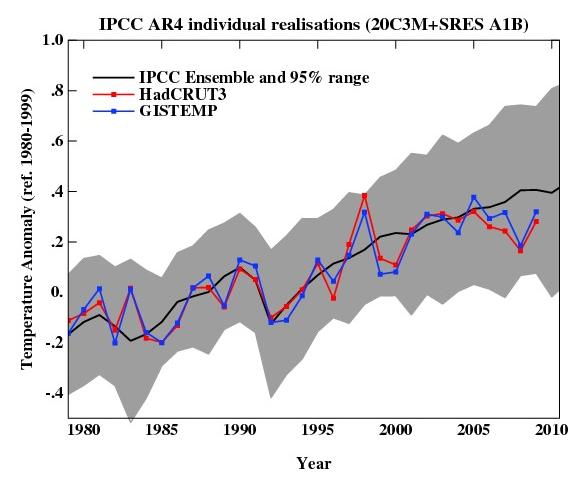
I've given the entire contents of the file below. The quote above is from an email from Tom Wigley to Michael Mann, and the figure in question is not Mann's. It's not clear to me whose figure it is. The email chain says it's from Gavin Schmidt, modified from this post on RealClimate, but that post contains several figures, including a comical figure from Christopher Monckton. so it's impossible to know which figure Wigley is referring to.

I didn't do enough research and fell into the trap. Mea culpa, and apologies to Michael Mann.

Is it significant that Tom Wigley considered another scientist's graph "deceptive?" No. Scientists doubt the work of others all the time. Doubt is their hallmark -- it's crucial to the enterprise. And there's absolutely nothing untoward about expressing such doubt to a colleague in a private communication. I was wrong on this one.

Update (10:55 am): Gavin commented on the figure in question this morning.
It's this one, and he wrote, "It was my figure - nothing to do with Mike, and I used it in this RealClimate post. I disagreed (and disagree) with Wigley, as I stated in response at the time (2509). There is an update to the figure here, and I will update it again in a month or so.- gavin]"


File 2884:
================================================================
cc: Kevin Trenberth <trenbert@ucar.edu>, Stephen H Schneider <shs@stanford.edu>, Myles Allen <allen@atm.ox.ac.uk>, peter stott <peter.stott@metoffice.gov.uk>, "Philip D. Jones" <p.jones@uea.ac.uk>, Benjamin Santer <santer1@llnl.gov>, Thomas R Karl <Thomas.R.Karl@noaa.gov>, Gavin Schmidt <gschmidt@giss.nasa.gov>, James Hansen <jhansen@giss.nasa.gov>, Michael Oppenheimer <omichael@Princeton.EDU>
date: Wed, 14 Oct 2009 15:57:10 -0600
from: Tom Wigley <wigley@ucar.edu>
subject: Re: BBC U-turn on climate
to: Michael Mann <mann@meteo.psu.edu>

<x-flowed>
Mike,

The Figure you sent is very deceptive. As an example, historical
runs with PCM look as though they match observations -- but the
match is a fluke. PCM has no indirect aerosol forcing and a low
climate sensitivity -- compensating errors. In my (perhaps too harsh)
view, there have been a number of dishonest presentations of model
results by individual authors and by IPCC. This is why I still use
results from MAGICC to compare with observed temperatures. At least
here I can assess how sensitive matches are to sensitivity and
forcing assumptions/uncertainties.

Tom.

+++++++++++++++++++

Michael Mann wrote:
> thanks Tom,
>
> I've taken the liberty of attaching a figure that Gavin put together the
> other day (its an update from a similar figure he prepared for an
> earlier RealClimate post. see:
> http://www.realclimate.org/index.php/archives/2009/05/moncktons-deliberate-manipulation/).
> It is indeed worth a thousand words, and drives home Tom's point below.
> We're planning on doing a post on this shortly, but would be nice to see
> the Sep. HadCRU numbers first,
>
> mike
>
> On Oct 14, 2009, at 3:01 AM, Tom Wigley wrote:
>
>> Dear all,
>>
>> At the risk of overload, here are some notes of mine on the recent
>> lack of warming. I look at this in two ways. The first is to look at
>> the difference between the observed and expected anthropogenic trend
>> relative to the pdf for unforced variability. The second is to remove
>> ENSO, volcanoes and TSI variations from the observed data.
>>
>> Both methods show that what we are seeing is not unusual. The second
>> method leaves a significant warming over the past decade.
>>
>> These sums complement Kevin's energy work.
>>
>> Kevin says ... "The fact is that we can't account for the lack of
>> warming at the moment and it is a travesty that we can't". I do not
>> agree with this.
>>
>> Tom.
>>
>> +++++++++++++++++++++++
>>
>> Kevin Trenberth wrote:
>>> Hi all
>>> Well I have my own article on where the heck is global warming?  We
>>> are asking that here in Boulder where we have broken records the past
>>> two days for the coldest days on record.  We had 4 inches of snow.
>>>  The high the last 2 days was below 30F and the normal is 69F, and it
>>> smashed the previous records for these days by 10F.  The low was
>>> about 18F and also a record low, well below the previous record low.
>>>  This is January weather (see the Rockies baseball playoff game was
>>> canceled on saturday and then played last night in below freezing
>>> weather).
>>> Trenberth, K. E., 2009: An imperative for climate change planning:
>>> tracking Earth's global energy. /Current Opinion in Environmental
>>> Sustainability/, *1*, 19-27, doi:10.1016/j.cosust.2009.06.001. [PDF]
>>> <http://www.cgd.ucar.edu/cas/Trenberth/trenberth.papers/EnergyDiagnostics09final.pdf>
>>> (A PDF of the published version can be obtained from the author.)
>>> The fact is that we can't account for the lack of warming at the
>>> moment and it is a travesty that we can't.  The CERES data published
>>> in the August BAMS 09 supplement on 2008 shows there should be even
>>> more warming: but the data are surely wrong.  Our observing system is
>>> inadequate.
>>> That said there is a LOT of nonsense about the PDO.  People like CPC
>>> are tracking PDO on a monthly basis but it is highly correlated with
>>> ENSO.  Most of what they are seeing is the change in ENSO not real
>>> PDO.  It surely isn't decadal.  The PDO is already reversing with the
>>> switch to El Nino.  The PDO index became positive in September for
>>> first time since Sept 2007.   see
>>> http://www.cpc.ncep.noaa.gov/products/GODAS/ocean_briefing_gif/global_ocean_monitoring_current.ppt
>>> Kevin
>>> Michael Mann wrote:
>>>> extremely disappointing to see something like this appear on BBC.
>>>>  its particularly odd, since climate is usually Richard Black's beat
>>>> at BBC (and he does a great job). from what I can tell, this guy was
>>>> formerly a weather person at the Met Office.
>>>> We may do something about this on RealClimate, but meanwhile it
>>>> might be appropriate for the Met Office to have a say about this, I
>>>> might ask Richard Black what's up here?
>>>>
>>>> mike
>>>>
>>>> On Oct 12, 2009, at 2:32 AM, Stephen H Schneider wrote:
>>>>
>>>>> Hi all. Any of you want to explain decadal natural variability and
>>>>> signal to noise and sampling errors to this new "IPCC Lead Author"
>>>>> from the BBC?  As we enter an El Nino year and as soon, as the
>>>>> sunspots get over their temporary--presumed--vacation worth a few
>>>>> tenths of a Watt per meter squared reduced forcing, there will
>>>>> likely be another dramatic upward spike like 1992-2000. I heard
>>>>> someone--Mike Schlesinger maybe??--was willing to bet alot of money
>>>>> on it happening in next 5 years?? Meanwhile the past 10 years of
>>>>> global mean temperature trend stasis still saw what, 9 of the
>>>>> warmest in reconstructed 1000 year record and Greenland and the sea
>>>>> ice of the North in big retreat?? Some of you observational folks
>>>>> probably do need to straighten this out as my student suggests
>>>>> below. Such "fun", Cheers, Steve
>>>>>
>>>>>
>>>>> Stephen H. Schneider
>>>>> Melvin and Joan Lane Professor for Interdisciplinary Environmental
>>>>> Studies,
>>>>> Professor, Department of Biology and
>>>>> Senior Fellow, Woods Institute for the Environment
>>>>> Mailing address:
>>>>> Yang & Yamazaki Environment & Energy Building - MC 4205
>>>>> 473 Via Ortega
>>>>> Ph: 650 725 9978
>>>>> F:  650 725 4387
>>>>> Websites:  climatechange.net
>>>>>           patientfromhell.org
>>>>>
>>>>>
>>>>> ----- Forwarded Message -----
>>>>> From: "Narasimha D. Rao" <ndrao@stanford.edu
>>>>> <mailto:ndrao@stanford.edu>>
>>>>> To: "Stephen H Schneider" <shs@stanford.edu <mailto:shs@stanford.edu>>
>>>>> Sent: Sunday, October 11, 2009 10:25:53 AM GMT -08:00 US/Canada Pacific
>>>>> Subject: BBC U-turn on climate
>>>>>
>>>>> Steve,
>>>>> You may be aware of this already. Paul Hudson, BBC’s reporter on
>>>>> climate change, on Friday wrote that there’s been no warming since
>>>>> 1998, and that pacific oscillations will force cooling for the next
>>>>> 20-30 years. It is not outrageously biased in presentation as are
>>>>> other skeptics’ views.
>>>>>
>>>>>
>>>>> http://news.bbc.co.uk/2/hi/science/nature/8299079.stm
>>>>> http://blogs.telegraph.co.uk/news/damianthompson/100013173/the-bbcs-amazing-u-turn-on-climate-change/
>>>>>
>>>>>
>>>>> BBC has significant influence on public opinion outside the US.
>>>>>
>>>>>
>>>>> Do you think this merits an op-ed response in the BBC from a scientist?
>>>>>
>>>>>
>>>>> Narasimha
>>>>>
>>>>>
>>>>> -------------------------------
>>>>> PhD Candidate,
>>>>> Emmett Interdisciplinary Program in Environment and Resources (E-IPER)
>>>>> Stanford University
>>>>> Tel: 415-812-7560
>>>>>
>>>>>
>>>>
>>>> --
>>>> Michael E. Mann
>>>> Professor
>>>> Director, Earth System Science Center (ESSC)
>>>>
>>>> Department of Meteorology                 Phone: (814) 863-4075
>>>> 503 Walker Building                              FAX:   (814) 865-3663
>>>> The Pennsylvania State University     email:  mann@psu.edu
>>>> <mailto:mann@psu.edu>
>>>> University Park, PA 16802-5013
>>>>
>>>> website: http://www.meteo.psu.edu/~mann/Mann/index.html
>>>> <http://www.meteo.psu.edu/%7Emann/Mann/index.html>
>>>> "Dire Predictions" book site:
>>>> http://www.essc.psu.edu/essc_web/news/DirePredictions/index.html
>>>>
>>>>
>>>>
>>>>
>>>>
>>>>
>>>>
>>>>
>>>>
>>>>
>>>>
>>>>
>>>>
>>>>
>>>>
>>>>
>>> --
>>> ****************
>>> Kevin E. Trenberth                  e-mail: trenbert@ucar.edu
>>> <mailto:trenbert@ucar.edu>
>>> Climate Analysis Section,
>>>           www.cgd.ucar.edu/cas/trenbert.html
>>> <http://www.cgd.ucar.edu/cas/trenbert.html>
>>> NCAR
>>> P. O. Box 3000,                     (303) 497 1318
>>> Boulder, CO 80307                   (303) 497 1333 (fax)
>>> Street address: 1850 Table Mesa Drive, Boulder, CO  80305
>>
>> <Wigley-RecentTemps.doc>
>
> --
> Michael E. Mann
> Professor
> Director, Earth System Science Center (ESSC)
>
> Department of Meteorology                 Phone: (814) 863-4075
> 503 Walker Building                              FAX:   (814) 865-3663
> The Pennsylvania State University     email:  mann@psu.edu
> <mailto:mann@psu.edu>
> University Park, PA 16802-5013
>
> website: http://www.meteo.psu.edu/~mann/Mann/index.html
> <http://www.met.psu.edu/dept/faculty/mann.htm>
> "Dire Predictions" book site:
> http://www.essc.psu.edu/essc_web/news/DirePredictions/index.html
>
>
>
>
>
>
>
>
>
>
>
>
>
>
>
>


</x-flowed>
================================================================

Tuesday, November 22, 2011

A Good Link to the Zipped File of Emails

Update: here is a better link to the email file, that opens formatted.

==

Here's a working link to the full set of emails released today. You'll need a Bittorrent client like ÂµTorrent.
.
http://btjunkie.org/torrent/ClimateGate-Dump-2011/4239ebd36afc51afef4486028c1940739e6112964629

The individual mail files are text documents that lack formatting when opened in Windows Notebook, but if you copy and paste them into Word they reformat, mostly. At least enough to be readable.