Last night I stumbled on to live video coverage of the Chilean miner's rescue, via The Lede at the NYT, and there was something very noble and transcendent and uplifting about it. The big, competent men in their overalls and hard hards were working hard, as they always do. The President of Chile was there, but didn't overwhelm the scene, like would have happened if this were taking place in America. The workers even sang a patriotic song or two and it didn't feel forced or weird, as (again) it would have been in America.
The first miner popped out and went through the crowd, looking incredibly strong and brave, and exactly like someone you'd want to be stuck in a hole with for two months, if you absolutely had to.
In other words, it was all genuine.
I had Twitter running alongside the video, and watched the comments come in in real time. Many were in Spanish, but I got their jist. This was something special, something unusual. Something beautiful.
Once again the world, via the ubiquitous networks that now cross (most) of our planet, had a front-row seat to a singular event, not unlike the BP oil spill. It makes such a huge difference. Imagine if there were a real-time Internet and cable feed to attacks in Darfur, or a family starving in Saharan Africa, or the Bangledeshi floods. If I were a relief organization that might be my first priority from now on -- get a camera in there, and a T1. The media, and the world, will flock to your door.
In any case, it was good, at least for a moment, to watch a success story. They seem to rare anymore. A lot of credit goes to everyone in Chile who worked long and hard to make this rescue happen. They did this, and they did it with class.
Wednesday, October 13, 2010

Monday, October 11, 2010
Hal Lewis's Temper Tantrum
So someone named Hal Lewis has resigned from the American Physical Society in a snit over their position on climate change, and this is supposedly "fracturing" the scientific community.
Who is Hal Lewis? I've been studying physics for 30 years, and I've never heard of him.
We're told that
Anthony Watts is calling it “…an important moment in science history. I would describe it as a letter on the scale of Martin Luther, nailing his 95 theses to the Wittenburg church door." Which is such an exaggeration it's essentially impossible to quantify, except to call it complete bullshit.
So who is Harold Lewis? First, let's note that he does not even appear to have a Web page of his own.
Here is the bio at the end of his letter (note: really important scientists don't sign their letters by including a bio):
He appears to have played it safe his entire career, and was sure to keep his top button fastened all day long, no matter how uncomfortable it was. They paid for him to fly all over the place.
I'm willing to be proven wrong. Can anyone point me towards a single important insight Lewis ever had, or an important result he's derived? An effect named after him, or a theorem? Even an ansatz?
Had Anthony Watts ever heard of Hal Lewis before this? Had Joanne Nova? I highly doubt it.
If Lewis has been an APS member for 67 years, he must be well into his 80s, or even his 90s. In other words, you can surely bet that he's not up on the latest climate date or the latest thinking in climate science, and moreover is probably basing his outrage on ideas he learned in graduate school a half-century ago.
The world -- and especially the US -- is full of such scientists, all of whom are surely smart people, and all of whom once had great potential. They rode the scientific wave spawned by WW2 and Sputnik. When their potential went unfulfilled, they satisfied their egos and justified their salaries by joining every and any federal committee that would have them.
That is really not so bad. At least they didn't become TV weathermen.
Let's note that Lewis's resignation letter does not give even one fundamental reason why modern climate science should be considered wrong. His complaints are all about secret committees and underhanded negotiations. Which is what you'd expect a long-term techno-bureaucrat to complain about.
I'm sure Dr Lewis deserves some respect. But his opinion on climate science does not. Let's move along.
Who is Hal Lewis? I've been studying physics for 30 years, and I've never heard of him.
We're told that
"Hal Lewis comes from the elite upper levels of science — a physics professor at University of California (Santa Barbara), and a member of the Defense Science Board advising the Pentagon).
He’s resigned from the American Physical Society (APS) today, after 67 years. The APS is the world’s second largest organization of physicists, with 48,000 members. He is scathing of the fall from grace of the once renowned institution.
Anthony Watts is calling it “…an important moment in science history. I would describe it as a letter on the scale of Martin Luther, nailing his 95 theses to the Wittenburg church door." Which is such an exaggeration it's essentially impossible to quantify, except to call it complete bullshit.
So who is Harold Lewis? First, let's note that he does not even appear to have a Web page of his own.
Here is the bio at the end of his letter (note: really important scientists don't sign their letters by including a bio):
Harold Lewis is Emeritus Professor of Physics, University of California, Santa Barbara, former Chairman; Former member Defense Science Board, chmn of Technology panel; Chairman DSB study on Nuclear Winter; Former member Advisory Committee on Reactor Safeguards; Former member, President's Nuclear Safety Oversight Committee; Chairman APS study on Nuclear Reactor Safety Chairman Risk Assessment Review Group; Co-founder and former Chairman of JASON; Former member USAF Scientific Advisory Board; Served in US Navy in WW II; books: Technological Risk (about, surprise, technological risk) and Why Flip a Coin (about decision making)In other words, Lewis is the kind of scientist who hasn't really accomplished anything fundamental worth noting in science, but has made a career of sucking up to those in authority via being on their many committees and boards.
He appears to have played it safe his entire career, and was sure to keep his top button fastened all day long, no matter how uncomfortable it was. They paid for him to fly all over the place.
I'm willing to be proven wrong. Can anyone point me towards a single important insight Lewis ever had, or an important result he's derived? An effect named after him, or a theorem? Even an ansatz?
Had Anthony Watts ever heard of Hal Lewis before this? Had Joanne Nova? I highly doubt it.
If Lewis has been an APS member for 67 years, he must be well into his 80s, or even his 90s. In other words, you can surely bet that he's not up on the latest climate date or the latest thinking in climate science, and moreover is probably basing his outrage on ideas he learned in graduate school a half-century ago.
The world -- and especially the US -- is full of such scientists, all of whom are surely smart people, and all of whom once had great potential. They rode the scientific wave spawned by WW2 and Sputnik. When their potential went unfulfilled, they satisfied their egos and justified their salaries by joining every and any federal committee that would have them.
That is really not so bad. At least they didn't become TV weathermen.
Let's note that Lewis's resignation letter does not give even one fundamental reason why modern climate science should be considered wrong. His complaints are all about secret committees and underhanded negotiations. Which is what you'd expect a long-term techno-bureaucrat to complain about.
I'm sure Dr Lewis deserves some respect. But his opinion on climate science does not. Let's move along.
Friday, October 08, 2010
The Climategate Investigation
I haven't been investigating the Climategate incident, which occurred not quite a year ago. But it seems to me quite strange that we haven't heard boo about this break-in.Wasn't Scotland Yard investigating? How can there be no word about the break-in after 10 months? If there isn't something known by now, why should we expect anything in the future?
I don't know anything here. But something doesn't smell right to me.
I don't know anything here. But something doesn't smell right to me.
Where is My Solar Cell?
David Biello tweets:
Instead we all have to go through this stupid cycle of eating the plants that can covert sunlight into energy (or, worse, of eating the animals that eat the plants that convert sunlight).
Why haven't I simply evolved with a bio-solar panel on top of my skull and back?
"once again the Nobel goes to chemists for finding a way to do in lab... what plants, animals, our bodies do every day http://bit.ly/a2lZntI was thinking about something similar the other day: why has no animal ever evolved to have a self-contained solar cell that would directly convert sunlight into the energy they need to survive?
Instead we all have to go through this stupid cycle of eating the plants that can covert sunlight into energy (or, worse, of eating the animals that eat the plants that convert sunlight).
Why haven't I simply evolved with a bio-solar panel on top of my skull and back?
Liu Xiaobo's Nobel Peace Prize
Liu's Nobel Prize is one of the most deserved in recent years, and it is good to see it awarded.
Human rights in China seem to be sadly forgotten amidst China's economic growth and their purchase of much of the US debt, but it is no less important than it ever was, or were the humans abused during the Soviet Union (or in today's Russia).
I don't think anyone really knows how many Chinese are unfairly prosecuted merely for their beliefs. Surely its is 10s of thousands, and no doubt many more. It is difficult to imagine. Such a thing seems almost impossible to Americans/Europeans like you or me.
The strange thing about human rights is that any country could have them, if only they simply marched en masse. A million people could easily overtake any Beijing institution, if they marched on them. For that matter, a mere hundred thousand Americans could overtake Congress any day of the week, though a few percent would die. But it's just easier for us to give in to our cowardice and all go along.
Who even looks at the label of a piece of clothing anymore, before they purchase it? A decade or two ago you might turn it down for purchase if it came from China -- I did, for awhile. Now, if it's 10 cents cheaper, any American consumer snatchs it up.
Like with climate change, we seem to have no scruples whatsoever, if it saves us (literally) a penny two. We are hopeless.
Wednesday, October 06, 2010
Can UAH Be Trusted With Climate Data?
The University of Alabama's Roy Spencer recently posted their number for the Sept-2010 global temperature anomaly (+/- 0.603°C), and his commentary does makes you wonder if they are being fair.
This measurement was the warmest September in their 31-yr recorded history -- and yet Spencer did not even mention that. That seems like a very significant oversight.
If skeptics are going to question NASA GISS's objectivity, then there's certainly plenty of room here to questions UAH's objectivity. Christy and Spencer are well-known climate change deniers. Are they being fair with their numbers? Calculations of raw data invariably include value judgements before the final numbers are produced -- can we be sure they are being fair?
Worse, Christy and Spencer for years propagated a major error in their satellite calculation that today is nearly forgotten. Had such an error taken place in NASA or Hadley statistics, we are all sure that professional liars like Marc Morano would still be sounding this to the rooftops.
OK. Scientists make mistakes. Christy & Spencer deserve credit for correcting their error -- and it was a MAJOR error. So major that you have to wonder why there are still in charge of this raw data.
I'm just asking. Deniers would certainly be asking these questions. They're fair questions, I think.
Saturday, September 18, 2010
Goiânia Accident
I am always amazed at how little I know, and how little all of us know. Did you ever hear of this nuclear accident?
The Goiânia accident was a radioactive contamination accident that occurred on 13 September 1987, at Goiânia, Brazil. Considered one of the worst nuclear disasters in history, it took place after an old nuclear medicine source was scavenged from an abandoned hospital site in the city, which serves as capital of the central Brazilian state of Goiás. It was subsequently handled by many people, resulting in four deaths and serious radioactive contamination of 249 other people. The dispersal of radiation was equivalent to a medium-size dirty bomb. About 130,000 people overwhelmed hospitals. Of those, 250 people, some with radioactive residue still on their skin, were found to be contaminated through the use of Geiger counters. Topsoil had to be removed from several sites, and several houses were demolished. All the objects from within those houses were removed and examined. Those that were found to be free of radioactivity were wrapped in plastic bags, while those that were contaminated were either decontaminated or disposed of as waste.
Arctic Ice Fake-out
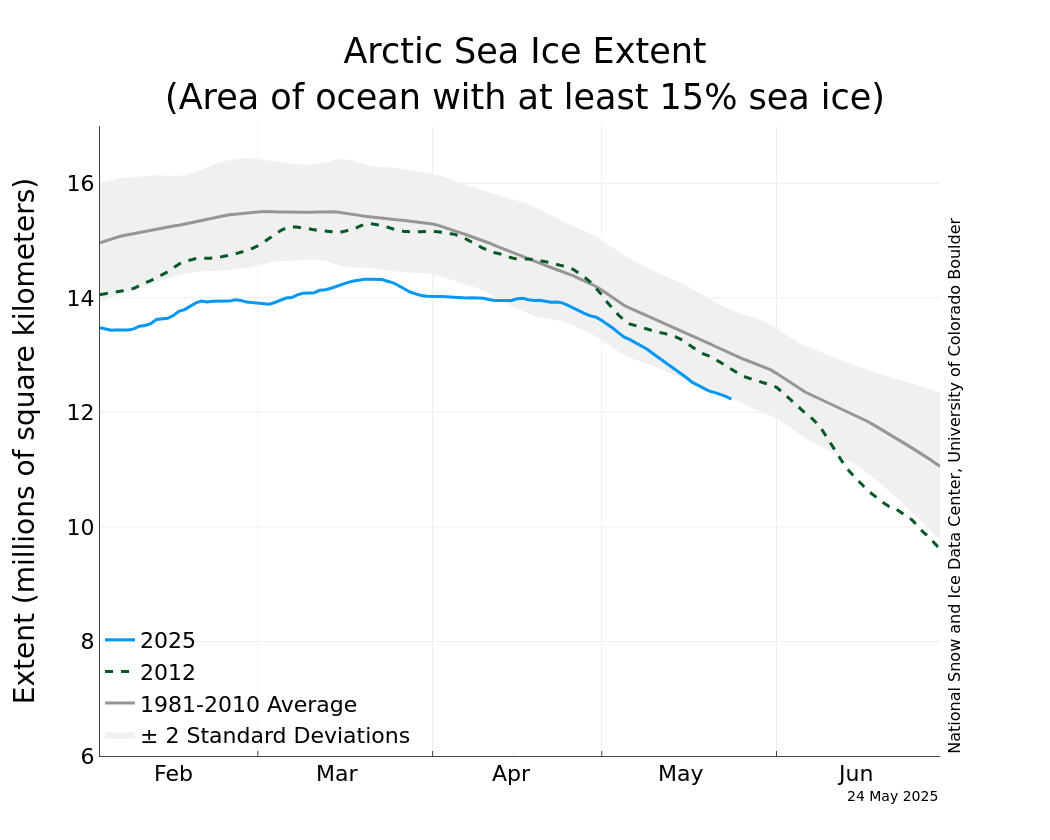
Everyone thought that Arctic sea-ice extent had bottomed out on Sept 10th, because it increased for a few days after that, but then it started to decrease again -- and is still decreasing. It's not going to threaten 2007's record low, but it still might come in 2nd place. In any case, it's fun to watch it defy simple expectations.

Wednesday, September 08, 2010
Quote
"Where they burn books, they will ultimately also burn people."
-- Heinrich Heine, Almansor (1821)
Tuesday, September 07, 2010
Your Y Chromosome
What pacifist notions can possibly compete with helicopters set to AC/DC?
It's not even a fair contest.
Dirty on Purpose
I am simply linking to song because I like it, a lot, and it's my blog:
Dirty on Purpose broke up over two years ago, which is a god-damned shame, because very, very few people can make music and noise like this. I certainly can't. You can't. Who can?
This kind of breaks my heart.
Dirty on Purpose broke up over two years ago, which is a god-damned shame, because very, very few people can make music and noise like this. I certainly can't. You can't. Who can?
This kind of breaks my heart.
Genetically Modified Salmon
I thought I had the subject of genetically modified organisms (GMOs) pretty much figured out. I spent a lot of time a few years ago investigating them, and even wrote a short piece for Wired magazine, and had decided that they probably weren't going to cause any harm.
For plants, anyway.
But this morning I read this Washington Post article about the FDA's approval of GM salmon, and now I'm not so sure anymore. Something about it really skivved me out.
My basic reasoning is this: everyone thought they had mammalian cloning all figured out, and then they cloned a sheep (Dolly). It turned out that Dolly had some very unforeseen problems, especially obesity and early aging. She had telemere problems.
Why didn't the all-wise scientists foresee this fundamental problem, if they have such control over genomes?
Now we're being expected to accept GM salmon, even though they have been forced to grow about twice their normal size. This is a HUGE difference in an organism and to think that we understand all the implications of it strikes me as silly.
Schneider on Australian TV
You really, really have to watch this debate on Australian television, which appeared last night, where the late Stephen Schneider takes on dozens of climate skeptics, answering all their questions.
Let's note: the skeptics are polite, and have really good questions. (Someone in the skeptic audience even used the word "logarithmic," which you'd never see in America!) Schneider is polite, and has really good answers.
Schneider takes them head-on and answers all their questions, and, when appropriate, tells them they simply don't know what they're talking about. And most of all, he stresses that scientists have (of course!) thought about all these issues, in far more detail than anyone in the audience has.
If only American television did anything like this. Even if the concept of a logarithm baffles most of the audience.
Via: Tim Lambert and Deltoid
Information's Carbon Footprint
This Boston Globe editorial doesn't have sourcing, but some of its claims definitely make you think:
- "emailing a 4.7-megabyte attachment — the equivalent of four large digital photos — can use as much energy as it takes to boil about 17 kettles of water."
- "The total amount of digital storage worldwide is approaching 1 zettabyte (10^21 bytes), or 1 million times the contents of the Earth’s largest library."
- "Currently, that information is archived on equipment with a mass equivalent to 20 percent of Manhattan."
- "Global data storage is expected to reach 35 zettabytes by 2020...."
- "The information industry already accounts for approximately 2 percent of global carbon dioxide emissions. That’s the same amount as the airline industry blasts into the atmosphere."
They don't say how much energy is used to route information versus to store information, but I would guess that the latter dominates. What will a 35x increase mean for energy consumption?
Friday, September 03, 2010
On the Interacademy Council Report
While everyone is bloviating about the Interacademy Council Report on the IPCC processes, can we please note that they wrote the following:
- "The Committee found that the IPCC assessment process has been successful overall." (pg 1)
- "This report examines the procedures and processes used to carry out IPCC assessments; it does not examine climate change science or the validity of its representation in the assessment reports." (pg 8)
Oregonian Op-Ed
I have an op-ed in today's Oregonian, correcting some of the endless streams of untruths that come from skeptic Gordon Fulks.
Thursday, September 02, 2010
Does "atmospheric blocking" Explain the Moscow Heat Wave?
Despite what you might have read, global warming did play a role in the recent Moscow heat wave.
Recently NOAA wrote about the heat wave in western Russia, attributing it to "atmospheric blocking." They went on to say that greenhouse warming played no role in the high temperatures:
But something about this explanation doesn't smell right. Regional climate phenomena are always going to be conmplicated with many factors in play.
So I asked Kevin Trenberth, Head of the Climate Analysis Section at NCAR, and he says that global warming certainly played a role in the heat wave:
Recently NOAA wrote about the heat wave in western Russia, attributing it to "atmospheric blocking." They went on to say that greenhouse warming played no role in the high temperatures:
Despite this strong evidence for a warming planet, greenhouse gas forcing fails to explain the 2010 heat wave over western Russia. The natural process of atmospheric blocking, and the climate impacts induced by such blocking, are the principal cause for this heat wave. It is not known whether, or to what exent, greenhouse gas emissions may affect the frequency or intensity of blocking during summer. It is important to note that observations reveal no trend in a daily frequency of July blocking over the period since 1948, nor is there an appreciable trend in the absolute values of upper tropospheric summertime heights over western Russia for the period since 1900.
But something about this explanation doesn't smell right. Regional climate phenomena are always going to be conmplicated with many factors in play.
So I asked Kevin Trenberth, Head of the Climate Analysis Section at NCAR, and he says that global warming certainly played a role in the heat wave:
The "stalled jet stream" or really the so-called blocking pattern is merely a description of the atmospheric state or phenomenon, not a cause. The question is why is it like that? For that we seek to find systematic influences (what we call forcings) on the atmosphere that tends to lock it into one state. The main sources of such forcings are the mountains, land vs ocean, and the heating of the atmosphere. Only the latter changes. With El Nino or La Nina, the changes in sea surface temperatures change the areas where convection, thunderstorms, tropical storms etc, occur systematically. The heavy rains in those phenomena produce large heating of the atmosphere through the latent heat release: the release of the heat that went into evaporating the moisture in the first place is given up when the moisture condenses. It is that heating pattern that sets up unusual wave patterns and teleconnections in the atmosphere. It acts a bit like a rock in a stream of atmospheric air, with ripples up and downstream. In the case of the very active monsoon, there tends to be generally rising air and a lot of heat released in the rains, and some of that air was coming down over southern Russia. "What goes up, must come down". We can demonstrate a direct link between the anticyclone over Russia and the monsoon rains over southeast Asia. This is in addition to the waves in the jet stream.
Under normal circumstances, it is not unusual for this pattern to develop over Russia, but it normally lasts only a week or so. What is unusual is the persistence and duration of this, so that it lasted 5 weeks or so. Weather systems tend to wax and wane but the anticyclones that move through stall and strengthen systematically in the same region because of the influence from SE Asia through the overturning monsoon circulation and the associated wave patterns.
In this way, we can assign blame for the atmospheric pattern to that of the sea surface temperatures, and the current La Nina. The latter determines the pattern. The elevated SSTs in the Indian Ocean and Indonesian region arise because of global warming and the effects of the last El Nino, and bolster the amount of water vapor available for all the storms, resulting in the excessive rains and flooding.
So there is a chain of events here, and several things have come together to make it record breaking. But it is not unexpected, even if it is not predictable more than a couple of weeks in advance.
Global warming plays a role by 1) elevating the SSTs in the Indian Ocean and Indonesian region, where it contributes to the excessive moisture and rains that gave the flooding over Pakistan, India and China; and 2) In Russia by adding to the heat and drying, making the drought more intense, longer lasting, and with stronger and record breaking heat waves. These events would not have happened without global warming.
Wednesday, September 01, 2010
New Hadley Temperatures
The Hadley Centre has been doing some nip-and-tuck work on their global temperature data, but they now seem to have things up-to-data. The data have 2010 as the 2nd warmest year in their records, year-to-date. (1998 is the warmest, year-to-date.) The last third of 1998 was relatively cool compared to the first eight months of that year, but we're now entering a La Niña, so it could be a horse race to the end.
Affluence and Religion
Gallup has a worldwide poll out showing that the poorer a country is, the more religious are its citizens:

But yes, the United States is an exception:

But yes, the United States is an exception:
About two-thirds of Americans -- 65% -- say religion is important in their daily lives. Among high-income countries, only Italians, Greeks, Singaporeans, and residents of the oil-rich Persian Gulf states are more likely to say religion is important.
Incredibly (and interestingly), only 17% of Swedes say religion is an important part of their lives, as do 19% of Danes. Yet these are among the most peaceful, socially advanced countries in the world. Food for thought.
Subscribe to:
Posts (Atom)