
Saturday, December 14, 2013

No, Scientists Don't Just Sued for Their Data
The legal threats faced by scientists aren't usually about their data.
There was a panel at the AGU meeting titled "Facing Legal Attack: Scientists Tell Their Stories," and I wanted to bring out a comment received at my article at the YFCC&M.
John Garrett there wrote:
But on the panel, Andrew Dessler offered this: he told of how he was invited to appear on Frontline after publicity from a FOIA request for his emails came from Chris Horner at the American Tradition Institute. Dessler said that after Horner saw that Dessler was on Frontine, Horner filed a second FOIA looking for emails between Dessler and Frontine.
As I replied at the YFCC&M, it is difficult to see how that those would be of any relevance whatsoever to any of Dessler’s work -- instead it looks like a pure fishing expedition.
There was a panel at the AGU meeting titled "Facing Legal Attack: Scientists Tell Their Stories," and I wanted to bring out a comment received at my article at the YFCC&M.
John Garrett there wrote:
A scientist who is threatened by a request for his data is not a scientist.As far as I know, no scientist has received a legal action asking for their data. The closest might be Joe Barton's request to Michael Mann, Ray Bradley, and Malcolm Hughes asking for (nearly) their entire professional life history, but it's unclear what legal authority Barton possessed.
But on the panel, Andrew Dessler offered this: he told of how he was invited to appear on Frontline after publicity from a FOIA request for his emails came from Chris Horner at the American Tradition Institute. Dessler said that after Horner saw that Dessler was on Frontine, Horner filed a second FOIA looking for emails between Dessler and Frontine.
As I replied at the YFCC&M, it is difficult to see how that those would be of any relevance whatsoever to any of Dessler’s work -- instead it looks like a pure fishing expedition.
Are Large Artic Melts Causing Part of the Hiatus?
Update 3/3/14: I just noticed that the table below contains a spreadsheet error. The top number in yellow (avg) should be 42°C; the stdev stays the same. So the data is showing just slightly cooler global temperatures, but with more variation.
I am intrigued about Judith Lean's hypothesis that large summer Arctic sea ice melting is affecting global winter temperatures, which I wrote about for YFCC&M here, and which Lean described for me in this short interview.
So I looked at HadCRUT4 seasonal temperature anomalies, comparing them to the previous year's decline in Arctic sea ice extent, and there does seem to be some correlation:

Winter average global temperatures are lately running far below those of other seasons, and seem somewhat correlated to the previous year's September melt.
I'll have to calculate more numbers, but there does seem at least the possibility that some negative feedback is suppressing global average temperature compared to what they would be otherwise, which might be a portion of the hiatus.
--
I am intrigued about Judith Lean's hypothesis that large summer Arctic sea ice melting is affecting global winter temperatures, which I wrote about for YFCC&M here, and which Lean described for me in this short interview.
So I looked at HadCRUT4 seasonal temperature anomalies, comparing them to the previous year's decline in Arctic sea ice extent, and there does seem to be some correlation:
Winter average global temperatures are lately running far below those of other seasons, and seem somewhat correlated to the previous year's September melt.
I'll have to calculate more numbers, but there does seem at least the possibility that some negative feedback is suppressing global average temperature compared to what they would be otherwise, which might be a portion of the hiatus.
Watts Fesses Up
It is reassuring to see how far I've gotten under the skin of Anthony Watts -- I must be doing something right.
Does anyone else get the impression his "coverage" of the AGU meeting seems to have been mostly about lurking around looking at people and daring them to look back, while imagining they actually care?
Watts now admits hewas lying had no evidence when he accused me of "grunting" when a presenter showed a slide with one of his blog entries (as, remember, an example of poor science), because (pick your excuse):
But I'm rather busy right now, and I know the answer anyway.
PS: An alias is, of course, the only way many people can comment on Watts' site, otherwise you are censored for not toeing the denier line. This is common knowledge.
Does anyone else get the impression his "coverage" of the AGU meeting seems to have been mostly about lurking around looking at people and daring them to look back, while imagining they actually care?
Watts now admits he
If Appell isn’t the one who grunted when the WUWT slide came up, I’ll certainly take his word for it.Actually I had my digital recorder running for the entire lecture, sitting on the chair right beside me. I've only listened to a snippet of it -- my notes were sufficient for writing my article on YFCC&M -- and while the speaker sounds quite distant, I suspect it would have picked up any noises close to me.
Maybe it was somebody behind me I couldn’t see or maybe it was somebody stifling a cough. All I know is that I heard something at that time that sounded like a grunt, and I thought the most likely candidates were Appell and Somerville, since they both have expressed strong disdain in the past for climate skeptics, and with Appell, me in particular.
But I'm rather busy right now, and I know the answer anyway.
PS: An alias is, of course, the only way many people can comment on Watts' site, otherwise you are censored for not toeing the denier line. This is common knowledge.
AGU13: "Facing Legal Attack: Scientists Tell Their Stories"
 I have one last piece up at the Yale Forum on Climate Change and the Media, covering the Thursday panel "Facing Legal Attack: Scientists Tell Their Stories" featuring Naomi Oreskes, Jeff Ruch, Kevin Trenberth, Michael Mann, Andrew Dessler, and Ben Santer.
An excerpt:
Young scientists should expect such travails, several of them said, and realize that help is available and that there is strength in numbers. And that one’s laboratory or academic management is not always of much help.The article is here.
“The most important thing you can do is talk to people who have been in the same situation,” said Naomi Oreskes, a historian of science now at Harvard University. Science magazine was threatened with a lawsuit in 2004 after publishing an article by Oreskes, and, she said, she felt threatened by extension.
“It wasn’t about me and my work personally, but it was political,” she said. “It’s about a much bigger political issue that you’re caught in the crosshairs of.”
The threat never did materialize as a lawsuit, and in the long run her career was actually strengthened, she said. She became friends with Science editor-in-chief Donald Kennedy, wrote a book that sold well, and got invitations to publish elsewhere.
“But I wouldn’t wish it on anyone,” she said of the experience.
Friday, December 13, 2013
GISS: Warmest November in Their Records
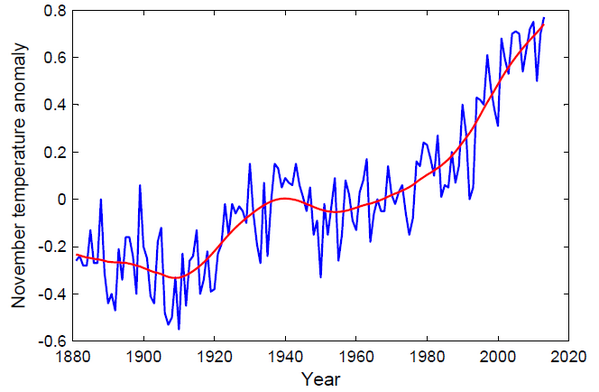
GISS global anomaly = +0.77 C.
http://data.giss.nasa.gov/gistemp/tabledata_v3/GLB.Ts%2bdSST.txt
That's the warmest November in their records, and the 6th warmest month.
Update 12/14: Here's a graph of GISS's November temperatures, from Stefan Rahmstorf:
http://data.giss.nasa.gov/gistemp/tabledata_v3/GLB.Ts%2bdSST.txt
That's the warmest November in their records, and the 6th warmest month.
Update 12/14: Here's a graph of GISS's November temperatures, from Stefan Rahmstorf:
What's New(s) ... from 'AGU Week' in San Francisco
YaleClimateMediaForum.org AGU13 Postings (Week of Dec 13 2013)
Reporting, commentary, and analysis on climate change.
[ Visit our youtube channel | Follow on twitter | Like on facebook ]
[ Visit our youtube channel | Follow on twitter | Like on facebook ]
 | |
| SUBSCRIBE/UNSUBSCRIBE POLICY Journalists, scientists, researchers, educators, and others can subscribe to this listserve by visiting us online at The Yale Forum. If you wish to unsubscribe, send an e-mail with "UNSUBSCRIBE ME" in the Subject line. PRIVACY POLICY Your e-mail address will be used for purposes of this listserve only. We do not distribute, sell, or provide any customer information to third parties without your prior consent. The Yale Forum on Climate Change & The Media is published by Yale Project on Climate Change Communication, Yale School of Forestry & Environmental Studies, 195 Prospect St., New Haven, CT 06511.  Copyright © 2013 Yale University School of Forestry & Environmental Studies All rights reserved. | |

Thursday, December 12, 2013
Wednesday, December 11, 2013
What We're Writing at the Yale Forum
Some of our writings over at the Yale Forum on Climate Change & the Media (where I'm now a "Regular Contributor"):
Judith Lean Summarizes Her AGU Lecture - includes an audio clip with her
Bruce Lieberman: When Measuring Climate Change, ‘What’ Do You Measure?
There is so much going on here that it's like trying to drink from a firehose Old Faithful. It's a continual choice between trying to listen to it, and trying to cover it....

Did Obama Get a Selfie Copy from the NSA?
 Do you suppose that when the Danish prime minister asked Obama if he wanted her to send him a copy of their selfie, he said, "Thanks, but I can get one from the NSA."
Just wondering....
According to this, Michelle Obama wasn't nearly as put-out as she looks.
Denning: Choose Your Future
A slide by Scott Denning at AGU:
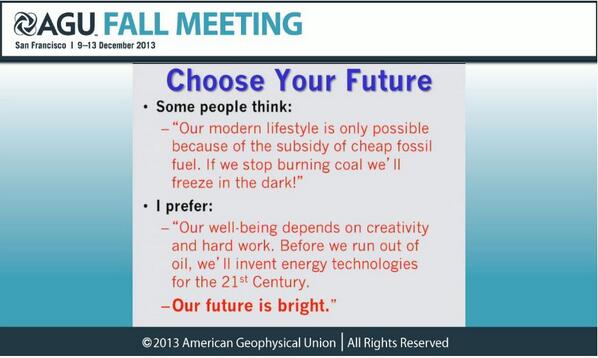
Denning's talk at a Heartland Institute conference is not to be missed.
Tuesday, December 10, 2013
Anthony Watts, Lying Again
Anthony Watts can't even tell the truth about the little things.
Writing about a session I attended this morning, he wrote, after the presenter (Judith Lean) displayed a slide with a blog post of his on it,
And if Watts can't tell the truth about the little things.... I'm more skeeved out that Watts is secretly monitoring my reactions to the talk, instead of paying attention to the speaker.
By the way, Lean's talk was really fantastic, showing the data for all the relevant climate factors, and stressing that surface temperature is a function of more than CO2.

Writing about a session I attended this morning, he wrote, after the presenter (Judith Lean) displayed a slide with a blog post of his on it,
Heard David Appell and Richard Somerville who were sitting near me both grunt when WUWT was displayed.which is an outright lie, concerning my reaction. Frankly, I couldn't care less -- and, let's note, the presenter, presented his site as an explicit example of bad science, as no Maunder Minimum-like changes in the Sun are going to cancel this century's global warming.
And if Watts can't tell the truth about the little things.... I'm more skeeved out that Watts is secretly monitoring my reactions to the talk, instead of paying attention to the speaker.
By the way, Lean's talk was really fantastic, showing the data for all the relevant climate factors, and stressing that surface temperature is a function of more than CO2.
My Postings at the Yale Forum Site
My postings so far on the Yale Forum on Climate Change and the Media:
Bud and Bruce are also worth checking out.
James Hansen's talk here today was cancelled, apparently due to a schedule conflict. A lot of people here were looking forward to it.... Not sure if it will be rescheduled.
Bud and Bruce are also worth checking out.
James Hansen's talk here today was cancelled, apparently due to a schedule conflict. A lot of people here were looking forward to it.... Not sure if it will be rescheduled.
Where Global Warming Is Going
From John Abraham and Dana Nuccitelli in The Guardian: "Global warming is unpaused and stuck on fast forward, new research shows."

Monday, December 09, 2013
NOAA Posts Another Large Jump in Ocean Heating
 New data for ocean heat content for the third quarter was just posted by NOAA. It shows another large increase for the 0-700 meter layer.
Compared to a year ago, 0-700 m OHC was up 0.90 x 10²² Joules, which works out to 285 terawatts, or 0.56 W/m2 over the Earth's entire surface.
(Using the Earth's entire surface area, instead of the area of the oceans, is probably a better calculation, since 90+% of the extra heat goes into the oceans.)
Comparing, the 0-700 m heating in the last year is twice the 15-year trend of 0.45 x 10²² J/yr, and 3.4 times the trend since 1955. An acceleration of warming?
The figure for the 0-2000 m region hasn't been posted yet.
Fwd: View AGU Fall Meeting Sessions - LIVE
-------- Original Message --------
AGU

| Subject: | View AGU Fall Meeting Sessions - LIVE |
|---|---|
| Date: | Mon, 09 Dec 2013 11:33:01 -0500 |
| From: | American Geophysical Union <aguservice@agu.org> |
| To: | <david.appell@gmail.com> |
Click here to access the web version of this message.
|

|


2000 Florida Avenue, NW, Washington, DC 20009-1277
Sunday, December 08, 2013
Hansen on Climate Sensitivity and Models
"Climate sensitivity will never be defined accurately by models."(He prefers paleoclimate studies instead.)
-- James Hansen, Storms of My Grandchildren, pg 44
In San Francisco for AGU Meeting
I'm in San Francisco for this week's AGU meeting. Expected attendance: 22,000.
There were obviously many other attendees on the flight down and the BART in -- science nerds tend to have a certain look, and a lot of them were carrying poster tubes.
I'll be covering the meeting for the Yale Forum on Climate Change and the Media, along with Bruce Lieberman and our editor Bud Ward.
I'll tweet at @davidappell, and we'll all be tweeting at @yalemediaforum with the conference hashtag #agu13.
The meeting has a virtual meeting option at http://fallmeeting.agu.org/2013/virtual-options/ . There will be nearly 100 sessions put online (almost 600 presentations in total), either live or on demand at
http://fallmeeting.agu.org/2013/virtual-options/live-stream-video-demand/
Should be fun.
There were obviously many other attendees on the flight down and the BART in -- science nerds tend to have a certain look, and a lot of them were carrying poster tubes.
I'll be covering the meeting for the Yale Forum on Climate Change and the Media, along with Bruce Lieberman and our editor Bud Ward.
I'll tweet at @davidappell, and we'll all be tweeting at @yalemediaforum with the conference hashtag #agu13.
The meeting has a virtual meeting option at http://fallmeeting.agu.org/2013/virtual-options/ . There will be nearly 100 sessions put online (almost 600 presentations in total), either live or on demand at
http://fallmeeting.agu.org/2013/virtual-options/live-stream-video-demand/
Should be fun.
Wednesday, December 04, 2013
Let's Stop Comparing Global Warming to the Hiroshima Bomb
 Skeptical Science has a widget that claims to show how much additional heat is being trapped on the Earth by anthropogenic factors: 4 Hiroshima bombs per second, or 4 Hiros/s.
The Hiro is an useful energy unit when discussing global warming, and I've certainly used it in the past, but a recent mailing list post I read has convinced me it's unnecessarily alarmist, and probably insensitive too.
It's useful because an energy imbalance of 1 W/m2 over the Earth's entire surface = 8.1 Hiros/second -- the yield of the Hiroshima bomb being 63 terajoules (TJ), or 15 kilotons of TNT.
But a couple of months ago, Alan Robock, who's done a lot of work on nuclear winter scenarios, wrote on a geoengineering mailing list:
I think this is a terrible comparison to make and should not be used. I heard someone this summer who was trained by Al Gore use this and she did not distinguish between all the effects of atomic bombs and the energy equivalent of the atomic explosions.He convinced me: the "Hiro" is inappropriate -- a scare tactic. And a false equivalence that neither captures the essence of global warming (since the energy is spread over the entire planet and not just a city), nor captures or respects the tragedy of the bombs dropped on Japan.
Equating nuclear war and global warming is a false comparison. Nuclear war is a much worse fate for our planet, and is a scare tactic. The number is correct (I did the calculation myself when I first heard of this), but trapping energy has completely different effects from dropping nuclear bombs on people. Using this is distracting, sensational, and easy to refute if the speaker does not carefully explain that it is the energy released by the bombs, with no other effects including radioactivity, fires, and blast.
I told John Cook this at the AGU Chapman Conference on Climate Communication this summer, and he said he would consider this recommendation, but I don't know if he plans to continue to feature this idea on Skeptical Science.
But see http://thebulletin.org/how-many-hiroshimas-does-it-take-describe-climate-change for another point of view.
As someone who in his late twenties often had nightmares about nuclear war and woke up screaming (much to the fright of a few girlfriends), and who when younger thought there would certainly be a global nuclear war in my lifetime, I'm not going to use the "Hiro" any more.
So what is a better unit? I asked Alan via the list, and he responded:
I think an array of incandescent light bulbs around the world would work much better. If you have 100 W bulbs, and want to model an imbalance at the surface of 1 W/m2, then you will need one light bulb every 100 m2, multiplied by 1 over the fraction of energy emitted by each bulb that is heat rather than light. Light bulbs in an array separated by 5-10 m on a side would not perhaps seem dramatic, but if you would zoom out and see them everywhere on Earth, it could be.It isn't as dramatic, which underscores the point: the "Hiro" is used for its incendiary nature, purposely trying to elicit fear. While global warming is, in some sense, scary, it's sloooooooow long-term scary, unfolding over decades, centuries, and millennia, and not wake-up-screaming scary.
Another option is to compare it to sunlight. At the top of its atmosphere, the Earth receives 1,376.6 W/m2 from the Sun, or 2,768 Hiros/second (as the Earth's intercepting area is only πR2). So global warming's 4 Hiros/second is equivalent to 0.1% more sunlight at the TOA.
Or, an energy imbalance of 4 Hiros/s is, over an entire year, an extra 8 billion terajoules, or 13 extra hours of sunlight at the TOA. That sounds impressive, but not in the way something terrifying is impressive.
Or, 4 Hiros/s = 252 terawatts, or about 14 times the power consumption of the entire Earth.
Tuesday, December 03, 2013
UAH: Last 5 Years Still the Warmest
The UAH anomaly for the lower troposphere for November was +0.19°C, which doesn't look impressive until you remember that their base period, 1981-2010, is quite recent.
(Really, is it too much to ask for the five major groups to get together and decide on, and use, a common base period? And for UAH and RSS to decide if their results warrant 2 significant figures (UAH, though they give 3 on Roy Spencer's blog) or 3 (RSS)? They're using the same raw data, after all, though with slightly different methodologies.)
In any case, this is still the warmest 5 years in the UAH record, though this isn't a statisically significant statement at the canonical level.

(Really, is it too much to ask for the five major groups to get together and decide on, and use, a common base period? And for UAH and RSS to decide if their results warrant 2 significant figures (UAH, though they give 3 on Roy Spencer's blog) or 3 (RSS)? They're using the same raw data, after all, though with slightly different methodologies.)
In any case, this is still the warmest 5 years in the UAH record, though this isn't a statisically significant statement at the canonical level.


Sunday, December 01, 2013
No, Climate Science Hasn't Lost It's Way
Judith Curry writes:

by linking to an LA Times article about medical science (which, let's stipulate, is not a physical science; see below).
In my opinion (and as I commented on Curry's blog), any scientist who has to ask “has science lost its way?” has just admitted that their ideas can’t compete in the arena of ideas. They are looking to win the argument by other (unscientific) means.
There is a simple way to win the scientific debate: produce better science. Period.
That has never, ever failed to win the day.
Ever.
But medical science is very different from the physical sciences like physics, chemistry, geology, mathematics, climate science, biology, etc.
For one thing, it's not nearly as rigorous. Yes, climate science deals with a very complicated beast -- the Earth's climate -- but medical science deals with one that is far more complicated -- the human body, or, more appropriately, the vertebrate body or even the organic organism.
That body is an immense bag of miracles, developed over billions of years of evolution, reaching a complexity we can barely begin to understand.
Not so for physics, or climate. We know, very well, the laws of blackbodies, and of quantum mechanics, and of radiation, and we know that the Earth will emit infrared radiation and that gases like CO2, CH4 and H2O have molecular energy levels that will absorb it.
Some of that absorption will be emitted back downward, towards the surface.
That is global warming. That's really about all you really need to know.
Global warming is required by the laws of physics. I think it was Michael Mann who said, during one of the times he was unjustifiably hauled before a Congressional committee, and then asked what it would take for him to admit that anthropogenic global warming was wrong, who replied, "Everything I know about physics and chemistry would have to be wrong."
And he was right. Completely.
Our world -- surface, oceans, sea ice, glaciers, and ice sheets -- must warm if we continue to emit greenhouse gases into the atmosphere.
Yet how that downward, extra heat gets distributed into the Earth's systems, and how it makes them evolve over time, is a very, very difficult problem. There are a great many variables, and the equations that describe these processes are very complicated, full of feedbacks.
But the planet will warm. It has to. It must. It will.
Attempts to parse that warming, by claiming that science is wrong because it can't yet describe the distribution of the warming, are inaccurate if they claim the Earth's many systems won't be affected, that they won't change.
Those systems will change, just in ways we can't yet predict, both in extent and in time.
But we can predict that they will change, somehow.
That's very, very different from medical studies where, primarily, a huge amount of money is at stake, from patents and partnerships and the results of clinical trials and how the science is interpreted.
If these clinical trials even are science. I once heard a talk by a science journalist (no names) that what journalists claimed as a "medical science" wasn't really a science, because it had too many variables and too many unknowns.
And I mostly agree with him.
So trying to piggyback on studies about medical papers isn't very convincing. They are barely doing science -- climate scientists are doing science, in the grand tradition of the king of the sciences, physics.
Their vulnerabilities are not the vulnerabities of the physical sciences. And they shouldn't be lumped toether, and blamed together. There are standards, and then there are standards.
by linking to an LA Times article about medical science (which, let's stipulate, is not a physical science; see below).
In my opinion (and as I commented on Curry's blog), any scientist who has to ask “has science lost its way?” has just admitted that their ideas can’t compete in the arena of ideas. They are looking to win the argument by other (unscientific) means.
There is a simple way to win the scientific debate: produce better science. Period.
That has never, ever failed to win the day.
Ever.
But medical science is very different from the physical sciences like physics, chemistry, geology, mathematics, climate science, biology, etc.
For one thing, it's not nearly as rigorous. Yes, climate science deals with a very complicated beast -- the Earth's climate -- but medical science deals with one that is far more complicated -- the human body, or, more appropriately, the vertebrate body or even the organic organism.
That body is an immense bag of miracles, developed over billions of years of evolution, reaching a complexity we can barely begin to understand.
Not so for physics, or climate. We know, very well, the laws of blackbodies, and of quantum mechanics, and of radiation, and we know that the Earth will emit infrared radiation and that gases like CO2, CH4 and H2O have molecular energy levels that will absorb it.
Some of that absorption will be emitted back downward, towards the surface.
That is global warming. That's really about all you really need to know.
Global warming is required by the laws of physics. I think it was Michael Mann who said, during one of the times he was unjustifiably hauled before a Congressional committee, and then asked what it would take for him to admit that anthropogenic global warming was wrong, who replied, "Everything I know about physics and chemistry would have to be wrong."
And he was right. Completely.
Our world -- surface, oceans, sea ice, glaciers, and ice sheets -- must warm if we continue to emit greenhouse gases into the atmosphere.
Yet how that downward, extra heat gets distributed into the Earth's systems, and how it makes them evolve over time, is a very, very difficult problem. There are a great many variables, and the equations that describe these processes are very complicated, full of feedbacks.
But the planet will warm. It has to. It must. It will.
Attempts to parse that warming, by claiming that science is wrong because it can't yet describe the distribution of the warming, are inaccurate if they claim the Earth's many systems won't be affected, that they won't change.
Those systems will change, just in ways we can't yet predict, both in extent and in time.
But we can predict that they will change, somehow.
That's very, very different from medical studies where, primarily, a huge amount of money is at stake, from patents and partnerships and the results of clinical trials and how the science is interpreted.
If these clinical trials even are science. I once heard a talk by a science journalist (no names) that what journalists claimed as a "medical science" wasn't really a science, because it had too many variables and too many unknowns.
And I mostly agree with him.
So trying to piggyback on studies about medical papers isn't very convincing. They are barely doing science -- climate scientists are doing science, in the grand tradition of the king of the sciences, physics.
Their vulnerabilities are not the vulnerabities of the physical sciences. And they shouldn't be lumped toether, and blamed together. There are standards, and then there are standards.
Subscribe to:
Posts (Atom)