If you had the chance to interview Trump's science advisor, would you ask him about climate change? Seems obvious, but apparently not if you're Nature News.
Wednesday, May 01, 2019
Sunday, April 28, 2019
US Oil Production Has Doubled in Less Than a Decade
Friday, April 26, 2019
World Oil Production - No Hubbert Peak (Yet?)
Thursday, April 25, 2019
Related to CO2, One Way or Another
A new paper found that during the Holocene, Arctic warming is associated with drying over the mid-latitudes of the Northern Hemisphere. That's potentially bad news:
Finally, from EIA.gov:
If the patterns observed during the Holocene hold for current anthropogenically forced warming, the weaker latitudinal temperature gradient will lead to considerable reductions in mid-latitude water resources.From the press release: "We found that when the Arctic warms, resulting in smaller temperature differences between the Equator and the pole, the jet stream gets weaker and less precipitation falls in the mid-latitudes."
* * *
Alaska's average temperature for March was 14.3°F (7.9°C) warmer than the 1981-2010 average. That was a record March and the fourth warmest (most anomalous) of any month since records began in 1925. (Data from NOAA.)
* * *
Meanwhile the continental US was 2.4°F (1.3°C) below the 1981-2010 average. Winter (DJF) was middling -- ranked 40th highest of 124 years. (Data from NOAA.)
* * *
An interesting graphic (Sorry, I don't know where it originated):
* * *
From @OceansClimateCU. Details here (RCP8.5, 2081–2099 vs. 1981–1999). Temperature change in °C.
* * *
Wednesday, April 24, 2019
How Orbital Advertising Will Look From the Surface
I promise to boycott, with prejudice, any company that advertises from space.
the orbital display in action from Vlad Sitnikov on Vimeo.
Monday, April 22, 2019
"...All We Love and All We Are"
In his daily NYT email, David Leonhardt observes Earth Day with this final paragraph of a new book by Nathaniel Rich titled Losing Earth: A Recent History.
“Everything is changing about the natural world and everything must change about the way we conduct our lives. It is easy to complain that the problem is too vast, and each of us is too small. But there is one thing that each of us can do ourselves, in our homes, at our own pace — something easier than taking out the recycling or turning down the thermostat, and something more valuable. We can call the threats to our future what they are. We can call the villains villains, the heroes heroes, the victims victims and ourselves complicit. We can realize that all this talk about the fate of Earth has nothing to do with the planet’s tolerance for higher temperatures and everything to do with our species’ tolerance for self-delusion. And we can understand that when we speak about things like fuel-efficiency standards or gasoline taxes or methane flaring, we are speaking about nothing less than all we love and all we are.”Last year the NY Times Magazine had this article by Rich, based on his book: Losing Earth: The Decade We Almost Stopped Climate Change. It's about there period 1979-1989. I'm a little dubious, but it's an article worth reading.
Sunday, April 21, 2019
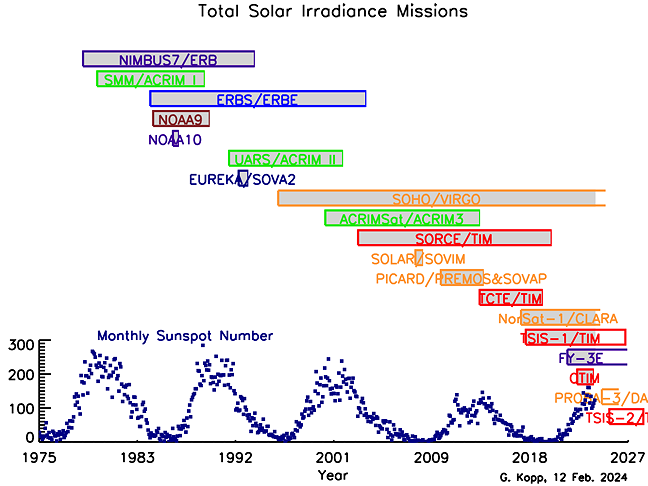
Abdussamatov's Prediction of a Solar Irradiance Decline is Failing
Back in 2012, Habibullo Abdussamatov, head of a space research lab at the Pulkovo observatory in Russia, predicted a sharp decline in total solar irradiance (TSI), and "new Little Ice Age" soon in the future. It got the deniers all tingley (not thinking that cooling for a decline in solar irradiance is natural and wouldn't say a thing about anthropogenic warming).
How well did Abdussamtov's prediction do? Poorly:
The figure is from his 2012 paper; I added the black line to represent the present.
Abdussamtov was right that we'd now be in a sunspot minimum -- but that's a pretty easy prediction, given what's know about the length of the solar cycle. But his prediction for TSI is badly wrong, by a sizzling 2 W/m2.
He says he used PMOD data, but I couldn't reproduce his graph using the PMOD data I found, in particular the baseline prior to 2010 of 1365.5 W/m2. (The baseline for the PMOD data linked above is more like 1360.5 W/m2. The difference isn't relevant here.) Here's a plot of my PMOD; the latest data only goes up to May 2, 2018:
No change in the baseline. But Abdussamtov's TSI prediction for the present can be easily discerned from his graph: a change in the baseline TSI (zero sunspots) from 1365.5 W/m2 to 1363.5 W/m2 -- a drop of 2.0 W/m2.
But the baseline change is zero. Here are TSI data from LASP (Laboratory for Atmospheric and Space Physics) in Colorado, updated to April 2019:
So, again, a different baseline, but not a change in baseline.
(Like a lot of measurements, determining the absolute value of a parameter is much harder than determining changes in it.)
There's no sign, at least yet, of a new Little Ice Age, or another Maunder Minimum, or any of that. Yes, the peak of Solar Cycle 24 was about half that of earlier peaks. (So how can anyone claim the Sun is responsible for modern warming? TSI averaged over a solar cycle has been declining since the 1960s.)
By the way, Abdussamatov wrote another paper, in 2016, doubling down. (Clarification: it appeared in a (non-peer reviewed) book, not a journal). He claims the new Little Ice Age did start, in 2015. But he (of course he did) moved out the start of the grand decline by about 30 years:
--
PS: The question of the cooling consequences of a future Maunder Minimum has been studied. It was found that anthropogenic greenhouse gas warming easily swamps any cooling from a Maunder Minimum-like sun. Cooling by 2100 would only be, at most, 0.3 C below IPCC projections.
"On the effect of a new grand minimum of solar activity on the future climate on Earth," G. Fuelner and S. Rahmstorf, Geo Res Lett vol. 37, L05707 2010.
http://www.pik-potsdam.de/~stefan/Publications/Journals/feulner_rahmstorf_2010.pdf
"Increased greenhouse gases enhance regional climate response to a
Maunder Minimum," Song et al, Geo Res Lett vol. 37, L01703 (2010)
http://www-cirrus.ucsd.edu/~zhang/PDFs/Song_et_al-2010.pdf
"What influence will future solar activity changes over the 21st century have on projected global near-surface temperature changes?" Gareth S. Jones, et al, JGR v 117, D05103 (2012) doi:10.1029/2011JD017013, 2012.
http://www.leif.org/EOS/2011JD017013.pdf
See also:
http://www.skepticalscience.com/what-would-happen-if-the-sun-fell-to-maunder-minimum-levels.html
How well did Abdussamtov's prediction do? Poorly:
The figure is from his 2012 paper; I added the black line to represent the present.
Abdussamtov was right that we'd now be in a sunspot minimum -- but that's a pretty easy prediction, given what's know about the length of the solar cycle. But his prediction for TSI is badly wrong, by a sizzling 2 W/m2.
He says he used PMOD data, but I couldn't reproduce his graph using the PMOD data I found, in particular the baseline prior to 2010 of 1365.5 W/m2. (The baseline for the PMOD data linked above is more like 1360.5 W/m2. The difference isn't relevant here.) Here's a plot of my PMOD; the latest data only goes up to May 2, 2018:
No change in the baseline. But Abdussamtov's TSI prediction for the present can be easily discerned from his graph: a change in the baseline TSI (zero sunspots) from 1365.5 W/m2 to 1363.5 W/m2 -- a drop of 2.0 W/m2.
But the baseline change is zero. Here are TSI data from LASP (Laboratory for Atmospheric and Space Physics) in Colorado, updated to April 2019:
So, again, a different baseline, but not a change in baseline.
(Like a lot of measurements, determining the absolute value of a parameter is much harder than determining changes in it.)
There's no sign, at least yet, of a new Little Ice Age, or another Maunder Minimum, or any of that. Yes, the peak of Solar Cycle 24 was about half that of earlier peaks. (So how can anyone claim the Sun is responsible for modern warming? TSI averaged over a solar cycle has been declining since the 1960s.)
By the way, Abdussamatov wrote another paper, in 2016, doubling down. (Clarification: it appeared in a (non-peer reviewed) book, not a journal). He claims the new Little Ice Age did start, in 2015. But he (of course he did) moved out the start of the grand decline by about 30 years:
The start of a solar grand minimum is anticipated in solar cycle 27 ± 1 in 2043 ± 11 and the beginning of phase of deep cooling in the new Little Ice Age in 2060 ± 11.I wonder if he's taken into account his failed prediction of 2012....
--
PS: The question of the cooling consequences of a future Maunder Minimum has been studied. It was found that anthropogenic greenhouse gas warming easily swamps any cooling from a Maunder Minimum-like sun. Cooling by 2100 would only be, at most, 0.3 C below IPCC projections.
"On the effect of a new grand minimum of solar activity on the future climate on Earth," G. Fuelner and S. Rahmstorf, Geo Res Lett vol. 37, L05707 2010.
http://www.pik-potsdam.de/~stefan/Publications/Journals/feulner_rahmstorf_2010.pdf
"Increased greenhouse gases enhance regional climate response to a
Maunder Minimum," Song et al, Geo Res Lett vol. 37, L01703 (2010)
http://www-cirrus.ucsd.edu/~zhang/PDFs/Song_et_al-2010.pdf
"What influence will future solar activity changes over the 21st century have on projected global near-surface temperature changes?" Gareth S. Jones, et al, JGR v 117, D05103 (2012) doi:10.1029/2011JD017013, 2012.
http://www.leif.org/EOS/2011JD017013.pdf
See also:
http://www.skepticalscience.com/what-would-happen-if-the-sun-fell-to-maunder-minimum-levels.html
Friday, April 19, 2019
Your Creepy Video of the Day
Robotic dogs -- only 10 of them -- pull a large truck up a 1° slope. They're now coming off the production line. (Stick around until 0:48, when the machines rise.)
Maybe This is Why Republicans Fear AOC
She's different. From WaPo -- "Barr" is Rep. Garland “Andy” Barr (R-Ky.).
Worse yet, Barr was lying. "...it turns out there are no active coal mines in Barr’s district anyway, which underscores her point."
Thursday, April 18, 2019
NOAA March Anomaly: 1.30°C
NOAA's determination of March's global average surface temperature is +1.30°C relative to 1880-1909.
Because why not.
That's 2.34°F.
It's the 2nd warmest March in their records, and the 5th warmest month of any in their records.
Because why not.
That's 2.34°F.
It's the 2nd warmest March in their records, and the 5th warmest month of any in their records.
Several IPCC Models Showing 5°C Climate Sensitivity
This week's Science magazine is reporting that several (at least eight) climate models being used as input to the IPCC's 6th Assessment Report have an exceptionally high climate sensitivity of about 5°C.
(Climate sensitivity is how much the planet's surface will warm for a doubling of CO2 in the atmosphere, after incoming and outgoing energy are again in balance. It's currently thought to be in the 2 - 4.5°C range, and calculations have stayed in that range for almost three decades now.)
5°C (9°F) would, of course, be significant warming and a significant change from current scientific thinking.
The article, by Paul Voosen, says modelers are working to understand which of their recent refinements are responsible for the surge. Modelers note it's still too early to know for sure, and that it's out-of-line with sensitivity estimates taken from past periods of climate change.
For example, the latest model from the GFDL in Princeton...
And this is interesting:
(Climate sensitivity is how much the planet's surface will warm for a doubling of CO2 in the atmosphere, after incoming and outgoing energy are again in balance. It's currently thought to be in the 2 - 4.5°C range, and calculations have stayed in that range for almost three decades now.)
5°C (9°F) would, of course, be significant warming and a significant change from current scientific thinking.
The article, by Paul Voosen, says modelers are working to understand which of their recent refinements are responsible for the surge. Modelers note it's still too early to know for sure, and that it's out-of-line with sensitivity estimates taken from past periods of climate change.
For example, the latest model from the GFDL in Princeton...
...incorporated a host of improvements in their next-generation model. It mimics the ocean in fine enough detail to directly simulate eddies, honing its representation of heat-carrying currents like the Gulf Stream. Its rendering of the El Niño cycle, the periodic warming of the equatorial Pacific Ocean, looks “dead on,” says Michael Winton, a GFDL oceanographer who helped lead the model's development. But for some reason, the world warms up faster with these improvements. Why? “We're kind of mystified,” Winton says. Right now, he says, the model's equilibrium sensitivity looks to be 5°C.Models from ETH Zurich, CCCM in Canada, GFDL and NCAR are all running hot. CMIP6, the Climate Model Intercomparison Model, where models all run the same scenarios and compare results, may sort out the issues, but it's running late, impacting deadlines for the first drafts of the 6AR.
And this is interesting:
In assessing how fast climate may change, the next IPCC report probably won't lean as heavily on models as past reports did, says Thorsten Mauritsen, a climate scientist at Stockholm University and an IPCC author. It will look to other evidence as well, in particular a large study in preparation that will use ancient climates and observations of recent climate change to constrain sensitivity. IPCC is also not likely to give projections from all the models equal weight, Fyfe adds, instead weighing results by each model's credibility.The IPCC 6AR is scheduled to come out in 2021.
Wednesday, April 17, 2019
Relative Health Care Spending is Declining
Data from The Altarum Institute:
Since Trump has done zero on health care, you have to wonder if this is due to Obamacare.... I don't know.
Tuesday, April 16, 2019
There are No Hard Deadlines in Future Climate Change
It's disappointing that an editor at Discover magazine would write this:"If you’ve been following climate news, you’ve probably heard about an approaching “tipping point” toward climate change — the point of no return after enough small changes brought us to certain disaster."The truth is, there is no such tipping point!
Climate change doesn't work that way. It's incremental -- some change in temperature for a change in emitted CO2 (about 2/3°F per trillion short tons of CO2 emitted, in fact).
(1 short ton = dumb English unit = 2,000 lbs = 907 kg (at Earth's surface.))
In smart units, that's 1.5°C/TtC (trillion tonnes carbon emitted). From Matthews+ Nature 2009.
This is a rather amazing equation, because it doesn't need to know how much CO2 goes into the ocean vs soil vs stays in the atmosphere. It doesn't explicitly need to know equilibrium climate sensitivity (the equilibrium temperature change after atmo CO2 doubles). These things cancel out (see the Matthews+ paper.) AFAIK, this is the relationship planners and policy makers use to determine how the world will stay below 1.5°C or 2.0°C or whatever.
Back to the quote. There may be tipping points in the future, but it is not nearly as clear cut as the author writes. No one knows. They are very uncertain. (No, that's not a good thing.) In fact, I've already heard (good) scientists say that Arctic sea ice has probably already passed a tipping point in its melting -- that it's not going to recover.
But there is no hard deadline by which we must solve climate change. It's not 12 years or 2030 or, now I'm seeing, 11.75 years. That's just not how climate change works. The sooner we cut emissions, the better. The later the worse. Partial cuts are better than none.
I (mostly) blame AOC.
Monday, April 15, 2019
It's Getting Warm Again
![]() |
| March 2019, NASA GISS |
GISS found March to be the 3rd warmest March in their records, and the 6th warmest of any month since their records began in 1880. The land-only anomaly of 1.39°C relative to 1951-1980 was the 2nd highest for March, and the 4th highest of all month.
Year-to-date 2019 is +0.12°C compared to last-year-to-date.
The land-only 30-year trend is 0.24°C/decade, meaning the warming over the last three decades is 0.73°C (1.32°F). That's over 0.4°F each decade.
The Japanese Meteorological Association also found the globe to be the 3rd warmest March (since 1890), and the 12th warmest of all months.
Saturday, April 13, 2019
"Religious Nones" Now Leading Religion Group in US
My guesses for the reasons behind this trend:
- the freedom from social norms unleashed in the '60s.
- more education over the decades.
- Catholic sex abuse scandals.
- Overly political, hypocritical behavior of Christian evangelicals.
- Richard Dawkins, Sam Harris, Christopher Hitchens, etc.
- Longer working hours = less time for traditional social activities such as church, mass or synagogue.
- Internet offers a sense of community and connection to the atheists and agnostics.
Anything else?
Now, when will politicians start catering to the Religious Nones in the same way they cater to Christians?
Thursday, April 11, 2019
Another Perspective on That Black Hole
A zoomed out image of yesterday's black hole in galaxy Messier 87, 54 million light-years away. Via Reddit.
Wednesday, April 10, 2019
"We're de-evolving the fish."
This documentary looks to be good. (Hopefully it will be widely available). From the press release:
Film finds hundreds of millions of American taxpayer dollars are wasted on an industry that causes more harm than good; an exposé on the high cost of fish hatcheries, fish farms, and human ignorance.
Monday, April 08, 2019
My SciAm.com Article about Gravitational Waves
I have an article today on ScientificAmerican.com:
"Gravitational Observatories Hunt for Lumpy Neutron Stars"
Monday, April 01, 2019
An Airplane's Contrail
Looking down at an airplane producing its contrail. Looks like a scene from Firefly.
Unusual footage of an airplane producing its contrail, from above!— Kees van der Leun (@Sustainable2050) March 24, 2019
Also a reminder of the amount of CO2 it emits. What you see is water vapor, and for every molecule of water, there’s roughly one molecule of (invisible) CO2 as well.
Imagine all our CO2 emissions were visible! https://t.co/ktZIHxrc2E
Tuesday, March 26, 2019
Is Atheism Consistent With Science?
Is atheism consistent with science?
I've been thinking about this since last week, when the winner of the 2019 Templeton Prize said it wasn't.
The John Templeton Foundation's goal is to show that religion and science can ideologically co-exist, and their $1.5M Prize
Is there a scientific reason why elephants can't have 1000 legs? Maybe too much body mass to eat for...or maybe we just haven't discovered the ninth force that makes 1000 legs possible but rules out any more or less as impossible.... What about 120 legs, then? Polka-dotted pachyderms? Does Gleiser think somewhere on Earth there may be a (natural) polka-dotted elephant with a head the size of a dump truck? With antlers? That can play Beatles songs on the guitar? Does he keep an open mind or does he say, no, those don't exist.
I think (s)he -- or anyone -- would say such a creature doesn't exist. (S)he wouldn't equivocate about it -- 'jee, we just don't know, ya know?' -- they'd make a definitive statement. Because leaving your mind open to all such possibilities is impossible -- otherwise we'd never have evolved to this stage, we'd never get anything done. If a writer thought he had to worry about the possibility of all the air in his room suddenly gathering in the top northward corner -- a possibility calculated by (I think it was) George Gamow in One, Two, Three Infinity -- he'd never get anything on thepage screen. Our minds have to be atheistic on many possibilities in order to get just from one day to the next.
Sure, you could say you're agnostic about that possibility -- jee, we just don't know -- but what's the point of that? To me it seems just a (too) cute rhetorical device to say we ought to be open to a god's existence (a god which no one ever describes in enough detail to seriously envision), the god John Templeton wants you to accept, so read your Bible and say your prayers and tithe to his church. Which is just a way to defend one's belief in a supernatural something even when there is no evidence whatsoever, to have your wafer [and wine] and eat it too. To me that seems to preclude serious thought, not encourage it.
I have no problem, of course, if someone is religious. But I think it's going too far to tell me I ought to be religious because jee, we just don't know. There are too many amazing things in this world that I want to see and learn about for me to spend time on something I've concluded I shouldn't spend any more time on because there's no evidence for it. Extraordinary claims require extraordinary evidence, not a mind so open it can make no sense of the world. Personally I think this world would make more sense and be kinder and more peaceful if religion and its intense belief in things without evidence -- beliefs that lead some of its adherents to violence and wars and horrific, premeditated violations of others -- didn't exist.
People who are kind will be kind whether God exists or not. But people who are not kind too often use religion to hide their unkindness. I think that's what Gleiser's philosophy leads to -- excuses. In other words I don't think his argument is morally neutral. He wants us to ignore arguments -- ignore our way of successfully navigating the world and discovering its workings -- about thousand-legged purple elephants when, and only when, it comes to God.
Anyway, I got that off my chest. What do you think?
I've been thinking about this since last week, when the winner of the 2019 Templeton Prize said it wasn't.
The John Templeton Foundation's goal is to show that religion and science can ideologically co-exist, and their $1.5M Prize
...recognizes an individual “who has made an exceptional contribution to affirming life’s spiritual dimension.”The winner, theoretical physicist Marcelo Gleiser, "a 60-year-old Brazil-born theoretical physicist at Dartmouth College," told SciAm's Lee Billings
I honestly think atheism is inconsistent with the scientific method. What I mean by that is, what is atheism? It’s a statement, a categorical statement that expresses belief in nonbelief. “I don’t believe even though I have no evidence for or against, simply I don’t believe.” Period. It’s a declaration. But in science we don’t really do declarations. We say, “Okay, you can have a hypothesis, you have to have some evidence against or for that.” And so an agnostic would say, look, I have no evidence for God or any kind of god (What god, first of all? The Maori gods, or the Jewish or Christian or Muslim God? Which god is that?) But on the other hand, an agnostic would acknowledge no right to make a final statement about something he or she doesn’t know about. “The absence of evidence is not evidence of absence,” and all that. This positions me very much against all of the “New Atheist” guys—even though I want my message to be respectful of people’s beliefs and reasoning, which might be community-based, or dignity-based, and so on. And I think obviously the Templeton Foundation likes all of this, because this is part of an emerging conversation. It’s not just me; it’s also my colleague the astrophysicist Adam Frank, and a bunch of others, talking more and more about the relation between science and spirituality.I just don't get this. I wonder if Gleiser is agnostic about the existence of thousand-legged purple elephants? Billion-legged? Purple elephants with 105846 legs?
Is there a scientific reason why elephants can't have 1000 legs? Maybe too much body mass to eat for...or maybe we just haven't discovered the ninth force that makes 1000 legs possible but rules out any more or less as impossible.... What about 120 legs, then? Polka-dotted pachyderms? Does Gleiser think somewhere on Earth there may be a (natural) polka-dotted elephant with a head the size of a dump truck? With antlers? That can play Beatles songs on the guitar? Does he keep an open mind or does he say, no, those don't exist.
I think (s)he -- or anyone -- would say such a creature doesn't exist. (S)he wouldn't equivocate about it -- 'jee, we just don't know, ya know?' -- they'd make a definitive statement. Because leaving your mind open to all such possibilities is impossible -- otherwise we'd never have evolved to this stage, we'd never get anything done. If a writer thought he had to worry about the possibility of all the air in his room suddenly gathering in the top northward corner -- a possibility calculated by (I think it was) George Gamow in One, Two, Three Infinity -- he'd never get anything on the
Sure, you could say you're agnostic about that possibility -- jee, we just don't know -- but what's the point of that? To me it seems just a (too) cute rhetorical device to say we ought to be open to a god's existence (a god which no one ever describes in enough detail to seriously envision), the god John Templeton wants you to accept, so read your Bible and say your prayers and tithe to his church. Which is just a way to defend one's belief in a supernatural something even when there is no evidence whatsoever, to have your wafer [and wine] and eat it too. To me that seems to preclude serious thought, not encourage it.
I have no problem, of course, if someone is religious. But I think it's going too far to tell me I ought to be religious because jee, we just don't know. There are too many amazing things in this world that I want to see and learn about for me to spend time on something I've concluded I shouldn't spend any more time on because there's no evidence for it. Extraordinary claims require extraordinary evidence, not a mind so open it can make no sense of the world. Personally I think this world would make more sense and be kinder and more peaceful if religion and its intense belief in things without evidence -- beliefs that lead some of its adherents to violence and wars and horrific, premeditated violations of others -- didn't exist.
People who are kind will be kind whether God exists or not. But people who are not kind too often use religion to hide their unkindness. I think that's what Gleiser's philosophy leads to -- excuses. In other words I don't think his argument is morally neutral. He wants us to ignore arguments -- ignore our way of successfully navigating the world and discovering its workings -- about thousand-legged purple elephants when, and only when, it comes to God.
Anyway, I got that off my chest. What do you think?
Thursday, March 21, 2019
Nifty Little Math Equation
Here's a nifty little math problem: evaluate
This video shows one way to do it.
The answer is surprising; scroll down for it:
Added next day: Using a spreadsheet, I calculated this up to n=143 (after which nn gets to large for Excel 365), when the left-hand term is 0.376 734, which differs from 1/e by 2.4%. A pinned comment below the video has a clever way to do the limit:
though the proof of Stirling's approximation is very similar to the method used in the video.
This video shows one way to do it.
The answer is surprising; scroll down for it:
.
.
.
.
.
.
.
.
.
.
.
.
.
.
.
.
.
.
.
.
.
.
.
.
.
.
.
.
.
.
.
.
.
.
.
.
.
.
.
.
.
.
.
.
.
.
.
.
.
.
.
.
.
.
.
.
.
.
.
.
.
.
.
.
.
.
.
.
.
.
.
.
.
.
.
.
.
.
.
.
.
.
.
.
.
.
.
.
.
Added next day: Using a spreadsheet, I calculated this up to n=143 (after which nn gets to large for Excel 365), when the left-hand term is 0.376 734, which differs from 1/e by 2.4%. A pinned comment below the video has a clever way to do the limit:
though the proof of Stirling's approximation is very similar to the method used in the video.
Friday, March 15, 2019
20th Anniversary of the Hockey Stick
Today is the 20th anniversary of the hockey stick paper by Michael Mann, Ray Bradley and Malcolm Hughes that reached back to 1,000 BP.
Jerry Mahlman, a climatologist at GFDL of NOAA, came up with the term "hockey stick graph." Their first graph was for the last 600 years of the northern hemisphere; today's anniversary is for the paper on the last millennium, then Mann and Phil Jones later reconstructed temperatures back to 2000 years BP.
Their work has been attacked like few others in science, but it has held up just fine. No one expected Mann to be the pugilist he turned out to be, who tirelessly fought off everyone at every turn -- auditors, congressman, lawyers and trolls. Sure, it wasn't the last word in temperature reconstruction, but first papers rarely -- for example, the Bohr Model, pre-Einstein papers on Lorentz transformations, the parton model of hadrons, and many many others in science. (I just happen to know the history of physics better than that of any other field.)
Many papers did their part in backing up the HS result by bringing in new data and improving the methodology. Here's a comparison of MBH98 to the PAGES 2k results of a couple years ago, from Stefan Rahmstorf's Facebook page:
One of the particular advancements of MBH was the inclusion of an uncertainty band around the temperatures.
I don't feel like relitigating any of the particulars of a case against the hockey stick, unless someone wants to bring something up in the comments. As I've written before, the hockey stick is required by basic physics, in particular radiative forcing's logarithmic dependence on CO2, which goes back to Arrhenius in 1896. Given that, it's a short argument to the hockey stick, one that can be condensed into a single tweet:
The hockey stick is required by basic physics:
1. temperature change is proportional to forcing change.
2. CO2 forcing change is proportional to log(CO2).
3. CO2 has been increasing exponentially.
=> hockey stick.
(209 characters.) Before the industrial era, the atmospheric CO2 concentration changed little during the Holocene, which implies the flat shaft of the HS. CO2 is increasing exponentially in the industrial era, which implies a linear increase in temperature, which is the blade of the hockey stick.
It'd be far more surprising if there wasn't a hockey stick in the data.
It's been interesting to follow all the twists and turns over the years of the effort to defeat this graph. It would have been interesting to have had social media during some of the big debates in science, such as the debates over the wave or corpuscular view of light, or the probabilistic nature of quantum mechanics, or the establishment of evolution by natural selection. (Here's a good book on some notable feuds in science.) I'd glad all that mischief is over. Science always wins.
Thoreau With a Machine Gun
The New Zealand shooting suspect, Brenton Tarrant, apparently said he is introverted, a racist, and an "eco-fascist by nature."
What is an "eco-fascist?" It's not what you might guess at first, which for me was some kind of right-wing climate denier who's sure green policies will be the death of the modern world. (No, that'd be a US Republican congressman.)
Apparently, eco-fascism advocates using the power of the state to enforce green policies, even if that power isn't based in popular elections and democratic processes. Naturally there's nationalism, racism and genocide involved.
Eco-fascists are "the nature-obsessed, anti-Semitic, white supremacists who argue that racial purity is the only way to save the planet."
Which would almost be funny if one of its adherents didn't just kill 49 people in a mosque.
Eco-fascism hardly seems a consistent ideology, but then consistency is about the last thing you can expect with the banality of evil. A few quotes the Reddit forum r/DebateFascism given by journalist Sarah Manavis last year:
We can probably expect the usual cretins to jump on this eco-fascist angle to ensure us that, see, as we've been saying all along, climate change is just a ploy from those who hate humans, hate civilization, and hate themselves, quote unquote.
And see, one of them has gone there already! So banal.
PS:
What is an "eco-fascist?" It's not what you might guess at first, which for me was some kind of right-wing climate denier who's sure green policies will be the death of the modern world. (No, that'd be a US Republican congressman.)
Apparently, eco-fascism advocates using the power of the state to enforce green policies, even if that power isn't based in popular elections and democratic processes. Naturally there's nationalism, racism and genocide involved.
Eco-fascists are "the nature-obsessed, anti-Semitic, white supremacists who argue that racial purity is the only way to save the planet."
Which would almost be funny if one of its adherents didn't just kill 49 people in a mosque.
Eco-fascism hardly seems a consistent ideology, but then consistency is about the last thing you can expect with the banality of evil. A few quotes the Reddit forum r/DebateFascism given by journalist Sarah Manavis last year:
"I believe that both the state and the state’s citizens have the right to use all means necessary to save the environment, including murder and sabotage,” one user wrote. “Murder is okay in this case, as combating climate change is sure to save more lives than it could ever hypothetically destroy.”
“To be fair, the Third Reich was one of the earliest governments to make conservationism a major focus,” wrote another.
“What really pisses me off is how everyone associates deep ecology with Communism and far left ideologies, which are deeply rooted in industrialization. It was Nazi Germany that was environmentally aware not Soviet Russia, with the rabid industrialisation,” one said.
“[Eco-fascists] have put the wellbeing of our earth, nature and animal on the forefront of their ideology.... It’s someone who has also turned away from industrial and urbanite society, seeking a more close to earth way of life.”So, eco-fascists desire to turn away from industrial society, but only after its war engines have punched out the machine gun you need for your terrorism.
We can probably expect the usual cretins to jump on this eco-fascist angle to ensure us that, see, as we've been saying all along, climate change is just a ploy from those who hate humans, hate civilization, and hate themselves, quote unquote.
And see, one of them has gone there already! So banal.
PS:
BIG CAVEAT with this 👇 a lot of the stuff in that manifesto is deeply Online ironic shit, but worth noting the space (and rhetoric) these people are floating around in https://t.co/pCO9N50gEE— Sarah Manavis (@sarahmanavis) March 15, 2019
Thursday, March 14, 2019
Greta Nominated
Ha! What did I say earlier? Via HuffPost:
Maybe she doesn't have enough accomplishments and experience yet to win. On the other hand, Malala Yousafzai won the Peace Prize when she was 17, just two years after surviving the assassination attempt against her.
From the article:
Maybe she doesn't have enough accomplishments and experience yet to win. On the other hand, Malala Yousafzai won the Peace Prize when she was 17, just two years after surviving the assassination attempt against her.
From the article:
“I think we have reached a tipping point where enough scientists are telling it like it is and not being so afraid of being alarmist,” Thunberg told New Scientist on Wednesday, adding it’s been frustrating that many people are paying more attention to her age than the issue at hand.She's right about this, too.
“They talk about our age, our looks and so on,” she continued. “The emissions are still rising and that is all that matters. Nothing has happened, that is crucial to remember.”
Friday, March 08, 2019
All Things Greta
![]() |
| Photo from TheNation.com |
When I was five [should be 11], I went into depression. I felt very bad, cried every rest of the toiletand [sic] went home and finally there was no point at all going to school because I would still have to go home. I also stopped talking and eating. One big reason I was depressed was that I was worried about the climate and the environment. I felt that there was no point in everything when the system was so wrong and I didn't see that I could do anything about it.Wow, these are very unfair thoughts for any child to have, let alone a 5-year old. Aren't kids being scared unnecessarily? A while back I saw someone on Twitter write that his 9-year old was looking up his life expectancy, and in the process came across some climate catastrophism and started crying. This (false) "we have 12 years to stop climate change" stuff isn't helping.
She also said:
I really do not like attention and being at the center, but one must take that if that is what is required for the media to start reporting on the climate and people should get their eyes up. Then it's a shame to complain. I myself have put myself in this situation.I predict his girl is either going to become Secretary-General of the United Nations or a shark of a hedge fund manager.
Wednesday, March 06, 2019
Bloggable Stuff
More Nuclear: Andrew Sullivan has an article about nuclear power in New York Magazine. (He's for it.) I just noticed it and having read it yet.... But I see that he repeated the claim that the cost of the New Green Deal is estimated to be $93 trillion, which is crap ridiculous. (Most of that estimate is due to the costs of the social changes it advocates -- job guarantees, livable wage, etc. But still.)
Here's another interesting graph. I'm guessing (?) the peak in industrial electricity, and the transition around 1980, is mostly due to the transition to a service economy:
--
Cold and wet: NOAA says the average USA48 temperature for February was in the lowest third of Februarys in their 125-year period. It had the second highest February precipitation, only 1/10th of an inch below 1998's record.
Here, Salem, Oregon had the coldest February in 30 years and the 7th-coldest February on record (since 1893). Eight days with snow, which is very unusual.
--
Record electricity: US electricity use set a record in 2018, was up 4% compared to the year earlier, largely because, the EIA says, a colder winter and a warmer summer. Cooling degree-days and heating degree-days both show signs of a warming temperature trend:Here's another interesting graph. I'm guessing (?) the peak in industrial electricity, and the transition around 1980, is mostly due to the transition to a service economy:
--
Another hockey stick: In Greenland, from an article by Carbon Brief that also debunks an old Don Easterbrook graph that has wormed it's way through the Web. (I'm sure there will be a retraction any time now.)Monday, March 04, 2019
Backflipping Bot
A new MIT robot that looks very much like the indefatigable "dog" in that episode of Black Mirror. It weighs 20 pounds, can move along at 5 mph, can do flips (why? Just for fun.) and can right itself when it falls over. Be sure to stay for the shots where it goes haywire.
Sunday, March 03, 2019
60 Minutes on Climate Case (Worth Watching)
![]() | David Appell (@davidappell) |
This Sunday's "60 Minutes" will have a segment on "Juliana v US," the lawsuit filed by youth plaintiffs against the United States claiming that climate change violates their rights. CBS, Sunday at 7 pm . Online here at 8 pm ET: bit.ly/2NyCvwf via Our Children's Trust | |
Download the Twitter app
Thursday, February 28, 2019
Electricity Percentage from Sustainables Unchanged in 20 Years
Here's a figure that was posted to Twitter the other day -- the world's non-fossil fuel electricity isn't even yet back to its 1995 peak:
Berkeley Earther Richard Rohde called his chart "depressing," and added his this take on it:
Clearly limiting warming to 1.5°C by 2050 requires either a significant new innovation(s) or a quick change of attitude among world leaders. It's difficult for me to see the latter happening -- the money in fossil fuels is just too large, the political corruption just too rampant -- so the former is really the only hope left. And that doesn't look to be anywhere on the horizon.
Wednesday, February 27, 2019
Saturday, February 23, 2019
Trump's Nominee for UN Ambassador Is a Tool
Donald Trump is nominating Kelly Knight Craft to be ambassador to the United Nations. She's currently United States ambassador to Canada, her husband is a billionaire Kentucky coal magnate, and she says she supports "both sides" of climate science, because "both sides have their own results, from their studies, and I appreciate and I respect both sides of the science." She comes off as a wide-eyed unthinking puppet who, of course, got the job because she and her husband donated $2M to Trump's campaign and inauguration. How embarrassing. How infuriating.
Thursday, February 21, 2019
One More Quote About Wallace Broecker
From WaPo:
“He has single-handedly pushed more understanding than probably anybody in our field,” Richard Alley, a geosciences professor at Pennsylvania State University, once told the alumni magazine Columbia College Today. “He is intellectually so huge in how the earth system works and what its history is that all of us are following Wally in some way or another.”Broecker was dyslexic and never typed or used a computer, and an evangelical Christian.
Dr. Broecker expressed skepticism that humanity would be able to wean itself from fossil fuels anytime soon, and backed proposals for devices such as a “scrubber” that would suck carbon dioxide out of the air so that it could be safely stored underground. Although such an invention seemed drawn from the pages of a science-fiction novel, drastic change was essential, he said.The articles leads off with a good picture of Broecker from 1972, working aboard a ship.
As Dr. Broecker put it, “The climate system is an angry beast, and we are poking it with sticks.”
January Globe-wide Temperatures
From a NOAA conference call this morning. (Note, this is a map of percentiles, not temperatures directly.) The January US cold snap seems to have been cancelled out by above average temperatures before & after it. Globally, NOAA found January 2019 to be tied for 3rd-lowest highest.
Tuesday, February 19, 2019
Broecker Quote
Via CNN:
I don't think the CO2-deniers, the dragon people, realize that physics requires global warming. All you need to show this are simple blackbody physics and the infrared emission/absorption spectrum of CO2. Warming necessarily follows. Sure, it's very difficult to calculate exactly how much, but it'd be far more surprising, and concerning, if modern global warming wasn't happening.
Monday, February 18, 2019
Wallace Broecker Has Died
A climate scientist par excellence. He was 87.
https://www.ajc.com/news/tech-science/scientist-who-popularized-term-global-warming-dies/EbAVMFNxumPzu5r4qRPZqK?sfns=mo
Friday, February 15, 2019
Climate Change as a National Emergency
Worth reading:
"6 Compelling Reasons Climate Change Might Be A National Emergency," Marshall Shepard, Forbes.com 2/15/19.
https://www.forbes.com/sites/marshallshepherd/2019/02/15/6-compelling-reasons-climate-change-might-be-a-national-emergency/
"6 Compelling Reasons Climate Change Might Be A National Emergency," Marshall Shepard, Forbes.com 2/15/19.
https://www.forbes.com/sites/marshallshepherd/2019/02/15/6-compelling-reasons-climate-change-might-be-a-national-emergency/
Thursday, February 14, 2019
Schopenhauer Not Schrödinger?
Schrödinger:
“The task is…not so much to see what no one has yet seen; but to think what nobody has yet thought, about that which everybody sees.”And there are variations on this, such as "Discovery consists of seeing what everybody has seen and thinking what nobody has thought," "Genius consists of..." and "Research is...."
But today, when I was trying to find out where Schrödinger said or wrote this, I found that he doesn't seem to have written it at all.
There are hundreds (about 680) of Google results that attribute it to Schrödinger. Wikiquote says Schrodinger said it, and so does the author Brian Greene.
But googling around I began to see attributions to the philosopher Schopenhauer, and then to the physiologist Albert Szent-Györgyi.
So who gets credit? Schopenhauer, I believe. This site, devoted to investigating quotes, written by a guy who says he wrote a best selling book on such investigations, finds
In 1851 Arthur Schopenhauer published a two volume work written in German titled “Parerga und Paralipomena” which contained a collection of long essays together with a series of short numbered passages. The piece numbered 76 included the following...."I'm not going to go look up the original reference -- I doubt I'd find it in the original German anyway, which I can't read anyway. And while I don't agree that it takes so much more to be a philosopher than a physicist(!) -- at least I can kind of understand the physicists -- this is some good evidence that the words, or something essentially identical to them, came from Schopenhauer and not Schrödinger. Poor Schopenhauer only gets about 25 Google returns for it.
Daher ist die Aufgabe nicht sowohl zu sehen was noch keiner gesehen hat, als bei Dem was Jeder sieht, zu denken was noch Keiner gedacht hat. Darum auch gehört so sehr viel mehr dazu, ein Philosoph als ein Physiker zu seyn.
Here are two possible translations into English:
1) So the problem is not so much to see what nobody has yet seen, as to think what nobody has yet thought concerning that which everybody sees. Also for this reason, it takes so very much more to be a philosopher than a physicist.
2) Therefore the problem is not so much, to see what nobody has yet seen, but rather to think concerning that which everybody sees, what nobody has yet thought. For this reason, it also takes very much more to be a philosopher than a physicist.
So now I have to go all over the Web correcting everyone who said it was Schrödinger. I'll return to blogging in 2020 when this task has been finished.
Tuesday, February 12, 2019
Michael Mann, Warren Washington, Win the "Nobel Prize for the environment"
From UCAR:
Each laureate receives $200,000 and a medallion. Past laureautes include some very important scientists: Wallace Broecker, Richard Alley, Jared Diamond, Charles Keeling, Jane Goodall, Roger Revelle and Edward O. Wilson.
Mann has won so many prizes now that I've lost track. As far as I know, Steve McIntyre was once co-winner of the immensely prestigious 2007 "Weblog Award for Best Science Blog."
Added: HuffPost has a nice article on Warren Washington. He was born and raised in Portland (Oregon), and went to Oregon State University, where his freshman advisor said he "shouldn’t stay in physics because it was probably too hard for me."
"The 2019 Tyler Prize for Environmental Achievement – often described as the "Nobel Prize for the environment" – has been awarded to climate scientists Warren Washington of the National Center for Atmospheric Research (NCAR) and Michael Mann of Pennsylvania State University."Here's a description of the prize:
"The Tyler Prize recognized the efforts of both men in explaining key tenets of climate science to influential audiences. Washington advised six consecutive U.S. presidents, while Mann has spoken extensively with media organizations and leading public figures."The press release also contains a biography of each winner.
Each laureate receives $200,000 and a medallion. Past laureautes include some very important scientists: Wallace Broecker, Richard Alley, Jared Diamond, Charles Keeling, Jane Goodall, Roger Revelle and Edward O. Wilson.
Mann has won so many prizes now that I've lost track. As far as I know, Steve McIntyre was once co-winner of the immensely prestigious 2007 "Weblog Award for Best Science Blog."
Added: HuffPost has a nice article on Warren Washington. He was born and raised in Portland (Oregon), and went to Oregon State University, where his freshman advisor said he "shouldn’t stay in physics because it was probably too hard for me."
Sunday, February 10, 2019
Who Gets How Much in a Carbon Tax-and-Dividend?
I was curious about how a carbon tax-and-dividend would play out. The plan would collect a carbon tax at the wellhead, mine or (for imports) the port-of-entry, then distribute all tax collected back on an equal per capita basis.
Warning: Wonky Ahead
First, I'm sure this has been done by some economists already. At an AGU talk a few years ago James Hansen mentioned an economic study, and I asked him about it afterward and he told me the firm's name but now I can't find my notebook from then, but I think it started with an "E." 😒 Anyway I didn't Google much because I wanted to try to calculate it myself.
The most recent chart of income vs CO2 I could find was this 2017 study about the US, by Lutz Sagar of the Grantham Research Institute on Climate Change and the Environment, which splits 2009 households (HHs) into ten deciles:
Here the wealthiest decile emits about three times the CO2 as the poorest decile.
I'll assume the carbon tax-and-dividend has no administrative costs (it's easy to add them in if so). The US had 117.181 M households in 2009, so there will 1/10th this in each decile. I digitized the above graph with Web Plot Digitizer, which was fairly easy to use. Then it's just calculating, which I'll leave in a footnote below, but I should note here that something doesn't add up somewhere, because the chart implies US 2009 CO2 emissions were 3.81 Gt CO2, when they were actually 5.39 Gt CO2. That's a big difference, but I don't know what it's from -- maybe someone reading this can make suggestions. (One thing I'm assuming is that the study alloted the emissions from businesses, industries and land changes to households.) Meanwhile I'll plow onward.
Given that, here my results for a carbon tax of $40, $100 and $300 per metric ton of CO2, where a positive "net dividend" is how much a household receives above what they paid in carbon fees:
The inflection point is at about $46,000/HH/yr in 2009 dollars, which is about $55,000/HH/yr today.
Personally, $300/t CO2 sounds right to me, if not low. Perhaps $500/t would be even better. It would help the poor quite a bit, and the upper middle class and wealthy would barely notice it.
Footnote:
Here's my calculation for a carbon tax of $300/t CO2. (I didn't worry about significant figures here because this is just blog work):
Thursday, February 07, 2019
The Green New Deal
The Green New Deal (text here) looks whacked -- of course we won't get to a carbon-free society in 10 years -- and surely the authors of the proposal know that. But I think what they have in mind is putting a stake in the ground -- stating what's really needed to stop climate change -- so that later piddly proposals can be compared to it.
But I wish it was only about carbon without the social welfare proposals, such as
(G) ensuring that the Green New Deal mobilization creates high-quality union jobs that pay prevailing wages....
Judith Curry has some thoughts on her Congressional testimony on Wednesday, and they're worth reading in full. She ends with this:
But I wish it was only about carbon without the social welfare proposals, such as
(G) ensuring that the Green New Deal mobilization creates high-quality union jobs that pay prevailing wages....
(H) guaranteeing a job with a family-sustaining wage, adequate family and medical leave, paid vacations, and retirement security to all people of the United States;....You may or may not think these are worthy aspirations, but such social engineering proposals are exactly what turns off some of the (rational) opponents of action on climate change. And I can't say I blame them. If Republicans came forth with comprehensive climate/energy legislation that also included banning abortions, ensuring nationwide right-to-work laws, and (still more) tax breaks for the wealthy, I'd oppose it no matter what the climate section proposed. I don't understand why AOC and the 37 other sponsoring Democratic representatives don't see that.
(I) strengthening and protecting the right of all workers to organize, unionize, and collectively bargain free of coercion, intimidation, and harassment;....
(O) providing all people of the United States with
(i) high-quality health care;
(ii) affordable, safe, and adequate housing;
(iii) economic security; and access to clean water, clean air, healthy and affordable food, and nature.
Judith Curry has some thoughts on her Congressional testimony on Wednesday, and they're worth reading in full. She ends with this:
No-regrets, win-win solutions seem politically palatable to the Republicans; it remains to be seen if Democrats will make incremental no-regrets policies such as proposed here the enemy of their grandiose ideas such as Green New Deal.I think that's a wise statement.
Wednesday, February 06, 2019
The Reluctant Radical
Last night I went to the Salem library to see the documentary film The Reluctant Radical, followed by a Q&A with the filmmaker and the subject of the film, Ken Ward of Portland. The link has a trailer for the film.The movie follows Ward, a 20-year employee of Greenpeace who then went out on his own to protest fossil fuels. It showed him trying to get in front of a Royal Dutch Shell ship leaving for the Arctic in 2015 -- the protest in Portland where about, notably, a dozen or so Greenpeace activists hung from a bridge, trying to keep the ship in harbor. (Actually the ship was a required vessel to deal with well blowouts that might happen in the Arctic.) Ward is shown at a Mobil gas station -- once on Christmas Eve dressed in a Santa suit -- with a sign board saying "Evil" and passing out an informational page about the news that ExxonMobil knew about human-caused warming in the 1970s. (He was arrested there more than once, and received community service.) Last, he broke into an oil pipeline safety valve station and turning the valve shut, temporarily blocking tar sands oil coming to the US from Canada. For this last act he faced several charges for trespassing, breaking and entering, and one felony (I forget what for), but a jury in Washington state deadlocked ("hung") on all the charges. And, as of the time of filming, he faced other charges too.
Ward has very strong and dire opinions on climate change. Some you can hear in the film: "the world as we know it is ending," we are at "the end of conditions that make civilization possible," "we're fucked," "we need to remake society or we're fucked." "We need moral clarity, lines to be drawn." His 15-year old son was shown saying "the world's [the human species is] screwed no matter what we do."
Ward is a very committed man, brave, willing to take risks that few are. I didn't know how I felt about that before the film, and after seeing it and hearing him, I still don't. His protests, of course, don't directly stop any fossil fuel use. But it does draw attention to the problem, and I suspect he's made some number of people wonder why he goes to such lengths, drawing their attention to the issue. Others, of course, see him as a zealot and a nuisance.
In the film a district attorney in Massachusetts said, when he decided to drop charges against Ward from earlier actions in that state, that we revere the civil disobedience of the Boston tea party. Martin Luther King Jr and Gandhi used civil disobedience to great effect. Someone in the jury in Ward's trial that ended the film must have thought the same of Ward.
But it bothers me that, at the same time, Ward got some of the science wrong, even though the film showed him spending a period (when he couldn't find a job) reading all he could about climate change. He said we will have 5 ft of sea level rise by 2050. (I don't know of any science showing it will be that abrupt.) He said the melting Arctic will swamp Florida. (Arctic ice is mostly floating, so its melting doesn't affect sea level rise.) He mentioned a study that has just come out that day, saying, he said, that 80% of Himalayan glaciers will melt by 2050. (It actually said at least a third by 2100.)
These falsehoods matter. For me, they are egregious enough to make me doubt everything and anything he says about climate change. But then I know the subject well; most in the audience didn't. (One question was from a woman who said they had taken a trip to North Dakota, and the region was rife with oil trains. Where are they all going, she asked. Into your gas tank I wanted to say, but didn't.) I don't see Ward's errors as much different from some of the falsehoods put forth by climate deniers -- at least, the ones who clearly don't know any science. (Professional liars like Heartland and Watts are a different group.) You've got to get your facts straight if you're going to advocate. You gotta.
And at one point last night Ward said that coal power plants like those in West Virginia should all be simply shut down tomorrow. That's way beyond radical -- it's stupid. Ward called cap-and-trade, which is being designed now in the Oregon legislature, "a terrible idea, far more of a problem than it's worth," and that the time to do it was 20 years ago.
I used to wonder about the Berrigan brothers, who were in the news for a few decades during the '60s and after. Both priests, they first protested the Vietnam War, then political injustice in general, then protested a nuclear armament facility by breaking in, destroying some things and pouring blood on documents. They both spent several years in prison, in total. Did they do any good? I think, for me, they made me think, and in some small way contributed to my overall progressivism. I couldn't do what they did, or what Ken Ward does, though. I don't know if that makes me a coward, or just rational. I tell myself I can't protest because I write about climate change and I shouldn't look biased. Like I matter or anyone would notice. Maybe that's just fear rationalizing. I tell myself I don't have the personality they do, and their all-or-nothing, black-and-white thinking. But then it's not just a matter of personality -- the film shows Ward talking to himself before chain cutting his way into the safety valve area, and saying he was afraid. I'm sure he is sometimes. He seems sincere. Maybe we all need to be that angry, at least to making changes in the political arena. We're all so passive. I just wish he'd stop exaggerating the science.
Tuesday, February 05, 2019
I Still Feel Like a Little Kid When It Snows
Saturday, February 02, 2019
Why Climate Models are So Complex
climate models are very complex due to the sheer number of groundhogs involved #alternativefact— Kate Marvel (@DrKateMarvel) February 2, 2017
Subscribe to:
Posts (Atom)