I've been keeping track of daily Salem Oregon weather since I moved here on 9/1/2011. The temperature deviances are actually a pretty good Gaussian distribution. So I can estimate occurrences of high temperatures.
A high of 108°F (24°F above normal) is 3.99 standard deviations over the mean, which should occur 84 years.
Our high of 117°F on 6/28/21, the monster Pacific Northwest Heat Wave of 2021, was 39°F above normal, which should happen every 165 million years. (!)
I only have 10.9 years of data, so these numbers probably aren't very good. Just for fun.
Here's the distribution in Salem for the last 11 years, for the daily temperature, which is the average of the high and low.
The peak is a little wonky. Don't ask me why. Horizontal axis is degrees Fahrenheit above or below the daily average; vertical axis is the rate of occurrence.
I calculated the mean anomaly and standard deviation of the daily highs to be 1.29°F and 5.69°F respectively.
There is remarkably little change in world oil production per capita per year:
Note the vertical axis scale is fairly refined, so the annual fluctuations are only about ±5% at most. I would have guessed there'd be a fairly large positive trend.
The era of global warming has ended; the era of global boiling has arrived,” António Guterres declared in a news briefing, as scientists confirmed that July is set to become Earth’s hottest month on record.
“Climate change is here. It is terrifying. And it is just the beginning,” he said at a briefing at U.N. headquarters in New York on Thursday, as he described “children swept away by monsoon rains, families running from the flames [and] workers collapsing in scorching heat.”
Sure, global warming is getting to be serious, and will get more serious. But calling it "boiling" is such a naked attempt to induce fright. And then, presumably, action. It's almost laughable, at least silly, and an easy target for deniers to mock. Besides, nothing is really boiling, and won't. Not even close. Seems like maybe it was dreamed up by PR types who are deep in a UN bubble.
I don't know what's going to get the world to take this problem seriously, but such extreme nomenclature isn't the answer, I believe. What do you think?
⁂
I don't see the world addressing global warming en mass via mitigation. I think we're well on the path to geoengineering via stratospheric aerosols. Then someday in decades carbon removal from the atmosphere. But it's going to get very hot before then, at least 2°C, and probably 2.5°C. I wouldn't bet against 3°C. IMO.
⁂
When water expands as it freezes, it exerts a pressure of 200 atmospheres. Watch it blow this steel container apart.
⁂
Sea level rise in Mayport, Florida is 1/3 inches a year over the last 20 years. It's located in the northeastern-most part of Florida, just outside Jacksonville--there's a big US naval station there, Naval Station Newport.
⁂
⁂ is my new favorite symbol. It's called an "asterism." A word from planetary astronomy.
⁂
Neat to see my comparison of record ocean temperatures to climate model projections in today's @nytimes. Its definitely approaching the upper end of what we'd expect to see based on climate models: https://t.co/mPb6IqsesZpic.twitter.com/bW1IUcFy9a
Then, the ratio of US CO2e to China CO2e emissions is, since 1850
This is all emissions, in CO2-equivalent units, for the Kyoto gases, which are
Carbon dioxide (CO2), methane (CH4), nitrous oxide (N2O), and the so-called F-gases(hydrofluorocarbons and perfluorocarbons) and sulphur hexafluoride (SF6). Each gas is weighted by its global warming potential and aggregated to give total greenhouse gas emissions in CO2 equivalents.
Up until about 1880, China actually led the US, presumably from methane emissions from growing rice.
Since just after the peak, say starting in 1970, this ratio is very linear and looks like
This linear trend reaches 1 in the year 2028.8--just 5.2 years from this August 1st.
Of course, China now has a population 4.2 times that of the US, so per-capita this ratio isn't even in the ballpark of one.
And per-capita, not per-country, is really how carbon emissions should be accounted for. Americans are still a much bigger energy hog and carbon polluter than the Chinese, and this may never reach parity. Even more so when you consider that we've outsourced some of our manufacturing (=carbon emissions) to China. Perhaps that's the only reason why US annual emissions have been decreasing in recent years. I'm pretty sure someone somewhere has been keeping the data on this.
in the journal that is the last recourse of deniers, Energy & Environment. In 2019 he wrote about this paper:
"The 2017 paper proposed a simple heuristic approach to climate science which plausibly proposes that a Millennial Turning Point (MTP) and peak in solar activity was reached in 1991,that this turning point correlates with a temperature turning point in 2003/4, and that a general cooling trend will now follow until approximately 2650."
still claiming that it started cooling in 2003/4, when of course it has done anything but:
In fact, the 20-year trend of GISS monthly global surface temperature is 0.45°C/20yrs.
Here Norman is, doubling down again on Judith Curry's blog just the other day, saying scientists have a "CO2 derangement syndrome."
Some people just refuse to learn. I wonder if Norman's salary depends on ignoring the evidence.
China's population fell for the first time last year, by 185,000 (-0.01%) compared to 2021. And India now has more people than China, by 5.0 million in 2022.
Copernicus [the Copernicus Climate Change Service (C3S)] released their temperature anomalies for June, and found that the global average temperature for June set a record, among Junes. Their data starts in 1979. {no fair! that's the beginning of the satellite era! ...So be it. The results from UAH and RSS also start in 1979.} They choose a baseline of 1991-2020. They write
Globally, June 2023 was:
0.53°C warmer than the 1991-2020 average for June
the warmest June in this data record
substantially warmer than the 0.37°C anomaly in June 2019, the second warmest June on record
That's quite a jump for a new record.
and here's my chart for the 10-year moving averages. There might even be an acceleration in these data....
Here's their wild looking chart for June SSTs.
which is the region of the ocean west of London/Pyrenees/western Africa and from the equator to Iceland. (Latitude lines on this map are 36° apart.)
One day I was talking to Cora. She prayed for me because she believed I was blind to sin, wanting me to kneel and pray too, because people to whom sin is just a matter of words, to them salvation is just words too.”
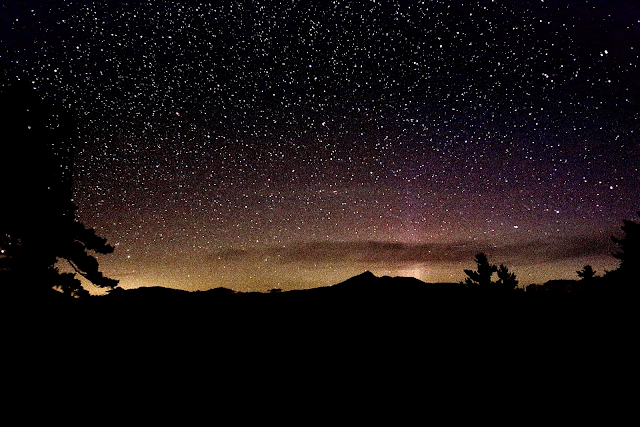
From my friend Jim D, a retired chemistry professor from Linfield College in Oregon who moved back east with his wife right across Lake Winnipesaukee from where I used to live!
I once saw the aurora from Gilford, but it was like a white glimmering sheet and nothing like this at all.
What a gorgeous high-res picture.
--
PS: I once hiked to the top of Mt Chocoura.
PPS: I tried again another time, this time on a second date with a woman, but we left too late in the afternoon and terminated the hike just before the really rocky, steep part to the top. She was a slow hiker, and we tried to take a shortcut trail to get back to the car. We ended up deep in some woods trying to grope our way back to the car. As the sun fell on that November night, I kept telling her, with more and more urgency, that we needed to hurry up. But she just couldn't. I was able to somehow follow the trail by starlight (we didn't have a flashlight) and got us out of the woods and on to a road that led back to my car. In my memory it is actually a special moment -- I was feeling that I somehow knew how the dark, not visible trail before us would go, as it twisted and turned around trees and humps and creeks and rocks. I almost felt like I had done enough hiking and backpacking by then -- 1900 miles on the Appalachian Trail, plus dozens of other trails -- that I could intuit where the trail would go based just on the terrain. And I did. It was kind of unnatural and, if I believed in it, a bit supernatural. I don't believe in the supernatural -- I just feel like my instincts kicked in when I really needed them, when I had started to think we were really going to be lost out there in the New Hampshire woods in November as it was getting quite cold.
But we made it out. I kissed her in joy, kind of awkwardly, we drove out the long dirt road to a place and ate pizza, and I never tried to see her again. Too slow. I have to admit that evening scared me more than almost any hike I'd ever been on. Although there was another one in the Superstition Mountains in Arizona in January....
Good times! Seems like all I have left anymore are memories.
As with most things, Kevin McCarthy is confused:
I heard the President gave a big speech about economics. Do you know what would be good economics for America?
The gap is growing, and it is visible even in the rural areas of Trump states.
But this didn’t come up when a Trump ally, Representative Jim Jordan of Ohio, held a hearing in New York in April to blast Manhattan’s prosecutor for being lax on crime, even though rates for all seven major crime categories are higher in Ohio than in New York City. Nor does House Speaker Kevin McCarthy — who tweets about Democratic “lawlessness” — talk about the per capita homicide rate in Bakersfield, Calif., which he represents, which has been the highest in California for years and is higher than New York City’s.
Why is this relevant? Because increasingly I've been seeing conservatives writing that some cities are going downhill -- crime, police issues, drugs, homelessness, decay -- because they have mayors who are Democrats. (And, the subtle allusion is, because many of these mayors are black.)
I'm not implying these mayors are perfect. Just that they're far from singularly responsible for the problems in big cities. In most cases it's state legislatures and governors who determine gun laws (which are increasingly lax, especially in the south, which may be partly or mostly responsible for the murder gap), or money for the homeless or medical care or rehabilitation programs, etc.
Then there are the policies of neighboring states. Chicago, for example, has some of the strictest gun laws, but most of the guns used in homicides there come from out of state:
In 2017, a report commissioned by former Mayor Rahm Emanuel analyzed four years of gun tracing data and found 60% of illegally used or possessed firearms recovered in Chicago come from out of state. Indiana was the primary source for approximately one in five such guns. In 95% of cases, the person with the gun was not the initial purchaser.
As always, the situations with respect to crime are far more complicated than the juvenile bullet points that get throw out as soon as the discussion begins.
Taken by NASA's rover Perseverance as the moon Phobos passes in front of the Sun, on April 2, 2022. The eclipse lasted 40 seconds.
Phobos orbits Mars at a distance of 6,000 km above the Martian surface.
Note that it doesn't cover the entire Sun, unlike solar eclipses on Earth. That's because the exact coverage of our Moon over the Sun is an extremely rare thing for a planet to have -- a moon that's just the right size and distance to the angle made by the diameter and its distance almost exactly matches the same angle to its sun. It's quite uncanny, and won't last forever as the Moon is moving away from the Earth by 3.8 cm/year. The last total solar eclipse on Earth will be in about 600 million years.
So in fact, we live in a very special time and place, when and where we have total solar eclipses. Might be enough of a reason for aliens to consider us a tourist attraction.
The county also seeks an estimated $50 billion for an abatement fund to study, plan and upgrade public health services and infrastructure to help “weatherproof” the county during future extreme heat events.
The video accompanying the story says more than two dozen cities, counties and states have filed similar lawsuits.
Given that the oil companies, like Exxon, did know of the warming potential of their fuels, I think lawsuits like this are justified, just as were the lawsuits against tobacco companies. With enough of them the fossil fuel companies may well settle by some kind of similar multiple hundred-billion dollar type of payment. And they'll be getting off easy.
This tweet made me want to look at the latest sea surface temperatures at the U of Maine's Climate Reanalyzer, and they're something else:
Extra atmospheric water vapor in the stratosphere from volcano Tongo?
In the study, published in Geophysical Research Letters, Millán and his colleagues estimate that the Tonga eruption sent around 146 teragrams (1 teragram equals a trillion grams) of water vapor into Earth’s stratosphere – equal to 10% of the water already present in that atmospheric layer.
The study says it could be there for awhile:
It may take several years for the H2O plume to dissipate. This eruption could impact climate not through surface cooling due to sulfate aerosols, but rather through surface warming due to the radiative forcing from the excess stratospheric H2O.
For the North Atlantic Brian McNoldy wrote the other day that the latest SST for the North Atlantic was a record high anomaly, 3.87 standard deviations above the mean (a 1-in-18,650 occurrence)
From William Ripple, a professor of ecology at Oregon State University. There is just too much money to be made in fossil fuels (~ $100T?).
This doesn't prove climate pacts and accords and conferences have done nothing -- we'd need to see the same curve but without them. But it's not encouraging in the least.
The writer Cormac McCarthy has died. But not before this bit of pessimism, from a 1992 interview with the New York Times:
McCarthy wrote All the Pretty Horses, which is a fabulous novel if you can adjust to his clipped, acerbic writing style that wonderfully sets the tone for the story and its location.
He also wrote Blood Meridian, which is now near the top of my reading list. I hear it's extremely violent, so much so that some people have stopped reading it out of revulsion and disgust. Today the NY Times called it "a bad dream of a Western." And he wrote the books on which two popular movies were based: The Road and No Country For Old Men, neither full of lollipops and rose petals. The former is set in an apocalyptic western Pennsylvania, not far from where I grew up, which some people consider the northernmost edge of Appalachia, one of McCarthy's two favorite locales (the other being the American southwest). He himself grew up in eastern Tennessee, of which he said, "We were considered rich because all the people around us were living in one- or two-room shacks."
He started college studying physics and engineering. After the Air Force he got serious about writing:
After marrying fellow student Lee Holleman in 1961, McCarthy "moved to a shack with no heat and running water in the foothills of the Smoky Mountains outside of Knoxville". There, the couple had a son, Cullen, in 1962. When writer James Agee's childhood home was being demolished in Knoxville that year, McCarthy used the site's bricks to build fireplaces inside his Sevier County shack. While Lee cared for the baby and tended to the chores of the house, Cormac asked her to get a day job so he could focus on his novel writing. Dismayed with the situation, she moved to Wyoming, where she filed for divorce and landed her first job teaching.
The CO2 emissions from fossil fuel energy production won't follow the same curve because the mixture of fuels -- coal, natural gas, oil -- has changed. I'll try to dig that up.
The IRI at Columbia University is out with their latest monthly ENSO prediction, and the average predicts a strong El Nino beginning around August:
Anything above 1.5°C is considered a "strong" El Nino. The 2015-2016 El Nino SST anomaly peaked at 2.6°C, and the 1997-1998 peaked at 2.4°C.
(An "El Nino" has a SST anomaly of 0.5-1.0°C, "moderate" El Nino is 1.0-1.5°C, and "strong" El Nino is > 1.5°C.) There have to be five consecutive months where the index is in a category before it earns one of these labels.
(This is from the same page as above.)
--
James Hansen said in his email newsletter that he has a paper coming out the concludes 'the present greenhouse gas forcing is 70% of the forcing that made Earth’s temperature in the Early Eocene Climatic Optimum at least +13°C relative to preindustrial temperature.'
The Eocene is the period after the PETM, from 59 million years ago (Ma) to 49 Ma. Here's more on the Early Eocene Climate Optimum. I don't know much more than this at present....
Looks like something from Planet of the Apes.... Hey, maybe that movie was set after global warming had destroyed mankind, and sea level rise was why the Statue of Liberty was destroyed.... (Yes, I know Charleton Heston said "they blew it up," but how would he have known exactly what happened?)
Lindell has done a huge amount of damage to America, and I hope the history books say that.
==
“The G.O.P. is a working-class populist party that has no interest in nurturing highly educated bobo boom towns. The G.O.P. does everything it can to repel those people — and the Tesla they drove in on.”
"Depending on the comparison, Washington’s gas prices have increased between 35 and 52 cents more than neighboring states since the state launched a tax on CO2 emissions at the beginning of the year."
Yeah, that's the point! Making fossil fuels more expensive incentivizes individuals to switch to noncarbon sources of fuel.
But I do agree with his second point:
"Despite the clear data, state politicians and agency staff refuse to acknowledge the cost of the increases and aren’t helping residents deal with the impact of the costs."
The poor (and middle class, today) can't just go out and buy an electric car to avoid the carbon tax. What's a new electric car cost, at least $25,000? That's beyond the means of a lot of people.
Personally, I can't afford an electric car, new or used, right now. Probably never a new one.
So all the poor and middle class can do is suffer the carbon tax. If they drive the US average of about 12,000 mi/yr, and their car gets the US average of about 25 mi/gal, they buy 480 gal/yr of gasoline. If Todd's lower limit of an additional 35 cents/gal (at a minimum) is accurate, that's an extra $168/yr they're paying in carbon taxes. $14/month.
That's not trivial if you're poor. $168 would cover about two months of electricity. (Personally, my average electricity bill over the last 12 months is $87/month.)
The problem is that these Washington legislators want to keep the carbon tax money for themselves, to use as they desire.
A much better way to use it, if you're really serious about halting climate change, is as James Hansen started advocating for long ago: refund all carbon taxes back on an equal per capita basis.
The poor would actually make money under this plan. Their refunds, since their use if average, would cover their up-front carbon fee costs. But those who use "too much" gasoline would pay more, and most of that would go back to the poor.
This plan would help alleviate poverty.
It should be relatively easy to return all money collected (minus a few percent for administrative costs) to households, it seems to me. They can return tax returns. But of course, there are people who are homeless, sharing a car, etc and how do you handle these situations? But it's not rocket science.
But politicians really don't care about the poor. Of course.
==
This March was the 2nd-warmest in its records, going back to 1880, according to NASA GISS. The 4th-warmest of any month. That's weird, considering we've just come out of the La Nina -- the third La Nina in consecutive years.
So we're not even in an El Nino yet -- which many are predicting for later this year -- and already temperatures have soared out of the La Nina zone. (The GISS global anomaly this past November was "only" 0.73°C [baseline: 1951-1980].)
Hockey's regular season is over and the playoffs begin tomorrow. Let me post this nice story first:
The Pittsburgh Penguins, my team, missed the playoffs for the time in 17 years. They played very inconsistently. Their playoff streak had been the longest in North American sports; I think the second-longest is now 9 or 10 years.
Now it's over.
They did this despite controlling their playoff destiny -- they lost to the worst team in the league, the Chicago Blackhawks, even though if they had won that game they were still in the hunt, and only needed to beat the second-worst team in the league, Columbus, two days later.
It was a monumental collapse. The Penguins fired their front office the next day, and they deserved it for having made several bad trades and contract agreements.
But no doubt some of the players didn't have enough heart, either. (Easy to say, as a fan.)
Crosby played great this season: 93 points, 1.13 points/game, 3.38 points per 60 minutes, played all of the 82 games without an injury. 35 years old.
So did their other superstar, Evgeni Malkin: 82 points, 1.00 points per game, unexpectedly played every game. 36 years old.
But they didn't have the contribution they needed from their third- and fourth-lines, and they didn't have the goal keeping they needed (.907 save percentage, 3.03 goals per game, if my spreadsheet it right).
It's a big disappointment, and although the Penguins have been receding since their back-to-back Stanley Cup wins in 2015-16 and 2016-17, this seems very stark, like the Crosby-Malkin-Kris LeTang era is over. Three Cups in Crosby's career, which is huge by any standard. Crosby was still outstanding this year, not only on offense, but making vital plays on defense too, diving for pucks in a way no others players were (consistently), and leading his team as always. (Crosby will always be a better 200-foot player than the league's current superstar, Connor McDaniel, and a better leader too. But McDaniel did score an incredible 153 points this year.)
In hockey, for players, a "point" is a goal or an assist. That's right, assists count as much as goals.)
Even though the Penguins would have very likely lost in the first round of the playoffs, to the Boston Bruins (the NHL's best team this year, who set the record for the most points ever in an 82-game NHL season), this is a great disappointment for Pittsburgh fans.
I guess now I will root for the Bruins. Actually I somehow got really tuned in to their playoff run in 2003-4 when I lived in New Hampshire; back then they were on regular TV out of Boston, and I had cable TV back then too, even though they were eliminated in the first round. I remember Ray Borque skating all over the place. But I didn't understand much about hockey then.
It's hard to imagine the Penguins doing much better next season. Sadly. As I've said before, I really regret I didn't become a Penguins fan until the year after their 2017 Stanley Cup. There were on a tremendous run, and changed the face of hockey with their fast play. But this year they were the oldest team in the league, which is now dominated by young, fast players (although most of them don't score a point a game, like Crosby).
Go Bruins, I guess. (Sigh.) But not one of them, or McDaniel, is the all-around player that Sidney Crosby is.
From the NY Times by Matthew Fetterman: The Boston Marathon Route: The Ups, the Downs and That Citgo Sign: From the rural suburbs to the bedlam of Fenway Park, the Boston Marathon is as special as distance running gets.
I think that's probably true, and I like this quote anyway. But I wish I knew Boston better (and not just one of its southern suburbs). I looked into living there in the early aughts, but concluded I couldn't afford it.
She's already shown she's incapable of embarassment.
If you believe that today’s “climate change” is caused by too much carbon, you have been fooled.
We live on a spinning planet that rotates around a much bigger sun along with other planets and heavenly bodies rotating around the sun that all create gravitational pull on one… pic.twitter.com/Tpzpgd2K2i
— Rep. Marjorie Taylor Greene🇺🇸 (@RepMTG) April 15, 2023