Monday, June 06, 2011

Mt Rainier is Melting

sn-rainier.jpgIn the last four decades Washington state's Mt Rainier has lost 14% of its ice and snow--enough to cover Rhode Island with 20 cm. All of its glaciers and snowfields have gotten smaller, except the two that have been insulated by falling rocks.

Wikipedia says "Between the height of the Little Ice Age and 1950, Mount Rainier's glaciers lost about one-quarter of their length. Beginning in 1950 and continuing through the early 1980s, however, many of the major glaciers advanced in response to relatively cooler temperatures of the mid-century."

In more important news, some politician sent some naughty pictures to some woman.


Sunday, June 05, 2011

An Outbreak of Reality in the Republican Party?

Apparently Mitt Romney was so cowed by Marc "The Science Bully" Morano's job on Newt Gingrich that he...went right ahead and acknowledged scientific reality--the planet is warming, humans are mostly responsible, and we should do something about it. Naturally, this is called a "blunder" by the extreme right.

Perhaps Morano isn't the Kingmaker on this issue he clearly aspires to be.

Romney's statement seems important, because this early in the primary season candidates usually battle for the edge of their party, then move towards the center once they've secured the nomination. Romney must have looked at that edge and decided he's not going over with them.

Huntsman, Gingrich, Christie, Romney... the smartest people in the Republican party are realizing how abysmally silly it is to deny the findings of science. Could admitting economic reality be next?

Trailer for "Rise of the Planet of the Apes"

This looks like it will be good:


2nd Trailer:

Saturday, June 04, 2011

No, the Rich Don't Pay All the Taxes

For those people (like commenter CharlesH) who think the rich pay all the taxes in the U.S.--well, it's simply not true. The affluent and rich may pay most of the income taxes, but of course there are lots of other taxes too. When you look at the total, the share of taxes paid is about the same as income earned all across the income spectrum. In other worse, the U.S. tax system is just barely progressive.


Source: Citizens for Tax Justice

More on Corporations and Taxes

Yesterday's post on the decline in federal revenue from corporations received some standard conservative talking points in the comments section, which we should clean up.
  • "The U.S. has the world's highest corporate tax rate."
Actually it's only the second highest, after Japan. But anyway, this is the nominal rate, at 39.2% (for the highest earners). Of course, no corporation pays the nominal rate. The effective rate averages 27.7% (LA Times, 6/3/11), lower than many other OECD nations. And, of course, some of the largest corporations pay no US taxes at all.
  • "What effect do you think this has on our job creation rate?"
Corporations are sitting on records amount of cash--about $2 trillion. Yet they're not now creating jobs. How, then, will giving them even more cash create jobs? It won't, because the problem with the economy is one of demand, not supply. People don't have money to spend, after the debt crisis, after the high unemployment, and after decades of stagnant wages.
  • "Corporations don't pay taxes, shareholders and employees do" [or pass them on to customers]
What's wrong with that? Shareholders should pay taxes. By incorporating, individuals get something very valuable: limited liability. (Not to mention all the valuable services they get from government, unless they'd prefer to set up their own hoses when their office building catches on fire). That's worth something, and so they should pay something.

There are many things a company can do other than pass increased taxes onto consumers. Foremost would be to reduce their massive cash positions, which many oil companies are currently using to buy back their stock, thus raising their stock price and so benefiting (among others) large stock holders like those in executive and director positions.

Likewise they can reduce their dividend payments, which also go primarily to the affluent and wealthy.

They can reduce executive compensation, reduce employee salaries and benefits, work harder with less, and eliminate waste, fraud and abuse.

Companies that do all these things will not have to pass increased costs onto consumers, and will be rewarded by having lower prices that in turn attract more customers. That's capitalism, right?

Friday, June 03, 2011

How the Federal Debt Was Created

How did the U.S. federal debt come about? Here's a plot of debt (left-hand scale) versus the percentage of federal revenue that comes from individuals and from corporations (right-hand scale):

US federal debt (red) vs. percentage of federal revenue from individuals (green) and from corporations (blue)
(Click chart to enlarge.)

The revenue percentage from individuals has stayed level for decades, while that from corporations has dropped to only 1/4th what it was in the 1950s.

Sources:
GPO: Budget of the United States Government: Historical Tables Fiscal Year 2012
US Treasury Dept: Historical Debt Outstanding – Annual (via Wikipedia)


Amazing Video of Massachusetts Tornado

Did you see this amazing video of the tornado that hit western Massachusetts the other day? Watch how it gathers up water from the Connecticut River:


I''ve never seen anything like this before.

Via Huffington Post

Emissions: Tracking the Worst of the IPCC Scenarios

Here's a very interesting graph from Brad Plumer, who got it from John Cook at Skeptical Science. It compares the world's history of carbon dioxide emissions to the scenarios considered by the IPCC in their Third Assessment Report of 2001. We're at the upper end, with (so far, at least) no room for optimism:


Here is roughly what how the scenarios are defined:
  • A1FI assumes high global economic growth and continued heavy reliance on fossil fuels for the remainder of the century.
  • B1 assumes a major move away from fossil fuels toward alternative and renewable energy as the century progresses.
  • A2, is a middling scenario, with less even economic growth and some adoption of alternative and renewable energy sources as the century unfolds.
In short, while the worldwide recession cut into emissions, we're now emitting at an even higher rate than before the recession. It looks like we'll be back on the A1FI line any year now.

World's Highest Standard of Living


Via: First Draft (and Paul Krugman).

Thursday, June 02, 2011

Free Books from National Academy of Sciences

This is great: all books from the National Academy Press (publishers for the National Academy of Sciences) are now freely downloadable as PDFs. They have tons of great titles, and the reports I've read are always packed with good information. Consider it ammunition.

Another Cartoon

Another cartoon, this one from NIST's William Phillips in a talk last year at KITP:


By the way, KITP has lots of good lectures online.

Cartoon

From Russell Seitz (thanks):

Posted by Picasa

Wednesday, June 01, 2011

Facile Denialism

I feel like I'm seeing more hardcore denial regarding climate change -- not just people who believe that man has no influence on today's climate, but who deny even that there has been any warming, that atmospheric carbon dioxide has a greenhouse effect, or even (as I saw in a blog comment the other day) that the Stefan-Boltzmann law describes blackbodies.

For example, Alan Caruba, a climate writer for the conservative organization Accuracy in Media, writes:
Plainly stated, CO2 emissions have zero effect on the weather or the climate.

Just for fun I wrote to him and asked how he explains the discrepancy between the Earth's surface temperature (about 14°C) and its blackbody temperature as observed by satellites (240 W/m2, or -19°C), and all he wrote back was "Global Warming was and is a hoax. Trying to dazzle me with your CO2 BS won't work. I have read and heard to much CO2 crap at this point to care. It has zero affect on the climate and you know it."

I don't think he even understood the question, let alone had an answer. And this is the person some organization pays to write about their position on climate change? Do they honestly think they're convincing anyone, anyone at all?

I think it was Andrew Revkin who said this, but it does seems that the more such crude, facile denials appear the more you can be sure that not only is manmade climate change a huge [probably unsolvable] problem, but the more even the denialists know it too. It seems they can't even go to the trouble any more of even trying to make an argument.

Tuesday, May 31, 2011

Video of Fred Singer's Talk at Portland State Univ

Someone has posted videos of the Q&A section of Fred Singer's May 23rd talk at Portland State University. The first one starts with with the issue of the UAH temperature trend that I wrote about here. Note that Singer's chart does say he's using v5.4 of the UAH data (I've also posted this chart below, courtesy of a commenter), though an audience member claims Singer's presentation is the 5.0 reconstruction of this data (viz. not adjusted for orbital decay). In any case, Singer's claim that it shows zero trend (see the 1:33 mark in the first video) wasn't correct. My comment is at the 3:37 mark in the first video.


Here's the slide I mentioned:


Today's someecard

Funny Seasonal Ecard: I've been waiting all winter to start complaining about the summer heat.

Via: Someecards (Motto: "When You Care Enough to Hit Send")


Monday, May 30, 2011

World CO2 Emissions See Record Jump

Somehow The Guardian got ahold of some unpublished IEA data that shows CO2 emissions set a record in 2010, up to 30.6 gigatons. The Chief Economist of the IEA is concerned:
"I am very worried. This is the worst news on emissions," Birol told the Guardian. "It is becoming extremely challenging to remain below 2 degrees. The prospect is getting bleaker. That is what the numbers say."

At 1.6 Gt, last year's increase is also the biggest yearly increase since the IEA began keeping records in 1971. That's perhaps understandable coming out of a serious global recession, but what is worrisome is that carbon intensity, after decades of steadily decreasing, has continued to be flat at 0.73 mt/$1000 (in 2000 dollars):


I suppose this is mostly because world oil production/usage has plateaued in recent years and the world is turning to coal instead, and coal is more CO2 intensive than oil. But I'm not really sure.

UPDATE: So I guess this doesn't look like such good news after all....

Sunday, May 29, 2011

Cmdr Data's First Role

Here is the first film role of Brent Spiner, who played the android Commander Data on Star Trek The Next Generation. It's from Woody Allen's 1980 movie "Stardust Memories." Spiner is the young man with a camera.

Saturday, May 28, 2011

Tall Bikes

I never saw these tall bikes before I came to Oregon, but here you occasionally see them zipping around. I've seen bikes significantly taller even than these:


Freak Bikes from wweek.vimeo on Vimeo.

Friday, May 27, 2011

Scientists Who Convinced Christie

Seems the two scientists most responsible for convincing Christie were Tony Broccoli and Ken Miller of Rutgers....

A Republican Admits Scientific Reality

Chris Christie, Republican Governor of New Jersey, has changed his mind on climate change; he now accepts the overwhelming scientific view that man is in part responsible for recent climate change and it is beginning to influence our weather systems:


How did Christie come to this change? He talked to scientists and accepted their expertise. This seems to shock some people -- Marc Morano is deliciously apoplectic, and is trying to throw Christie under the same bus he tried to throw Newt Gingrich under. I don't think that's going to be as easy -- Christie has some integrity and seems much less interested in pandering than does Gingrich (or almost any other Republican).


ClimateDepot.com screen capture, 5/27/11


Wednesday, May 25, 2011

Who Said It?

John Fleck has a climate quote quiz. It begins "Mankind has a record of reacting after a disaster strikes.... If we ignore the present warning signs and wait for an ecological disaster to strike, it will probably be too late."

You might be surprised who said this.

Singer's Folksy Schtick

William Connolly writes that Fred Singer gave a talk at his former institute about 5 years ago, and Singer used the same folksy manner in an attempt to cover up glaring errors:
He used junk data, and anytime anyone pointed this out, he put on the folksy-old-man persona and pretended he knew nothing about it. As a rhetorical trick, I don't think it works well: rather than a poor old man being assailed by nasty young men pointing out his errors, he comes across as a senile old chap who doesn't really know what he is talking about.

Tuesday, May 24, 2011

Fred Singer's Fact-free Lecture in Portland

 
Fred Singer spoke at Portland State University yesterday, the token "skeptic" in a series of five lectures that included speakers like Phil Mote and Aslam Kahlil.

Singer is 87 years old, and I genuinely hope I'm as healthy and cognizant as he is when I'm that age.

Unfortunately, this is the nicest thing I can say about the talk, and I've been trying. Almost everything he said was either wrong, deceptive, or both.

As one member of the audience noted, Singer has a very folksy, relaxed style. He made repeated claims to simply be following the methods of science, but there was little evidence of this.

But what Singer said was deceptive and almost all of it entirely wrong. That's obvious if you know a little climate science, but I fear that some in the audience took him seriously.

The highlights were:
  • Singer claimed that climate models predict the infamous tropical tropospheric "hot spot" that is not actually there.
  • That the global temperature rise since 1975 "is not real."
  • That UAH satellite data show no warming trend since 1979.
  • That "part of the explanation is the Urban Heat Island Effect."
  • That "there must be some human effect but it's so small we can't see it -- so it's of no consequence."
  • "There's very little we can do about climate change, since it's mostly natural."
  • "We don't know why models and observations disagree."
  • "The warming is probably caused by the Sun, but how?" [He hypothesized it was cosmic rays.]
  • "It's very possible air traffic is responsible for Northern Hemisphere warming."
About the only things he said that made any sense were (1) "CO2 is a greenhouse gas," (2) "models are chaotic," and (3) Like all results in in science, the CO2 correlation cannot be proved, it can only be falsified.

I'll first discuss the second of the highlights, because it's the most egregious, and then the first. The rest often contradict themselves (Singer claims there is no warming, and then gives possible explanations for...the warming.

Most of Singer's arguments seemed to come from his work with Douglass, Pearson and around 2004-5, and have been dissected in this RealClimate post and associated links.

Most egregious of his claims was that there has been no warming since 1975. As proof he put up a graph of UAH (University of Alabama at Huntsville) satellite data, compiled by the Christy/Spencer group. Singer said he calculated that it had zero linear trend. 

One audience member down front almost jumped out of his seat while pointing out that Singer was using version 5.0 of the UAH data, which is years old and had not been properly (and famously) corrected for satellite drift. UAH did that and their new data, version 5.4, now shows warming, and they list the trend at the bottom of their data page: +0.14°C/decade for the globe, +0.17°C/decade for land. Astonishingly Singer feigned ignorance of this.

The other major falsehood was that old saw of the tropical tropospheric hot spot. Singer put up this graphic from the 2006 CCSP Report Temperature Trends in the Lower Atmosphere:


2006 CCSP Report, Ch 1 Fig 1.3F

He then put up this figure from a later chapter in the same report:

2006 CCSP Report Ch 5 Fig 5.7E

Or, as he summarized it in his next figure:


which I have taken from RealClimate. As RC points out, the first thing you should notice about this plot of the data is that it has no error bars. That, of course, is scientifically verboten. As RC shows in excruciating detail, when you do properly adjust the radiosonde data and when one considers the errors there is no disagreement between models and observations. RC concludes:
...there is no clear model-data discrepancy in tropical tropospheric trends once you take the systematic uncertainties in data and models seriously. Funnily enough, this is exactly the conclusion reached by a much better paper by Peter Thorne and colleagues. Douglass et al’s claim to the contrary is simply unsupportable.
(Of course, this has never stopped David Evans from proclaiming there still is a discrepancy, in every venue that will have him, except the only one that really counts: a scientific journal.)

Three years later Singer and Douglass were still using the same uncertainty free-plot.

[As well, the tropical tropospheric hot spot is not a signature of GHG warming, it's a fingerprint of any warming, regardless of the source, as Tim Lambert has been pointing out for years.]

--

There were so many basic errors in Singer's talk that it's hard to believe this is the best skeptics science deniers can do. Worse of all was his continuing insistence that he was simply following the science, with the implication that others weren't. It would be sad if Singer hadn't been so dangerous all these years.

Monday, May 23, 2011

Chinese Journalists Banned from Space Shuttle Launch

This is perverse: Chinese journalists were not allowed access to cover last week's space shuttle launch because of a recent Congressional ban on interactions between NASA and the Chinese government:
A NASA spokesperson says the agency was simply following instructions in last month's 2011 spending bill that averted a government-wide shutdown. The legislation prohibits NASA from using any resources to host visits by a Chinese official to any NASA facility as well as for collaborations with any Chinese government entity....

The language was written by Representative Frank Wolf (R-VA), chair of a House of Representatives spending panel that oversees NASA's budget. Wolf is a vocal critic of China's human rights record and what he believes are government-sanctioned cyberattacks on U.S. institutions and businesses.

Here's what Wolf said last month:
"We don't want to give them the opportunity to take advantage of our technology, and we have nothing to gain from dealing with them. And frankly, it boils down to a moral issue. ... Would you have a bilateral program with Stalin?"
The human rights violations of the Chinese government government are certainly troubling, and in a way it's refreshing to see any politician speak of them (especially when recent presidents visit China and say little-to-nothing in public about the problem). But I don't think this is the way to handle the situation. Time and again scientists have been among the first to break down barriers between nations--the canonical example being Einstein and Eddington after World War I--and one of the best things about science is its international character and inclusiveness. That's what makes inroads in advancing rights. Blunt, intransigent insistence rarely works, if it ever does. We should show the Chinese the benefits of an open society so they change themselves, not slam the door in their face until they meet our standards.

Wolf says he wants to extend the ban to Chinese NGOs next year.

Sunday, May 22, 2011

One Hundred Mil Wasted

The saddest thing about the entire Harold Camping saga is that he and his group spent over $100 million on an advertising campaign warning people of the Rapture he guaranteed was coming. What a waste. Wouldn't a better, more Christian response have been spending it where it might do some good--on those people whose worlds really are ending?

Saturday, May 21, 2011

More Abysmal Fred Singer Predictions

In October 1967 Fred Singer wrote an article for the Washington Post, writing as if it were 2007. Among his predictions were a few that were rather obvious:
  • that man-made satellites had been orbiting the earth for 50 years. 
  • None of the fundamental laws of physics had been overturned. 
  • increased understanding of the natural environment, and the relationships between the atmosphere, oceans, and the land. As the scale of human activity increased, so had the understanding of the subtle relationships between large-scale irrigation schemes and the climate. Weather satellites were able to indicate the trend of climate change.
  • increased reliance on the electronic computer and data processor.
And a few that were far off:
  • Planets had been explored but not colonized.
  • the increase in human intellect by direct electronic storage of information in the brain—the coupling of the brain to an external computer, thereby gaining direct access to an information library.
  • Population in the U.S. had doubled and the demand for water and energy had risen by a factor of four.
This last prediction was quite wrong on all three items:


Hardly an impressive track record.

Sources: 1967 US Population, 2007 US Population, US water usage, US energy consumption

Back When the Denialism Started

Finally, here's another article from the Jan 7, 1981 Calgary Herald, capturing the early days of the Republican Party's break with scientific reality:


30-yr Old Article About Global Warming

Here's an article covering global warming from the same 1981 AAAS meeting where Singer made his wrong prediction (click to enlarge).


Shows just how long these concerns have been around and available to the public.

Fred Singer's Lousy Prediction on Oil

Here's an article from the January 7, 1981 Calgary Herald where Fred Singer predicts a sharp decline in world oil usage:


Needless to say this was completely wrong -- world oil consumption is now over 80 million barrels a day.

Singer is giving a seminar on climate change this Monday at Portland State University. Perhaps this will come up.

Charlatans, Cranks, and Clowns

Now that the Rapture has not occurred, as predicted (though leaving cats behind is extremely unfair--they ought to be the first to go), can we expect Harold Camping to admit that he was wrong? That the Bible is not an absolute font of truth? Will his followers admit that he's a false messiah, just another in a long line of charlatans, cranks, and clowns who have previously predicted the End of the World? That their beliefs might not be serving them well and a bit more rationality and critical thinking might be in order, and that such a philosophy might help rid the world of prejudice, falsehoods, and turmoil?

Don't be ridiculous.


Friday, May 20, 2011

Chart O' The day


In other words "the economic downturn, President Bush’s tax cuts, and the wars in Afghanistan and Iraq explain virtually the entire federal budget deficit over the next ten years."

Source: Center on Budget and Policy Priorities

Via: Kevin Drum

Wednesday, May 18, 2011

US Emissions to Stay Below Pre-Recession Peak Until 2028

Here's an interesting chart from the recent National Academy of Sciences report America's Climate Choices. It projects that [energy-related] US CO2 emissions won't rise back to pre-recession levels until 2028, assuming business-as-usual, as a result of better energy efficiency and lower economic activity in their recession:


Lester Brown thinks US emissions are headed for a massive decline. I am skeptical.


Friday, May 13, 2011

The Cats of War

From Slate:


Deficit Now Lower Than When Bush Left Office

The federal deficit is certainly a problem, but here's something interesting: the present federal deficit is now lower than it was at the conclusion of the Bush II presidency:

today's deficit: $1.38 T (9.2% of GDP)
deficit on Jan 17, 2009: $1.44 T (10.2% of GDP)


April Tied for 4th Warmest April in Records

According to NASA GISS, last month was tied for the fourth warmest April in their 132-year-long records: 0.55°C above baseline.

Unless you'd prefer to apply Goddard-Motl theory, which is that it was 0.22°C colder than last year so we'll be deep into an Ice Age by the 2030s....

Useless Occupations for the Apocalypse

Wednesday, May 11, 2011

"Transcendent Man"

Does God exist? Well, I would say ‘not yet.’

-- Ray Kurzweil, last line in the movie Transcendent Man

Actually this is not a bad movie. Sure, Kurzweil is a self-promoter, but he does have some interesting ideas, and to be fair the film does include critics of his work (though my favorite remark about the Singularity, by Douglas Hofstadter, isn't included: "It’s as if you took a lot of very good food and some dog excrement and blended it all up so that you can't possibly figure out what's good or bad. It's an intimate mixture of rubbish and good ideas, and it's very hard to disentangle the two, because these are smart people; they're not stupid").


Tuesday, May 10, 2011

Stephen Hawking on Universal Health Care

Stephen Hawking responds to claims, in the United States press [Investor's Business Daily] in summer 2009, that the National Health Service in Great Britain would have killed him off, were he a British citizen:
I am British, I live in Cambridge, England, and the National Health Service has taken great care of me for over 40 years. I have received excellent medical attention in Britain, and I felt it was important to set the record straight. I believe in universal health care. And I am not afraid to say so.

-- interview in the New York Times (May 10, 2011)


Linus Pauling's House in Portland

Linus Pauling -- the only person ever to be awarded two unshared Nobel Prizes -- grew up in Portland, Oregon. In fact, his family's house is still there, on Hawthorne Blvd, just north of the Fred Meyers (3945 SE Hawthorne Blvd, to be exact).


That small sign above the steps notes its famous former occupant:


On "American Exceptionalism"

Richard Cohen in today's Washington Post:
The huge role of religion in American politics is nothing new but always a matter for concern nonetheless. In the years preceding the Civil War, both sides of the slavery issue claimed the endorsement of God. The 1856 Republican convention concluded with a song that ended like this: “We’ve truth on our side/ We’ve God for our guide.” Within five years, Americans were slaughtering one another on the battlefield.

Therein lies the danger of American exceptionalism. It discourages compromise, for what God has made exceptional, man must not alter. And yet clearly America must change fundamentally or continue to decline. It could begin by junking a phase that reeks of arrogance and discourages compromise. American exceptionalism ought to be called American narcissism. We look perfect only to ourselves.


Monday, May 09, 2011

Shattering Myths About U.S. Health Care


Why Your Stitches Cost $1,500 - Part Two


Via: Medical Billing And Coding


Why Your Stitches Cost $1,500 - Part One


Via: Medical Billing And Coding

(I switched their order for better understanding.)

Via: The Incidental Economist

Larger Government = More Satisfaction

People often argue -- endlessly, especially on the Internet -- about what level of government is best. Now some political scientists have actually collected some data.

The answer is: larger and more active governments lead to greater satisfaction.

Patrick Flavin and co-authors found that people who live in countries with larger and more active governments are happier than those with smaller governments:
"...regardless of the specific measure used, we find that citizens living in countries with a larger and more active government report higher levels of life satisfaction even after accounting for a host of alternative explanations.  Moreover, the substantive effect rivals that of other traditional predictors of life satisfaction."

The difference in self-reported satisfaction is about the same as that between being married vs. unmarried, and the difference does not depend much on one's affluence.

The difference isn't large: the average satisfaction (as defined and measured by the study) for the U.S. is only 0.07 standard deviations below the mean of 15 industrialized countries (for a list, see page 9 of the study -- it's essentially the OECD). Enough worth emigrating for?

Flavin said "the research is focused only on the link between government intervention and life satisfaction and not whether it achieves economic growth or such goals as reducing poverty or violent crime.... To the extent that it is a primary task of democratic governments to secure the well-being of their citizens, studying what government activities make citizens happier helps inform the 'politics vs. markets' debate.'"

I doubt this will sink into the heads of most Americans anytime soon, because, you know, it's far more important that gays not be able to marry than that all American have a sound education, health care, security in retirement, and adequate food and housing.

But now we know what empirical data says.

Friday, May 06, 2011

More Sellouts

From a study at Univ Calif - San Francisco:

The ongoing controversy surrounding the safety of using TASER® electrical stun guns took a new turn today when a team of cardiologists at the University of California, San Francisco announced findings suggesting that much of the current TASER®-related safety research may be biased due to ties to the devices’ manufacturer, TASER International, Inc.

...The new study’s authors report that among the product safety studies they analyzed, the likelihood of a study concluding TASER® devices are safe was 75 percent higher when the studies were either funded by the manufacturer or written by authors affiliated with the company, than when studies were conducted independently.

Outdoor Secondhand Smoke

Should outdoor smoking in public places be banned?

Some anti-smoking advocates seem to believe that any exposure to secondhand smoke can be dangerous. In yesterday's New York Times, Michael B. Siegel, professor of community health sciences at the Boston University School of Public Health writes:
...no evidence demonstrates that the duration of outdoor exposure — in places where people can move freely about — is long enough to cause substantial health damage.

But that hasn’t stopped many opponents of smoking. Citing new research, they have argued that even transient exposure to tobacco smoke can cause severe health effects like heart disease and lung cancer. For example, last year the surgeon general’s office claimed that “even brief exposure to secondhand smoke can cause cardiovascular disease and could trigger acute cardiac events, such as heart attack,” and that “inhaling even the smallest amount of tobacco smoke can also damage your DNA, which can lead to cancer.”

... A ban on outdoor smoking may provide a symbolic victory. But from a public health perspective, it’s pointless. Instead, antismoking organizations should focus on extending workplace protections, already enjoyed by millions of New Yorkers, to the 100 million Americans still denied the right to work without having to breathe in secondhand smoke.

This was exactly the point I made in my 2008 article in the Skeptical Inquirer ("No Safe Level?" Skeptical Inquirer, Sept./Oct. 2008), though that article was first rejected by a major U.S. science magazine.

Look: I hate smoking more than you do, or anyone you can name. It's obnoxious, disgusting, and unsightly, and it has killed or maimed several members of my family. But that doesn't mean we should ignore what science actually says.


A Great Question

Peter Moskos:
I’m not fond of ideologies. I don’t like it when people have answers before they know the question. So why shouldn’t libertarianism be dismissed as just another ideology. Perhaps less government is the solution to many specific problems. But I refuse to believe anything is the solution to all problems. I’m willing to accept (or at least debate) libertarian positions on any policy issue. I’m not willing to consider libertarianism as the Correct Ideology.

That’s my basic problem. Here’s my real question: What is the libertarian answer to society’s f*ck ups? What about people who–through their own ineptitude, stupidity, laziness, or drug abuse–simply fail? What do we do about the undeserving poor?

I don’t want to see people starve in the streets. I certainly don’t want desperate people to mug me. At some point, in a rich and civilized society, don’t we just have to be compassionate… even to people who don’t “deserve” it? Isn’t that what government is for? Isn’t it cheaper than prison?

Strange Unemployment Numbers

Employment statistics are often a mystery to me. This month the number of those employed actually decreased by 190,000 from last month, the employment/population ratio decreased, the number of unemployed increased by 205,000, and more people have left the labor force. Yet out of all this somehow 244,000 jobs were gained and the report is considered good news.


On Celebrating Bin Laden's Death

“To victory one must not add provocation. To desecrate the cadaver or the memory of Bin Laden is to revive him. To cry one’s joy in the streets of our cities is to ape the turbaned barbarians who danced the night of Sept. 11. It is to tell them the ghastly competition continues between them and us.”

-- Christophe Barbier editor of L'Express

from the New York Times


Wednesday, May 04, 2011

Pauli's Pwn of Heisenberg

Annoyed by Heisenberg’s claims that modulo some details he had a wonderful unified theory (he didn’t), Pauli sent his friends a postcard containing a blank rectangle and the text “This is to show the world I can paint like Titian. Only technical details are missing.”

-- Peter Woit, "String Theory: An Evaluation"

Woit blogs here.

Bizarre Cuccinelli Tweet

Here is the bizarre tweet Ken Cuccinelli (the Virginia Attorney General who is investigating Michael Mann) wrote this morning:


Strange.

(Via ThinkProgress)

Tuesday, May 03, 2011

Why Grocery Store Lines are Long

Stores with checkout registers could arrange things so that checkout times are shorter, but they don't because we don't understand queuing theory:


Sunday, May 01, 2011

British Accent After a Surgery

A woman born and raised in Oregon acquired a British accent after oral surgery:


Fortunately she has a sense of humor.

Tornadoes and Global Warming

There are lots of thoughts out there, but the bottom line seems to be that strong-to-violent tornadoes have been, if anything, decreasing in recent decades, and any link to AGW is probably weak:

Roy Spencer:
Tornadic thunderstorms do not require tropical-type warmth. In fact, tornadoes are almost unheard of in the tropics, despite frequent thunderstorm activity.

Instead, tornadoes require strong wind shear (wind speed and direction changing rapidly with height in the lower atmosphere), the kind which develops when cold and warm air masses “collide”....

It is well known that strong to violent tornado activity in the U.S. has decreased markedly since statistics began in the 1950s, which has also been a period of average warming. So, if anything, global warming causes FEWER tornado outbreaks…not more. In other words, more violent tornadoes would, if anything, be a sign of “global cooling”, not “global warming”....

But then there's this: Global Warming Will Bring Violent Storms And Tornadoes, NASA Predicts:
NASA scientists have developed a new climate model that indicates that the most violent severe storms and tornadoes may become more common as Earth's climate warms....

The model developed at NASA's Goddard Institute for Space Studies by researchers Tony Del Genio, Mao-Sung Yao, and Jeff Jonas is the first to successfully simulate the observed difference in strength between land and ocean storms and is the first to estimate how the strength will change in a warming climate, including "severe thunderstorms" that also occur with significant wind shear and produce damaging winds at the ground.

This information can be derived from the temperatures and humidities predicted by a climate computer model, according to the new study published on August 17 in the American Geophysical Union's Geophysical Research Letters. It predicts that in a warmer climate, stronger and more severe storms can be expected, but with fewer storms overall.

(This paper won the "GISS Best Publication" award in 2007.) From their abstract:
For the central-eastern United States, stronger updrafts combined with weaker wind shear suggest little change in severe storm occurrence with warming, but the most severe storms occur more often.

But Steve Goddard points out this NOAA data (though I doubt the authors are "delusional"), which indicates fewer strong+ tornadoes in recent decades:


though the chart seems to be for the U.S. as a whole and not just the central-eastern U.S., which the paper talks about (is there a substantial difference?). But NOAA also gives this chart for tornadoes of all types, from their 2010 Annual Report on Tornadoes:


But the Washington Post weather blog says this may be due to more measurements:
There is no clear indication that severe thunderstorms and tornadoes have become more common due to climate change, in part because of major limitations in relying on the historical record of severe weather reports. While the number of tornadoes recorded in the U.S. has just about doubled during the past 50 years, the number of strong tornadoes (EF2 and above) has actually been decreasing. It may be the case that more tornadoes are being noticed today, given a network of trained storm spotters and a national Doppler radar network, both of which didn’t exist as recently as the early 1980s.

and an author of this 2008 EOS paper (from the AGU) on tornado statistics says we just don't know:
“The changes in reporting practices make it impossible to tell anything about frequency and strength changes” of tornadoes to date.

which is basically what the IPCC says that I quoted the other day.

--

More (via AFP): "If you look at the past 60 years of data, the number of tornadoes is increasing significantly, but it's agreed upon by the tornado community that it's not a real increase," said Grady Dixon, assistant professor of meteorology and climatology at Mississippi State University.

50 Feet of Snow

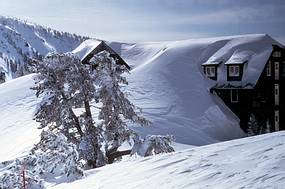
Crater Lake Lodge in deep snowThis year Crater Lake National Park in southern Oregon has received 615 inches of snow -- that's over 51 feet. The average is 533 in/yr, and the seasonal record is 879 inches (73.25 ft, or 22.3 m).

This is Priceless

Seth Meyers laid into everyone at last night's White House Correspondence Dinner, but nothing is better than watching Donald Trump sit there seething when the jokes come around to him. It starts about the 11:50 mark.


Meyers: "Donald Trump says he would run for President as a Republican, which is surprising as I just assumed he was running as a joke."

Almost everyone else managed to laugh when they were being made fun of, except Trump? Is there a more classless person?

Thursday, April 28, 2011

Tornado Hypocrites

Of course, some climate activist somewhere was going to link the horrendous tornadoes in the American south with anthropogenic climate change.

I just never thought it would be someone respectable, like Peter Gleick.

Let's review what the IPCC has to say about tornadoes (IPCC 4AR WG1 Ch3 FAQ3.3 p308):
Observational evidence for changes in small-scale severe weather phenomena (such as tornadoes, hail and thunderstorms) is mostly local and too scattered to draw general conclusions; increases in many areas arise because of increased public awareness and improved efforts to collect reports of these phenomena.

They clarify this, a little, in section 3.8.4.2, again stressing that the question of tornadoes depends on local measurements, which are too variable to use for any global conclusions. But basically they punt on the issue. Fair enough.

Gleick makes a cursory effort about sticking to the science:
More extreme and violent climate is a direct consequence of human-caused climate change (whether or not we can determine if these particular tornado outbreaks were caused or worsened by climate change).

but then he just can't help himself:

The extreme nature of the ongoing severe weather is well described by Jeff Masters on his Weather Blog. The 3-day total of preliminary tornado reports from this week's outbreak is nearing 300, close to the 323 preliminary tornado reports logged during the massive April 14 - 16 tornado outbreak. That outbreak has 155 confirmed tornadoes so far, making it the largest April tornado outbreak on record.

You don't have to look very far to disprove this -- in fact, you don't even have to look farther than the Drudge Report, which today links to this story:

TuscaloosaNews.com
5 P.M. UPDATE: Hundreds treated at DCH
"The loss of life is the greatest from an outbreak of U.S. tornadoes since April 1974, when 329 people were killed by a storm that swept across 13 Southern and Midwestern states."

When are activists going to learn that they will never make their case by falsifying the science, and that, in fact, they only harm their cause when they do so? You cannot draw conclusions about climate based on weather. You can only do it via long-term (decadal or more) statistics.

Please tattoo this on your foreheads, so you don't ruin this for those of us trying to communicate actual, real science, with all its inconvenient unknowns and uncertainties.

More on Conspiracy Theories

Joel Achenbach of the Washington Post on conspiracy theories:
...it is the nature of a conspiracy theory that all information must pass through a very discerning, yet simple, filter. Information that is confirmational is accepted; that which is contradictory is rejected.

Conspiracy theories have the self-sustaining gift of ramification: They sprout new tendrils, like a mad vine that has invaded from another continent. For the committed conspiracy theorist, there is always another angle to explore, another anomaly to scrutinize.

[emphasis mine] And:
These theories do not always find a purchase on one distinct portion of the ideological spectrum. What they have in common is the emotional investment of the believers: The theory becomes not merely a hunch or a notion, but rather a core belief that is part of the believer’s identity. The person isn’t going to abandon the faith simply because a piece of paper surfaces that would seem — to others who are not so invested in the theory — to refute the central notion.

“It’s easier psychologically to come up with a rationalization than it is to admit that you were wrong,” said Ronald Lindsay, president of the Committee for Skeptical Inquiry, in Amherst, N.Y., publisher of the myth-debunking magazine The Skeptical Inquirer.

“If you have a pre-commitment to a certain point of view, and that point of view is important for your identity — if you are emotionally attached to it — your emotion is going to shape your reasoning process. You’ll be presented with facts, but you’ll find some way to minimize the significance of those fact,” Lindsay said.

Wednesday, April 27, 2011

On Conspiracy Theories

"Arguments, speculation—-conspiracy theories of all kind. The usual thing, right? No one is ever simply assassinated anymore. Ever since your Kennedys, it is always a matter of how many stories you can invent to explain the same body of facts. This is the great pleasure of conspiracy theory—not explanation, but narrative. It is like Scheherazade."

-- Kim Stanley Robinson, Green Mars