Thursday, September 15, 2011

How Michele Bachmann Gives Me Hope

Michele Bachmann is getting a lot of heat for her comment after Monday night's debate about the woman who told her her daughter became mentally retarded after getting the HPV vaccine. Here's only one editorial I've seen on this:

http://www.oregonlive.com/opinion/index.ssf/2011/09/michele_bachmanns_dangerous_in.html

Wouldn't it be great if a presidential candidate finally sank after making a scientifically false or dubious statement? Wouldn't it resurrect your faith in the electorate, in the media, and even in America for at least one brief moment? Might candidates also start getting slammed for their junky views on evolution and their inanities on climate science, and begin to actually read the Executive Summaries of all those reports being produced?

Could this be the turning point we're waiting for, when the fever of irrationalism broke and half the country didn't dismiss science and critical thinking as elitist?

Probably not. But it's a glimmer of hope. And who doesn't need that now?

Arctic Sea Ice in 2nd Place, However...

Arctic Sea Ice appears to have reached it minimum extent for the year, at 4.53 Mkm2 (IJIS data; NSIDC gives 4.33 Mkm2).

That's the second lowest in the records, after 2007's 4.25 Mkm2 (IJIS).

However, I think a more relevant metric (after volume, of course) is the extent's yearly average. By that measure, 2011 is the lowest, at 10.65 Mkm2 (as of Sept 14th), lower than 2007's 10.70 Mkm2 as of the same date that year.

Last year at this time the year-to-date average was 10.91 Mkm2. We'll see how the year ends. The 2007-2011 difference peaked at 0.062 Mkm2 on August 24th, and lately 2007 has been gaining ground to where the difference is now 0.043 Mkm2.

In terms of volume it's not even close: the latest PIOMAS data, which gives modeled ice volume up until 8/31/11, has that date's sea ice volume as 36% below 2007. (4.28 Kkm3 to 6.65 Kkm3.) That's astonishing. Over 1/3rd of the sea ice have melted in just 4 years.

Ray Bradley's New Book

I just finished reading Ray Bradley’s new book Global Warming and Political Intimidation: How Politicians Cracked Down on Scientists as the Earth Heated Up. It’s really good – I recommend it. I’m left with the impression that he’s pretty fed up and can’t, or won’t, or doesn’t need to, hold in his frustration anymore. He’s direct and honest, but still polite (he’s British, after all).

He goes through the Hockey Stick War, the case for anthropogenic global warming, and his thoughts on the intimidation of scientists coming from politicians, certain media, and numerous bloggers. Bradley is particularly direct about his thoughts on Joe Barton and James Inhofe, and his book is, notably, dedicated to Republican representative Sherwood Boehlert.

Some of the highlights:

  • He essentially calls John Christy a flat earther: “John is one of a handful of scientists who have become known as ‘climate skeptics’ or ‘contrarians,’ who are often invited to hearing such as this one to provide some sort of ‘balance.’ I wonder if, when the Space Science Committee meets to discuss the latest shuttle mission, they also invite someone from the Flat Earth Society to ensure they are getting both sides of the story.”
  • He introduces the term “lapdog bloggers.” I like it.
  • Regarding attaining an atmospheric level of 350 ppm CO2, Bradley notes that “If we continue to increase CO2 levels to, say, 450 parts per million (a virtual certainty, given that by the beginning of this century we were at 390 ppm) and then suddenly decided to stop all fossil fuel consumption—instantly, overnight—carbon dioxide levels would gradually decline, but they would not drop below about 350 ppm for the next one thousand years! (Emphasis his.) I wonder if the people at 350.org are aware of this.
  • He follows this with a point you don’t see often enough: “To put this another way, we can’t just keep ‘testing the waters’—adding more and more carbon dioxide to the atmosphere until things ‘start to go wrong’ with the global climate, and only then put the brakes on. At that point, even completely eliminating fossil fuel use overnight will bring only a very, very slow decline in the atmospheric concentration, and will do little to rectify the immediate climate problem.”
  • I was unaware of this: American scientists who agreed to participate in writing the CCSP report (published in in 2008) were required to be fingerprinted. This report (Climate Change Science Program) was requested by the Bush Administration after they didn’t like the conclusions of the IPCC 3AR or the report by the National Research Council they also didn’t like, as a way to continue stalling action on the problem. (And it worked.) Bradley says that the fingerprinting (which is required of all US government employees) was a way to the scientists temporary government employees so the report would be considered a government document so that any editing or redactions by the Bush Administration would be hidden or justifiable.
  • He notes this from Marc Morano, said on a radio interview on April 22, 2010: “It is so nice to have the light of day and stench of corruption coming from people like Michael Mann and Rajendra Pachauri and Phil Jones and the upper echelon of UN scientists. We should be rejoicing that their entire careers are getting pissed on at the moment and justifiably so.” Later Morano said, “I seriously believe we should kick them while they’re down. They deserve to be publicly flogged.” I believe the day will come where Morano admits that he regrets that.
  • Bradley uses the term “scientific prostitutes” for those scientists who “perform” on the behalf of “energy companies and right-wing foundations” on topics like smoking, acid rain, and global warming.
  • In 2010 the South Dakota House of Representatives
    passed a resolution urging that public schools teach about the "astrology dynamics" that can "effect" [sic] world weather phenomena. Only in America. (An amended version, less comical but no less outrageous, later passed the SD Senate.)

Bradley's book is definitely not the kind you usually see from scientists. That makes it well worth reading.

About that Texas Drought

Here's a chart showing just how much of an outlier this summer has been in Texas:

Texas temperature and precipitation for summer, including 2011

On a press teleconference this morning John Nielsen-Gammon, the Texas state climatologist, said the drought's economic impact on Texas was estimated at $5.2 billion through mid-August, and that the fires have caused $1-2 billion in damages. (Their gross domestic product is $1300 billion/yr.)

La Nina were said to cause a 4 in 5 chance of below average precipitation in that region, so the drought there looks likely to continue. Why can't a moderator at the next Republican candidate's debate ask about these numbers in particular instead of simply asking another bland question about climate change that merely challenges Rick Perry to give another over-the-top, meaningless answer about how it's all a hoax?

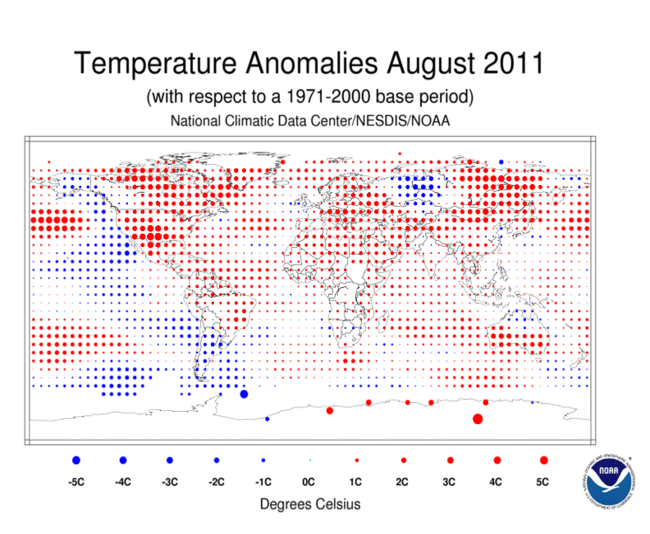
Here's the global anomaly map for August. Note how warm it was in Texas. (And it was below average in western Russia, site of last summer's horrific heat wave.)


Monday, September 12, 2011

The Most Amazing 9/11 Photograph I've Seen

The blog Iconic Photos, which is always thoughtfully good, has some amazing photographs from 9/11 that I've never seen before, including the one below. This is one of the most startling photographs I have ever seen, and even though it's difficult to look at I don't think it's in bad taste or should be hidden away, or even come with a warning.

I feel ten different things at once when I see this photograph, and after discovering it yesterday I feel them all over again now that I'm writing this. This is the reality of what happened. Before I saw this photograph I knew that, on some level.... I'm sitting here now trying to figure out what to write next, and I just don't know. I think that's why this photograph is necessary.


"The Hand, 9/11" by Todd Maisel

It is a shame our media almost always suppress these kinds of photographs, whether they're from 9/11 or the wars that America wages and that are suffered on all sides. (This particular picture was taken by Todd Maisel and appeared in the New York Daily News, and was thoroughly criticized.) Of course, the media is effectively forced to do this by public reaction and public expectations. Which it unfortunate, because I think photographs like this one have a lot to teach, and not just the obvious things, either. (Or even the things that occur to me.)

Tip of the Day

Never use vanilla flavored soy milk when a pasta alfredo recipe calls for "milk."

4th Warmest August

GISS puts August as the 4th warmest in their records, +0.61°C above their baseline:

http://data.giss.nasa.gov/gistemp/tabledata/GLB.Ts%2bdSST.txt

Year-to-date (i.e. Jan-August) this is the 8th warmest year in their records. (2010 had the warmest Jan-Aug.)

The other day NOAA said this summer was the 2nd warmest summer the US has ever seen. (The meteorological summer is defined as June-August.)

And also, that a new La Niña has started (which is bad news for the southwestern drought).

By the way, here is why you need to look at 30-yr trends (or so) to detect climate signals: El Niños and La Niñas can cause swings of several tenths of a degree. Since we're warming now at about 0.2°C/decade, an ENSO fluctuation of, say, 0.4 degrees would temporarily swamp, or exaggerate, about two decades of climactic warming.

Sunday, September 11, 2011

"War: The Fiscal Stimulus of Last Resort"

Ellen Brown at Nation of Change:
Protesters have been trying to stop the military juggernaut ever since the end of World War II, yet the war machine is more powerful and influential than ever. Why? The veiled powers pulling the strings no doubt have their own dark agenda, but why has our much-trumpeted system of political democracy not been able to stop them?

The answer may involve our individualistic, laissez-faire brand of capitalism, which forbids the government to compete with private business except in cases of “national emergency.” The problem is that private business needs the government to get money into people’s pockets and stimulate demand. The process has to start somewhere, and government has the tools to do it. But in our culture, any hint of “socialism” is anathema. The result has been a state of “national emergency” has had to be declared virtually all of the time, just to get the government’s money into the economy.
If Rick Perry really believes that Keynesian is dead and government spending doesn't provide a stimulus, I wonder how he would feel about the US cutting defense spending by pulling all its military bases, personnel, and defense contracts out of Texas.

Ebert Quote

"I know the Supreme Court has ruled that corporations are individuals, but when did one ever tell you a good joke?"

-- Roger Ebert, review of The Company Men

If Galileo Could Speak For Himself


Saturday, September 10, 2011

Lancet 9/11 Cover

Here is the cover for The Lancet's special issue on 9/11:


Pretty good. Personally, it reminds me of this. And this.

What the Ozone Nonregulations Won't Prevent

I know I'm beating a dead horse (or, at least, a horse Barack Obama won't feed until he gets himself reelected, and one whose entire herd the Rs and Ts want sent to the glue factory), but here are a few more relevant items about the stricter ozone regulations the President won't enact.

The federal regulations would have only established a goal for state air pollution programs, and so wouldn't have cost anything now. From a letter to the NY Times from an instructor in environmental law at Syracuse:
"...The withdrawn standard, however, would establish a goal for state air pollution programs and therefore produces no immediate costs at all.

"Companies will incur costs only many years from now after states translate these goals into specific requirements for polluters. And if history is any guide, those costs will have a vanishingly small effect on employment, and some of that effect may be positive.

"Environmental regulations account for less than one-tenth of 1 percent of mass layoffs. An administration seriously concerned about unemployment, rather than appeasing polluters and their allies, would focus its attention elsewhere.

"The recession does not justify sacrificing thousands of lives by suspending a crucial health-protective standard being carried out many years hence.

DAVID M. DRIESEN
Syracuse, Sept. 5, 2011

The writer teaches environmental law at Syracuse University."
From Democracy Now: the new standards were projected to prevent 2,200 heart attacks and 23,000 asthma attacks every year. (To be fair, though, such people probably don't give a lot in political contributions.)

More numbers politicians don't care can be found here.

We Need More of This

The former Speaker of the Massachusetts House gets 8 years in prison for steering a software contract to Cognos in exchange for a kickback of $65,000. A State House lobbyist gets 7 years. The company salesman will get less in exchange for his cooperation.

http://www.boston.com/news/local/massachusetts/articles/2011/09/10/former_house_speaker_salvatore_dimasi_sentenced_to_8_years

He is the third consecutive Mass House Speaker to be convicted of a crime.

Friday, September 09, 2011

EQ Felt in Seattle

The Seattle Times says the earthquake happened 173 miles west of Vancouver, at a depth of 16 miles, and was felt as far south as Seattle. They haven't reported any damage.

The quake happened at 12:41:35 pm PDT, so it took just over one minute to travel to where I am, even if I didn't notice anything.

No tsunami warning, either.

Local Seismograph Reading

Here's a seismograph reading from a PNSN station (B023) in Clatskanie, Oregon, about 25 miles to the northwest of me; it shows the earthquake's waves arrived here at 19:42:40 pm UTC (12:42:40 pm PDT):

Vancouver Quake's Location

City map

Magnitude 6.7 - VANCOUVER ISLAND, CANADA REGION

There was a M 6.7 earthquake in Vancouver BC about a half-hour ago:

http://earthquake.usgs.gov/earthquakes/recenteqsww/Quakes/usc0005rsj.php

That's fairly big.... I didn't feel anything here.

Thursday, September 08, 2011

4th Circuit Appeals Court Rejects Virginia, Liberty University Challenges To Health Law - Kaiser Health News

Today a court rejected the case brought by Ken "Show me your emails" Cuccinelli et al on the individual health insurance mandate, ruling that they had no "a personal stake."

http://www.kaiserhealthnews.org/Daily-Reports/2011/September/08/4th-circuit-health-law-decision.aspx

Perhaps Cuccinelli should refuse his government-bought health care and try again.

Wednesday, September 07, 2011

Smog Levels to Remain Higher than Scientists Suggest Safe for Public Health

David Biello at Scientific American has a nice writeup on the recent Obama decision not to lower ozone levels:

http://blogs.scientificamerican.com/observations/2011/09/02/smog-levels-to-remain-higher-than-scientists-suggest-safe-for-public-health/

Had the new regulations been enacted, the bottom line would have been:

COST:
$90 B/yr

SAVINGS:
$100 B/yr in health costs
1500 lives/yr
probably tens of millions of dollars/yr in crop damages

Instead Obama clearly capitulated for the sake of getting reelected. It was probably a good decision from a purely political point of view, but it probably won't help  It certainly won't help the people breathing in all this crap.


No, a new study does not show cosmic-rays are connected to global warming

Phil Plait ("Bad Astronomy") has a nice writeup on how the CERN CLOUD experiment does not provide proof that the Sun is responsible for global warming:

http://blogs.discovermagazine.com/badastronomy/2011/08/31/no-a-new-study-does-not-show-cosmic-rays-are-connected-to-global-warming/

Note especially his excerpt from the paper's abstract.

By the way, I recently watched his three part TV series "Bad Universe" and thought it was really good. I hope they let him make more.

A Very Fast Fire

Michael also has this amazing video of an advancing fire in central Texas. It looks to be moving forward at roughly a meter every two seconds (if not more, at least during this particular minute), which is over one mile-per-hour. Walking speed is 3 mph, so you would want to be running to get out of the way of this thing.

Striking Fire Picture from Texas

A striking picture from the Texas firefront, from Michael Tobis (who has lots of good, local information about what's going on there):

The Essence of Dessler's Rebuttal

I've been trying to understand Andrew Dessler's new GRL paper that rebuts the infamous Spencer & Braswell (SB) paper [and also Lindzen & Choi (LC)]. It seems to me that the essential argument made by Dessler is this: SB made an assumption that clouds have an important relative role in the climate system, and then found that...clouds have an important relative role in the climate system.

They also made two other big mistakes.
  1. SB & LC both used a simplified description of the climate system that likely violates conservation of energy. It involves how they treat the ocean, but it's as if if one assumed that the Sun not only heats the Earth, but also that the Earth significantly heats the Sun. 
  2. Later in their analysis they make a different assumption: that the ocean exchanges no heat.
  3. The most important issue, though, involves the relative role of clouds. SB simply assume a value for the importance of clouds relative to the ocean: that they have 2.3 times the forcing. (LC assumes this number is 0.5.) Dessler calculates the value from actual data and finds the value is 0.05. 
SB's assumed value for the relative importance of clouds is 50 times that Dessler finds from the data.

By the way, these are very, very simple climate models SB and LC are using. It's essentially just air on top of water, warmed by the Sun. All the things we hear about: carbon dioxide, other GHGs, land use changes, are shoved in one term with a given climate sensitivity. All the "radiative forcings," like changes in clouds, are shoved into another term, and all the other "nonradiative forcings," like heat exchange between the air and oceans, are shoved into another term. The air changes temperature just liked you learned in 8th grade science: according to its specific heat value. That's it.

Dessler uses the same model only by way of comparison and rebuttal.

This is, of course, a simplification of their scientific arguments, but I think it boils down to these items (and essentially to #3). I haven't interviewed anyone or confirmed the above, I'm just a journalist so I could well be wrong. In any case, people will no doubt fight over them for a good while longer.

Tuesday, September 06, 2011

Dessler's Video

If you're trying to keep up with the fireworks-- and who isn't?-- this video by Andrew Dessler is probably the best explanation of the basic difference between the camps. A copy of his new Geophysical Research Letters article is here, and the press release is here.


Notice the difference in tones between the two press releases...matter-of-fact versus sensationalistic.

Monday, September 05, 2011

One Good Movie and One Good Book

The Movie:

Monsters (2010) is a bit derivative of Cloverfield, but if it had come first (and been made by JJ Abrams) it would have received just as much attention. (And without making you nauseous.) It's about two people who are trying to get back into the U.S. through the "infected zone" inhabited by extraterrestials brought to Earth from a moon in our solar system when a space probe crashed. That sounds like it could be a bit silly, but the movie is anything but. It's filmed in that verisimilitude style that started with The Blair Witch Project, and it feels extremely real. The settings and the acting and the special effects are fabulous -- the latter were all done by the director on a laptop in his bedroom, and the entire movie was made for only $500,000. I don't want to say much more than that, because it's the kind of movie that is more special the less you know going in. If you like contemporary Sci-Fi like Cloverfield and District 9, you'll surely like Monsters -- rent it. Here's the trailer

The Book:

The President and the Assassin: McKinley, Terror, and Empire at the Dawn of the American Century by Scott Miller. The story of the 1901 assassination of President McKinley, the man who shot him (your stereotypical loner who couldn't fit in), and the subculture of anarchism and terror that was in the air at the time (and the exploitation of workers that gave it traction). The author weaves it all together very well; he discussed his book on the July 21st Daily Show. History the way it should be written. Here's a video clip from a History Channel program of a few years ago on the same topic.

Sunday, September 04, 2011

A Downright Moron for President?

H.L. Mencken in the Baltimore Evening Sun in 1920:
“As democracy is perfected, the office represents, more and more closely, the inner soul of the people....On some great and glorious day the plain folks of the land will reach their heart’s desire at last, and the White House will be adorned by a downright moron.”
(From a letter in the NY Times.) Perhaps next year?

Friday, September 02, 2011

The Heartland Institute's Epic Fail

So, this past Monday the Heartland Institute released a "report" called Climate Change Reconsidered: 2011 Interim Report. It was authored by Craig Idso, Robert Carter, and Fred Singer, and typed up to look like a real IPCC report. It was as big a ball of crap that you would expect, and.... it dropped like a stone.

A Google News search for the report's title finds five results, none of them the least bit significant.  

A Google News search for "NIPCC" finds four results, none of them even in English.

No one cares. Everyone knows their game. Maybe even Fred Singer has lied one too many times.

I'd write and call the Institute and authors, and ask what they were paid and where the money came from, but the report is so...inconsequential that it's not even worth it anymore. Clearly, no one cares.

Maybe the world really is learning about all this.

The End of Day One of Today's Battle

There has been full-out war in the comments at Roy Spencer's blog, with Spencer responding to many of them. Just read it.

David Deming, a contrarian from the University of Oklahoma, says there was "political pressure" for Werner Wagner (the editor) to resign. But he offers no evidence at all. Spencer himself writes
"The 'gatekeeping' activities of IPCC scientists is indisputable, and has been reported on repeatedly (e.g. here)."
As far as I can tell, that link is just more of the usual misinterpretations of the "Climategate" emails. When asked what evidence there is of IPCC involvement in Wagner's resignation, Spencer says he has nothing specific:
"Only their history of interference in the peer review process. And why would the editor not even bother to ask for my side?"
To me it's obvious why the editor didn't ask for Spencer's side: he saw all he needed to know from Spencer's blog posts, and he said as much in his resignation letter (third paragraph).

I don't see any evidence that any "IPCC scientist" (for want of a better term) put "political" pressure on the editor (doe anyone know of any?), but I suspect they did let him know their thoughts on the paper he published. Is that wrong? I don't think so. Is it normal? I don't really know. Sure, it'd be nice if everyone made their comments in the peer reviewed literature, via rebuttal papers and letters, and maybe in four years there'd be a resolution to the issue that no one would notice.

But, for better or worse, we don't live in that era anymore.

Moreover, today's climate science isn't a normal scientific situation. I'm sure the "IPCC scientists" are absolutely sick of being insulted, of having their integrity questioned, of receiving abusive emails, of being said their life-long work is all a "hoax" and a fraud and worse. You would be too. They're no doubt fed up with being hauled before Congressional committees (as Barton did to MBH), of having their emails stolen, of being the target of certain Attorney Generals, of being bullied by $240,000/yr Marc Morano, and of having their personal emails requested through legal channels. I would be too, and so would you.

So they're fighting back. Spencer can't complain now, when he's one of the most political scientists out there. And he is. He is on the Board of Directors of the George C Marshall Institute. If he dislikes being called "political" he can start by resigning from that position.

After today, though, I can't see how Spencer escapes from being irrelevant.

PS: Do you think the BBC took a cheap shot when their captioned of their picture of Spencer by writing he was a "committed Christian"? At first glance I thought so, but upon reflection I changed my mind. He is. Is that relevant? Is it relevant if someone believes in something for which there is no evidence?

Some Reactions

As of 2:49 pm EDT, Climate Depot doesn't have a word about the resignation. Perhaps he is huddling with his buddies trying to figure out how they can spin all this?

Tom Nelson: silent

Watts: Silent except to repeat Spencer's post.

Best comment at Watts so far:

Alan Clark of Dirty Oil-berta says:September 2, 2011 at 10:00 am7. Trenberth, K.E., Fasullo, J.T., O’Dell, C., Wong, T. Relationships between tropical sea surface temperature and top-of-atmosphere radiation. Geophys. Res. Lett. 2010, 37, L03702.
Nuff said.


A Devastating Comment on Spencer

In a news story at The Guardian, John Abraham (the man who demolished Christopher Monckton) is quoted:
"Spencer and his colleagues have a long history of minimising the effects of human-caused climate change; they also have a long history of making serious technical errors. This latest paper is only one in a decade-long track record of errors that have forced Spencer to revise his work as the errors are brought to light. Spencer is well known in the scientific community for publishing high-profile papers that initially dispute global warming and only later are found to be faulty.
Devastating.

3rd Warmest August

Amidst all this, UAH releases their calculation of August temperature anomaly: +0.325°C, which sounds low but is the 3rd warmest August in their 32+ years of record keeping. (Recall that last September they moved their baseline from 1979-1998 to 1981-2010.)

Their overall slope remains 0.13 ± 0.01 °C/decade (r2 = 0.32).

Slope of last 10 years = -0.01 ± 0.05 °C/decade (r2 = 0.001).

Slope of last 15 years = 0.08 ± 0.03 °C/decade (r2 = 0.03).

Slope of last 20 years = 0.20 ± 0.02 °C/decade (r2 = 0.28).

Editor's Most Important Words

This, also from Wagner's resignation letter, may be his most important words of them all:
With this step I would also like to personally protest against how the authors and like-minded climate sceptics have much exaggerated the paper’s conclusions in public statements, e.g., in a press release of The University of Alabama in Huntsville from 27 July 2011 [2], the main author’s personal homepage [3], the story “New NASA data blow gaping hole in global warming alarmism” published by Forbes [4], and the story “Does NASA data show global warming lost in space?” published by Fox News [5], to name just a few. Unfortunately, their campaign apparently was very successful as witnessed by the over 56,000 downloads of the full paper within only one month after its publication. But trying to refute all scientific insights into the global warming phenomenon just based on the comparison of one particular observational satellite data set with model predictions is strictly impossible. Aside from ignoring all the other observational data sets (such as the rapidly shrinking sea ice extent and changes in the flora and fauna) and contrasting theoretical studies, such a simple conclusion simply cannot be drawn considering the complexity of the involved models and satellite measurements.
Wagner linked only to Roy Spencer's home page, but I suspect he had in mind these specific posts. Really, is there a more consistently political scientist than Roy Spencer?

More on Editor's Resignation

Dr. Wolfgang Wagner
Here is more (and more relevant) detail behind Wagner's reasons for resigning:
So why, after a more careful study of the pro and contra arguments, have I changed my initial view? The problem is that comparable studies published by other authors have already been refuted in open discussions and to some extend also in the literature (Trenberth et al. 2010), a fact which was ignored by Spencer and Braswell in their paper and, unfortunately, not picked up by the reviewers. In other words, the problem I see with the paper by Spencer and Braswell is not that it declared a minority view (which was later unfortunately much exaggerated by the public media) but that it essentially ignored the scientific arguments of its opponents. This latter point was missed in the review process, explaining why I perceive this paper to be fundamentally flawed and therefore wrongly accepted by the journal. This regrettably brought me to the decision to resign as Editor-in-Chief―to make clear that the journal Remote Sensing takes the review process very seriously.”
(Emphasis mine)

Here is a Wagner's biography; clearly he is a quite accomplished scientist in the field of remote sensing.

Breaking: Editor Resigns Over Roy Spencer Paper's Controversy

Shades of the Climate Research kerfuffle: the editor at the journal Remote Sensing has resigned over the controversy of his publication of Roy Spencer's recent paper "On the Misdiagnosis of Surface Temperature Feedbacks from Variations in Earth’s Radiant Energy Balance.”

In his resignation letter, Wolfgang Wagner writes:
In other words, the problem I see with the paper by Spencer and Braswell is not that it declared a minority view (which was later unfortunately much exaggerated by the public media) but that it essentially ignored the scientific arguments of its opponents. This latter point was missed in the review process, explaining why I perceive this paper to be fundamentally flawed and therefore wrongly accepted by the journal. This regrettably brought me to the decision to resign as Editor-in-Chief―to make clear that the journal Remote Sensing takes the review process very seriously.
Spencer says he stands behind his paper and calls this a defeat for "scientific progress."

Week's Best Someecard

Funny Somewhat Topical Ecard: Dick Cheney's memoir is a great reminder of when we believed Republicans couldn't get more terrifying than Dick Cheney.

Why No Bathrooms in Star Trek?

The opening of Star Trek promises that man "will boldly go where no man has gone before," but why does no one ever use a bathroom in any of the series? I've seen them all, and I've never seen anyone go to the bathroom, or say they had to take a break, or talked to a colleague while they combed their hair in the restroom mirror. They still must have bladders in the 24th century, right? Especially since genetic modification was considered a terrible idea that was tried and then rejected? Even all the other species must take a pee sometime, especially the Klingons, with all that drinking. But I don't remember anyone even mentioning it, even as humor, like the kind of humor they often used on Enterprise. I recall Troi or Riker splashing water on their face from one of those retracting sinks, and one episode opening with Captain Archer in the shower as the artificial gravity cut out, but no one ever does any business. Would that have ruined the certain sense of utopia that Gene Roddenberry tried to convey? Would it have required unsightly zippers in those one-piece uniforms? How do you pee in one of those, anyway? Especially 7 of 9.

And if Vulcans have green blood, what color is their pee?

Thursday, September 01, 2011

God Denies....

This is great; from Is Outrage:


God Denies Hurricane Is Punishment for Anything

Hurricane IreneCHARLESTON, SC – In a widely-broadcast announcement earlier today, celestial spokespostle and gatekeeper Simon (“Saint”) Peter, speaking on behalf of well-known deity God, stated flatly that Hurricane Irene is not divine punishment for anything. “Sometimes a hurricane is just a hurricane,” the protoPope declared. “Nor will I answer any questions about how an all-powerful, all-loving God can allow things like hurricanes to exist. You guys have to work that out for yourselves.

Oh, and the Creator and Sustainer of All has asked me to specifically tell Pat Robertson, ‘Knock it off.’”
The article continues here.

Isn't it interesting how Michelle Bachmann sees earthquakes and hurricanes as signs from God (or at least jokes about them), but not warming from CO2?

Or that she doesn't see, say, the Everglades as a sign of God's beneficence, but as a potential place to tear up for more fossil fuels? (Even Florida's Republican representatives had something to say about that one.)

"I Just Write the Songs"

"You can get the song for free with technology -- I don't know. I don't understand. That's for someone else to figure out. I just write the songs."

-- Billy Corgan, Smashing Pumpkins, about their freely downloadable new version of "Drown"

Wednesday, August 31, 2011

The Emissions Trading Mess

Here's an interesting and informative video on the big mess of emissions trading. It's particular to New Zealand, but much of it applies anywhere. It's via Roger Pielke Jr -- read the comments under his post, as it seems some of the economics in the video aren't really correct. In general, though, it shows what a clusterfuck the emissions trading scheme can be, which is simply a reflection of the basic problem there is just no getting around: reducing atmospheric GHGs is going to cost a lot of money, and not reducing them is going to someday cost a lot of money. You can come up with any scheme you want -- it's going to cost a lot of money. The only solution is development of a cheaper noncarbon energy source than fossil fuels. Period.


Coming Clean - New Zealand's Emissions Trading Scheme Explained from Lindsay Horner on Vimeo.


By the way, isn't this beautifully filmed?

Roy Spencer Smarter than Feynman?

At drroyspencer.com:
maxwell says:
August 22, 2011 at 8:17 PM
You know, Feynman had a pretty great quote…well he had many great quotes, but one of my favorites is,

‘I believe that a scientist looking at nonscientific problems is just as dumb as the next guy.’

I know you’re trying to sell some books and move up the list of ‘conservatives liberals love to hate’, but please stick to the science.
Roy W. Spencer, Ph. D. says:
August 23, 2011 at 5:05 AM
I agree *most* scientists are even more clueless about economics than your average joe. I’m not one of them.

Video of Vermont Destruction

A good video overview of the destruction in Vermont from Irene:

http://www.wcax.com/global/video.asp?autoStart=true&topVideoCatNo=default&clipId=6205991&flvUri=&partnerclipid=

(I can't get the video to embed.)

The Scariest Thing Rick Perry Has Said

Of all the crazy things Rick Perry has said or written that are now being revealed, this seems to me by far the scariest:
“Sometimes the rules must protect society at large at the expense of individual expression when that expression is deemed harmful to others and society at large.”

-- Rick Perry, Fed Up! (2010)
I doubt Perry means simply outlawing people from yelling Fire! in a crowded theater. And this from someone who claims to cherish liberty and freedom. But clearly he wants a country that will only tolerate freedom if it's an expression of freedom that he agrees with. Absolutely chilling.

As Dana Milbank writes, Perry is a theocrat. He's dressed up as a populist, but that's just to get elected. I hope voters keep in mind that history shows that it's during times of crisis that the worst people have found a way to power -- but I doubt that they will.

Dana Milbank and Ruth Marcus have more, as does Steven Levingston.

Tuesday, August 30, 2011

What I Don't Understand About Economics

Here is something I don't understand about economics, and maybe one of my smart commenters can educate me.

Jeff Jacoby has a column disputing that disaster relief and rebuilding has any stimulus for the economy. He notes Bastiat's parable of the broken window. As Jacoby tell it:
A boy breaks a shopkeeper’s window, and everyone who sees it deplores the pointless destruction. Then someone insists that the damage is actually for the good: The six francs it will cost the shopkeeper to replace his window will benefit the glazier, who will then have more money to spend on something else. Those six francs will circulate, and the economy will grow.

The fatal flaw in that thinking, Bastiat wrote, is that it concentrates only on “what is seen’’ - the glazier being paid to make a new window. What it ignores is “what is not seen’’ - that the shopkeeper, forced to spend six francs on that, has lost the opportunity to spend them on better shoes, a new book, or some other addition to his standard of living.
I'm with this so far. But then Jacoby concludes:
The glazier may be better off, but the shopkeeper isn’t - and neither is society as a whole.
Here's where I am puzzled -- why isn't society as a whole better-off? Or, at least, equally as well-off? It's true the shopkeeper isn't better-off and the glazier is. Why is this a bad thing, from a macroeconomic point of view?

My only guess is that shopkeeper is forced to spend money he might have used 'more wisely' (my quotes) -- to expand his business, or buy his wife some earrings, or buy stock in a business so they can built a new product. But then, the glazier is still worse-off and doesn't get to spend that money. If the shopkeeper buys stock the jeweler doesn't sell the earrings and he doesn't pay the earring maker, who then doesn't buy her kid a new pair of shoes. So what's the difference?

This is essentially the same question (isn't it?) of whether it's better for government to tax and then spend money, or not tax and let the citizens spend it himself. Which is better, macroeconomically? And why? Do citizens really make better economic decisions than does the government? If so, in what way?

Sunday, August 28, 2011

Hadley: 9th Warmest July

Hadley says: July 2011 was the 9th warmest in their record of Julys, at +0.444 C.

http://www.cru.uea.ac.uk/cru/data/temperature/hadcrut3vgl.txt


PS: 3 significant figures? Really??

PPS: Year-to-date (viz. Jan-July), 2011 is their 11th warmest year.

PPPS: Slope of Hadley temperature anomaly for last 10 yrs (viz. 120 months) is  -0.05 +/- 0.03 C/decade, though R^2 = only 0.03. But for the last 15 yrs it is +0.06 +/- 0.02 C/decade (R^2 = 0.05). So Joe Bastardi is wrong when he says temperatures have been "flat" for the last 15 years.


Hurricanes Irene and Before

Now that Hurricane Irene has hit New York city as only a tropical storm (not to minimize the great damage such a storm can do -- it landed in North Carolina and then New Jersey as a legitimate (Cat 1) hurricane), I wonder if Bill McKibben will rethink his recent column that blamed global warming for Hurricane Irene. Remember, it's hardly unprecedented for a major hurricane to hit that area -- this is from Wikipedia:

  • "The Great September Gale of 1815 (the term hurricane was not yet common in the American vernacular), which hit New York City directly as a Category 3 hurricane, caused extensive damage and created an inlet that separated the Long Island resort towns of the Rockaways and Long Beach into two separate barrier islands.
  • "The 1821 Norfolk and Long Island Hurricane, a Category 4 storm which made four separate landfalls in Virginia, New Jersey, New York and southern New England. The storm created the highest recorded storm surge in Manhattan of nearly 13 feet and severely impacted the farming regions of Long Island and southern New England.
  • "The 1869 Saxby Gale affected areas in Northern New England, decimating the Maine coastline and the Canadian Outer Banks. It was the last major hurricane to affect New England until the 1938 storm.
  • "The 1893 New York hurricane, a Category 2 storm, directly hit the city itself, causing a great storm surge that pummeled the coastline, completely removing the Long Island resort town of Hog Island."
  • The Great Hurricane of 1938, which made landfall as a Category 3 hurricane and killed upwards of 800 people with $41 billion (2011 dollars) in damage.
Again, I'm not minimizing this hurricane, which as I write this has killed 22 people (16 in the U.S.) with $7 B in damage. But, storms happen.

PS: Thanks to commenter Steve Bloom for mentioning Kerry Emanuel's Power Dissipation Index as an alternative to Accumulated Cyclone Energy. (Also see Steve's comment here.) PDI essentially adds up the cube of a storm's velocity, while ACE adds up the square. Emanuel has a reason for this (details here), which I'm still trying to understand. It's not intuitively obvious to me that that's a better measure; it does, though, track sea surface temperatures:


This graph is from Emanuel's 2007 paper in Journal of Climate.

von Neumann Quote

From the blog of Ben Horowitz:

There's no sense in being precise when you don't even know what you're talking about. - John Von Neumann


Surprisingly, More Renewables than Nuclear

Who would have guessed: worldwide, there is now more installed energy capacity for renewable sources than for nuclear, according to a new Pew/Bloomberg survey. (And yes, "installed capacity" doesn't mean "energy production.")

There was $243 B invested in clean energy last year, up 33%. Dismally, the U.S. accounted for only 14% of that -- Europe, 39%. Germany now has more renewable energy installed than the U.S, with 1/4th our population.

China got $54 B of last year's investment, or 22%. Or, $20 billion more than the U.S.

China now produces half the world's wind and solar equipment. We install oil pipelines atop one of the best aquifers in the world from environmentally ravaging tar sands.

Other surprising facts:
  • prices of solar panels have dropped 60% in the last 30 months.
  • by the end of this year solar modules are expected to cost half what they did 4 years ago.
  • Last autumn, Germany's environment ministry reported that renewable-energy jobs had doubled since 2004, to 340,000. Remember that next time a right-winger complains that there are no green jobs.

Alberta Tar Sands
Alberta Tar Sands

Saturday, August 27, 2011

Rick Perry's Flu Shot

"The second tack is to run against the lunacy of the opposition. In the same week that scientists announced the discovery of fossils 3.4 billion years old, evidence of explosive growth of early life through evolution, Rick Perry showed he will take his science from the Bible. He called evolution “a theory that’s out there.” If he thinks it is just a theory, he should get last year’s flu shot.

-- Timothy Egan, NY Times, August 26, 2011

Friday, August 26, 2011

Charging Your Car in (one of) Portland's Hip Neighborhoods

You can now charge your electric car at a charging station in one of the hipper neighborhoods in Portland (Hawthorne Blvd SE):

http://www.oregonlive.com/portland/index.ssf/2011/08/on_southeast_hawthorne_you_can.html

It may be free -- a commenter to this Oregonian article says that all the charging stations he's seen so far in Oregon are free, as a way for businesses to entice customers:
"...so far all the electric vehicle charging stations I've come across in Oregon have been free to use. Most commercial business will see these as a way to "drive" in some business, kinda like wifi at coffee shops, because of the low cost of electricity (maximum of about $0.23 per hour of charging for the Nissan LEAF).

Personally, I see networks of charging stations coming online charging around $0.50 to $0.75 per hour of charging, with DC Quick Charging (full charge in about 30 minutes) costing about $1.00 to $1.50 per half-hour, but so far nobody has announced any plans."
Someday, probably sooner than we would ever guess, this won't be newsworthy at all....