A brilliant use of the Web -- Google's Person Finder:
http://google.org/personfinder/global/home.html
This ought to catch on like wildfire....
Monday, April 15, 2013

Sunday, April 14, 2013
The Seinfeld Dilemma: Should China Frack to Contain Climate Change?
In the New York Times, Elizabeth Mueller of BEST calls on China to exploit its shale gas by fracking it out:

The leveling off in the first half of last decade may have been due to changes in Russian production of natural gas due to the collapse of the Soviet Union. Here's a paper in ACPD that discusses the increase more thoroughly, which speculates that part of the recent increase was due to natural wetland emissions. Russian natural gas production hasn't increased overall in almost a decade, while US emissions have:

So should China (or the US, for that matter) frack to contain climate change? It would mean less CO2 emissions, which can be in the atmosphere and oceans for centuries (if not longer -- much longer), while increasing a shorter-lived but more potent greenhouse gas, methane. It's kind of like that Seinfeld skit where he's in a drug store trying to decide between two bottles of cold medicine:
Instead of fighting hydraulic fracturing, environmental activists should recognize that the technique is vital to the broader effort to contain climate change and should be pushing for stronger standards and controls over the process.Except...fracking natural gas actually increases greenhouse gas emissions, emitting more methane through leakage while decreasing carbon dioxide from burning the fuel. That was the conclusion of a 2011 study by Howarth et al:
Nowhere is this challenge and opportunity more pressing than in China. Exploiting its vast resources of shale gas is the only short-term way for China, the world’s second-largest economy, to avoid huge increases in greenhouse gas emissions from burning coal.
...Natural gas is composed largely of methane, and 3.6% to 7.9% of the methane from shale-gas production escapes to the atmosphere in venting and leaks over the lifetime of a well. These methane emissions are at least 30% more than and perhaps more than twice as great as those from conventional gas. The higher emissions from shale gas occur at the time wells are hydraulically fractured—as methane escapes from flow-back return fluids—and during drill out following the fracturing. Methane is a powerful greenhouse gas, with a global warming potential that is far greater than that of carbon dioxide, particularly over the time horizon of the first few decades following emission. Methane contributes substantially to the greenhouse gas footprint of shale gas on shorter time scales, dominating it on a 20-year time horizon. The footprint for shale gas is greater than that for conventional gas or oil when viewed on any time horizon, but particularly so over 20 years. Compared to coal, the footprint of shale gas is at least 20% greater and perhaps more than twice as great on the 20-year horizon and is comparable when compared over 100 years.Perhaps not coincidentally, atmospheric methane levels measured at Mauna Loa started to rise again just about the time the U.S. started its current round of fracking:

So should China (or the US, for that matter) frack to contain climate change? It would mean less CO2 emissions, which can be in the atmosphere and oceans for centuries (if not longer -- much longer), while increasing a shorter-lived but more potent greenhouse gas, methane. It's kind of like that Seinfeld skit where he's in a drug store trying to decide between two bottles of cold medicine:
"This is quick-acting, but this is long-lasting. When do I need to feel better, now or later?"Of course, the reality is that China (and the US) will frack if it's cheaper and provides the energy needed, with little real concern for climate change.
Saturday, April 13, 2013
Most U.S. State Maximum Temperatures Occurred Before 1990
A new paper in BAMS evaluated the record of extreme weather in the U.S., state-by-state, going back into data archives and ensuring the same methodology was used through time.
The end result was this table of extremes for each of the 50 states.
Interesting, there is onlyone 1.5 maximum temperature records that was set in the 2000s -- in South Carolina in 2012, and a tie in South Dakota in 2006 -- and only 4.5 in the 1990s (one was a tie). All others occurred before that, many in the 1930s.
The end result was this table of extremes for each of the 50 states.
Interesting, there is only
Friday, April 12, 2013
Australia's Carbon Tax is Working
The latest data shows emissions from Australia's power sector have dropped to a 10-year low:
Australia's greenhouse gas emissions from electricity generation have fallen to a 10-year low as coal-fired power slumped to its lowest level in a decade, a new report says.The country's (and the world's) largest mining company says its effective tax rate in Australia is 45%....
At the same time, the share of renewable energy in the National Electricity Market (NEM) has soared beyond 12 per cent and looks set to continue rising.
In its latest quarterly emissions outlook, energy and carbon research firm RepuTex found coal power made up 74.8 per cent of the NEM in the three months ended in March - its lowest point in 10 years.
Coal was at more than 85 per cent of the NEM four years ago, when wind made up just half a per cent of the overall mix.
Today, wind generation is at 3.8 per cent, hydro 8.7 per cent and gas at 12.7 per cent of the NEM.
"Renewables are basically cancelling out coal," RepuTex executive director Hugh Grossman told AAP on Thursday.
As a result, Australia's CO2 emissions were driven down to a ten-year low, he said.
Wednesday, April 10, 2013
Published: Yet Another Hockey Stick
Martin Tingley, whose work I wrote about for Scientific American a few years ago, has new work that reconstructs the mean temperature in the Arctic Atlantic Region over the last 2,000 years. He and his colleagues use his Bayesian matrix methods to find...another hockey stick:


Monday, April 08, 2013
Delingpole: All Bluster, no Content
I don't have much to say about James Delingpole. He's a kind of clown, which is clear from his Twitter profile:

These four words -- "I'm right about everything" -- are enough to tell you this is a writer getting by on bluster instead of content.
Like Ann Coulter, outrage is really all he has, so he goes with it.
Of course, any decent publisher would have fired him first thing this morning. But who really expects decency from a UK newspaper, after all the phone hacking revelations? Most of them are getting by on bluster rather than content. His publisher is only interested in how many hits he can bring in.
Scumminess is the only way some of them can make a living. Delingpole is no exception. The man couldn't make sense of climate science if his life depended on it.
Someday, probably soon, Delingpole will go the way of John Derbyshire, another conservative writer who relied on bluster, and finally pissed off the wrong person -- forgotten. The science won't be.
Worthless Without Water
A simple but profound quote, from a NY Times article about the drought in Texas:
Wes Perry, an oilman who doubles as Midland’s mayor, put it this way recently: as valuable as oil and gas are, he said, “we are worthless without water.”
Annette Funicello Has Died
But there is still Cissy from Family Affair.
Saturday, April 06, 2013
The Enlightenment Vision
In the mail: The Enlightenment Vision: Science, Reason, and the Promise of a Better Future by Stuart Jordan.
"In the seventeenth and eighteenth centuries, a major cultural shift took place in western Europe. Leading thinkers began to emphasize the use of reason to tackle the challenges of material and social life, and they questioned the tenets of Christianity concerning the existence of God, the purpose of life, and the needs of the individual. Instead of religion, intellectuals put their faith in science and humanistic ethics in the hope of improving the secular lives of people everywhere. Today we call this development the Enlightenment. Contemporary society is the principal beneficiary of Enlightenment discoveries. In this thought-provoking analysis, physicist Stuart Jordan evaluates the progress that global society has made since the Enlightenment."

Thursday, April 04, 2013
Blog Posts Are Not Science
A commenter named Frank popped in here to say:
If that population was the group participating in a clinical trial, its results would be laughed out of any journal in existence. For good reason -- it is not representative, and McIntyre's readership certainly does not constitute anything like anonymous peer review from experts.
Blog posts are not science. In certain hands, though, they are harassement, which is mostly what their blogs are about.
"David: You correctly complain that Steve McIntyre's blog articles are not peer-reviewed science. They are, however, "peer reviewed" by literally hundreds of climate scientists and highly educated readers who would love to catch Steve McIntyre making a serious mistake."McIntyre's readership is a self-selected group. Such groups are known to exhibit significant biases, which is why polls taken from them, such as the Internet polls some newspapers now run, are meaningless.
If that population was the group participating in a clinical trial, its results would be laughed out of any journal in existence. For good reason -- it is not representative, and McIntyre's readership certainly does not constitute anything like anonymous peer review from experts.
Blog posts are not science. In certain hands, though, they are harassement, which is mostly what their blogs are about.
Pipelines and Disincentives
Ray Pierrehumbert makes a good point about the Alberta tar sands, that also pertains to arguments you hear here in the Pacific Northwest, that if we don't let coal companies ship their coal down the Columbia River basin to China they'll just find another way to do it:
He goes on to say:
But perhaps this is all beside the point according to the State Department's analysis -- which, as HuffPost previously reported, suggested that Alberta's tar sands would be extracted at pretty much the same rate with or without Keystone, thanks to alternative transport via other pipelines and trains.If coal or oil companies can't ship via their perferred route, which is presumably the cheapest one they can envision, then other routes will be more expensive. That raises the price of the oil or coal, which provides an incentive for alternative energies.
"That's pulled directly out of industry writing," said Pierrehumbert. "And it's just nonsense."
"Building a new pipeline provides a new market for the oil. And by providing another outlet, you are increasing the stream of capital going into tar sands development," he added. "If we get Keystone, rail isn't going to go away. It'll be rail plus Keystone."
He goes on to say:
"You could always take the world's fossil fuel consumption and break into small-enough pieces to say that each piece is too little to matter," said Pierrehumbert, referring to the oil that flows through any one pipeline. "But each adds up to something that does matter."The Athabasca oil sands contain about 1.7 trillion barrels of oil. At 0.43 metric tonnes of CO2 per barrel, and a 14-37% premium because the tar sands are harder to extract than conventional oil, that's 230 to 270 gigatonnes of carbon, or about 30 times current annual emissions. At a carbon-climate response of 1.5°C/TtC, it's 0.3-0.4°C of warming (if we burn it all).
Wednesday, April 03, 2013
Iain M Banks
This is sad: the science fiction writer Iain M Banks announced he has terminal cancer and only months to live.
Here is a personal statement he made today.
 I just read The Hydrogen Sonata
 which I picked up by chance without knowing anything about it or him. What a wild and imaginative book. It's got people downloading their personalities into processors; ships run by AIs who operate independently of their crew, and who have conference calls with AIs from other ships to make plans, gab, whine and moan; a 5-year party in a moving underground blimpy-thing by a species about to "sublime" into a higher zone of existence, lead by a hard-partier who grows dozens of penises all over his body; other species competing for scavaging their civilization after their subliming, and a woman trying to perfectly plan a sonata written so as to be nearly impossible to play, on a instrument the size of a house that she plays from the inside. It just went on and on like that.
Bravo. I look forward to reading more for years to come.
Here is a personal statement he made today.
which I picked up by chance without knowing anything about it or him. What a wild and imaginative book. It's got people downloading their personalities into processors; ships run by AIs who operate independently of their crew, and who have conference calls with AIs from other ships to make plans, gab, whine and moan; a 5-year party in a moving underground blimpy-thing by a species about to "sublime" into a higher zone of existence, lead by a hard-partier who grows dozens of penises all over his body; other species competing for scavaging their civilization after their subliming, and a woman trying to perfectly plan a sonata written so as to be nearly impossible to play, on a instrument the size of a house that she plays from the inside. It just went on and on like that.Bravo. I look forward to reading more for years to come.
Modern-like Spikes Would Have Been Detected
Tamino puts some modern-like spikes into the Marcott data -- three with 0.9°C warming over 100 years -- and found the Marcott methodology easily detected them.
He concludes:
He concludes:
The spikes are a lot smaller than with no age perturbations, which themselves are smaller than the physical signal. But they’re still there. Plain as day. All three of ‘em.and ends with
My opinion: the Marcott et al. reconstruction is powerful evidence that the warming we’ve witnessed in the last 100 years is unlike anything that happened in the previous 11,300 years.
The idea so terrifies those in denial of global warming, that they have undertaken a concerted effort to “smear” this research. That’s because it clearly implies that modern global warming is unprecedented, and shines a light on the folly of throwing a monkey wrench into the climate machine. And that means we ought to change our ways, which just happen to involve some of the biggest money-making ventures in the history of humankind.
There Is No Perfect Data, Population Version
Here's a analogy about comparing time series.
The U.S. population used to be known every 10 years, from the census. But now it's known every year, because we're a lot better at record-keeping and statistics and such.
Can one therefore not compare the US population of the last few decades to the population in 1790 or 1800 or 1810?
Do we just throw up our hands and say, we just don't know! We simply can't compare today's population time series to that of the early days of the country, because for all we know the U.S. population doubled in 1794 and then halved in 1795 and the census then wouldn't have noticed.
Of course we don't. We lay them beside each other and learn what we can, keeping the uncertainties and limitations of both in mind.
(Yes, I know this isn't a perfect analogy, because there are other records that might have recorded a sudden doubling of colonial population, but no such records for the Holocene thousands of years ago. It's just a rough analogy, OK?)
There is no perfect data.
Spikes Would Make Manmade Warming Worse
 Someone made this cartoon graph to illustrate their problem with Marcott et al's resolution, and a commenter at Roger Pielke Jr's blog wrote:
There could have been many temperature spikes--both cold and hot-- in the early and middle Holocene. Many could have been far more dramatic than what we are apparently experiencing today. This cannot be ruled out..But if there were such spikes, that makes an even stronger case for addressing manmade warming, because it's known that modern warming can't be explained solely in terms of natural factors.
So if there were the possibility of such spikes, we'd have to worry about them adding to CO2-caused warming and causing even more warming.
Also, it would be suspicious, if this were all natural to have all those spikes throughout the Holocene, and to have our period have a strong upward spike. Why an upward spike now? Why not a downward spike, or neutral conditions?
It's absurd, in a field like climate science, to say you can't compare two time series unless they have the same resolution. There is no perfect data, especially in climate science, which isn't an experimental science. You take the data you can get, and do with it what you can. It's a completely obvious question to ask how a reconstrution of the Holocene compares to the modern instrumental record, and that you can't answer it with the rigor of a pure mathematician doesn't mean you should compare what you can. And if you can't keep in mind the limitations and uncertainties of each piece of the larger time series, maybe you should following another field. Because the question of how does the last century compare to the Holocene is important for science, and beyond that too.
Maybe This Helps Explain the Marcott Swiftboating
Another sign that attitudes are changing, from the Yale Project on Climate Change Communication:
This report contains topline results of a national survey of 726 adults who recently identified as a Republican or a Republican-leaning Independent.and
Highlights:
A majority of respondents (52%) believe climate change is happening, while 26 percent believe it is not, and 22 percent say they “don’t know.”
By a margin of 2 to 1, respondents say America should take action to reduce our fossil fuel use.I'm sure contrarians, desparate to keep from losing even the Republicans, are busy planning the debunking of this poll as we speak, maybe on a conference call originating from Mr. FOIA's lair, because, you know, it looks like the poll didn't include enough people with red-haired Labradoodles.
Only one third of respondents agree with the Republican Party’s position on climate change, while about half agree with the party’s position on how to meet America’s energy needs.
Tuesday, April 02, 2013
The Real Problem With Quick Claims of Malfeasance
As I was waiting for my not-even-three-years-old-and-already-sclerotic computer to reboot (*), I reached over to a pile of things I had printed months ago and found this article near the top: "The Real Holes in Climate Science" from Nature, over 3 years ago. It contains this:
If it gets to the point where climate scientists need to retain a lawyer every time they publish a paper, there is going to be a lot less openness of the real state of the science, uncertainties and all. Perhaps there already is.
The usual suspects who immediately jump on any inconvenient result, who root around until they find something -- anything -- to whinge about, no matter how trivial or silly, are helping to shut down the science, not, as they like to claim, just criticiquing it. It goes without saying that there is, of course, the need for honest and direct scientific critique, but you have to wonder if any science can properly develop in an environment like this.
(*) But I do ask a lot of her.
"Of course there are gaps in our knowledge about Earth's climate system and its components, and yes, nothing has been made clear enough to the public," says Gavin Schmidt, a climate modeller at NASA's Goddard Institute for Space Studies in New York and one of the moderators and contributors to the influential RealClimate blog. "But this climate of suspicion we're working in is insane. It's really drowning our ability to soberly communicate gaps in our science when some people cry 'fraud' and 'misconduct' for the slightest reasons."And there it is: the real damage done by those who are quick to claim misconduct or worse.
If it gets to the point where climate scientists need to retain a lawyer every time they publish a paper, there is going to be a lot less openness of the real state of the science, uncertainties and all. Perhaps there already is.
The usual suspects who immediately jump on any inconvenient result, who root around until they find something -- anything -- to whinge about, no matter how trivial or silly, are helping to shut down the science, not, as they like to claim, just criticiquing it. It goes without saying that there is, of course, the need for honest and direct scientific critique, but you have to wonder if any science can properly develop in an environment like this.
(*) But I do ask a lot of her.
Monday, April 01, 2013
James Hansen: A Unique Role in a Unique Time
From the New York Times, referring to James Hansen's June 1988 testimony to Congress:
Since the day he spoke, not a single month’s temperatures have fallen below the 20th-century average for that month. Half the world’s population is now too young to have lived through the last colder-than-average month, February 1985.Hansen is retiring on Wednesday. I'm trying to think of a predecent for the position he's occupied and the influence he's had, but nobody comes to mind. He's played a unique role in a unique time.
Now Bjorn Lomberg Does It Too
Apparently Bjorn Lomberg can't read for comprehension either. On Facebook he writes:
The last hundred years is not only below the resolution of the reconstruction, but also not representative:Let's quote from the paper again:
"the 20th century portion of our paleotemperature stack is not statistically robust, cannot be considered representative of global temperature changes, and therefore is not the basis of any of our conclusions."
It is worrying that they only tell us this *now*, after the story has been broadcast around the world.
Without filling data gaps, our Standard5×5 reconstruction (Fig. 1A) exhibits 0.6°C greater warming over the past ~60 yr B.P. (1890 to 1950 CE) than our equivalent infilled 5° × 5° area-weighted mean stack (Fig. 1, C and D). However, considering the temporal resolution of our data set and the small number of records that cover this interval (Fig. 1G), this difference is probably not robust.The large red words are my emphasis, but perhaps they should have appeared that way in the paper too, so Lomborg would have seen them.
Is Marcott et al a "Gross Misrepresentation?"
Roger Pielke Jr has a provactive post this morning that comes within a hair's breath of accusing Marcott et al of misconduct. He does accuse them, and the NSF of "gross misrepresentation," which I just don't see at all.
I like Roger, I like a lot of his writing, I loved his book, and he always gives me good interviews. But I have to disagree here.
Roger writes,
Likewise
For the same reason, the press release, which is setting the context, is going to address what every journalist is immediately going to want to know: what does this say about today's warming? Not, what does this categorically prove -- there is no such thing -- but what does this say, what does it "indicate?" Because here we have this 11,000 year reconstruction, and on the other hand we have the instrumental record over the last 130 years or so, so what do they say together? It would be irresponsible (and a waste of taxpayer-funded research) not to say something about the broader context in an issue of this importance.
So it seems to me that
(a) the scientists made it clear in their paper their results were not robust for 1850 CE onward
(b) they addressed, in their discussion and in interviews, the immediate question on everyone's mind: so how do your results compare to today's warming?
And today's warming looks pretty darn troubling, and my cynicism is wondering if that's what almost all of the paper's post-publication criticism is trying to suppress by any means necessary (although my guess is that's not Roger's motivation, which (I'm guessing) he sees along this line).
Update: I made much this same comment on Roger's blog, and he responded here.
.
I like Roger, I like a lot of his writing, I loved his book, and he always gives me good interviews. But I have to disagree here.
Roger writes,
There is a big problem with the media reporting of the new paper. It contains a fundamental error which (apparently) originates in the NSF press release and which was furthered by public comments by scientists.How is this "startling?" They say in their paper that it's not robust:
In a belatedly-posted FAQ to the paper, which appeared on Real Climate earlier today, Marcott et al. make this startling admission:
Q: What do paleotemperature reconstructions show about the temperature of the last 100 years?Got that?
A: Our global paleotemperature reconstruction includes a so-called “uptick” in temperatures during the 20th-century. However, in the paper we make the point that this particular feature is of shorter duration than the inherent smoothing in our statistical averaging procedure, and that it is based on only a few available paleo-reconstructions of the type we used. Thus, the 20th century portion of our paleotemperature stack is not statistically robust, cannot be considered representative of global temperature changes, and therefore is not the basis of any of our conclusions.
Without filling data gaps, our Standard5×5 reconstruction (Fig. 1A) exhibits 0.6°C greater warming over the past ~60 yr B.P. (1890 to 1950 CE) than our equivalent infilled 5° × 5° area-weighted mean stack (Fig. 1, C and D). However, considering the temporal resolution of our data set and the small number of records that cover this interval (Fig. 1G), this difference is probably not robust.(Emphasis mine.)
Likewise
- on the first page, right-hand column, they explicitedly note their reconstruction stops at "100 yr B.P," and their "present" is defined as 1950 CE.
- The graphs on page 2 have the blade in different colors, and the captions make it clear these aren't their results.
- On the last page: they write, "Our results indicate...." which is not the same as writing "Our results show...." Anyway this is the discussion portion of their paper, and what's wrong about discussing how their results look in light of the recent instrumental record?
For the same reason, the press release, which is setting the context, is going to address what every journalist is immediately going to want to know: what does this say about today's warming? Not, what does this categorically prove -- there is no such thing -- but what does this say, what does it "indicate?" Because here we have this 11,000 year reconstruction, and on the other hand we have the instrumental record over the last 130 years or so, so what do they say together? It would be irresponsible (and a waste of taxpayer-funded research) not to say something about the broader context in an issue of this importance.
So it seems to me that
(a) the scientists made it clear in their paper their results were not robust for 1850 CE onward
(b) they addressed, in their discussion and in interviews, the immediate question on everyone's mind: so how do your results compare to today's warming?
And today's warming looks pretty darn troubling, and my cynicism is wondering if that's what almost all of the paper's post-publication criticism is trying to suppress by any means necessary (although my guess is that's not Roger's motivation, which (I'm guessing) he sees along this line).
Update: I made much this same comment on Roger's blog, and he responded here.
.
Friday, March 29, 2013
As They Say, Nature Always Bats Last
Did you catch this quote at the end of today's NYT story on colony collapse disorder?
But Mr. Adee, who said he had long scorned environmentalists’ hand-wringing about such issues, said he was starting to wonder whether they had a point.As they say, Nature always bats last. Environmentalists are the catchers.
Of the “environmentalist” label, Mr. Adee said: “I would have been insulted if you had called me that a few years ago. But what you would have called extreme — a light comes on, and you think, ‘These guys really have something. Maybe they were just ahead of the bell curve.’”
More About Stossel's Set-Up
Watching the Stossel show again, I have to say, I thought both scientists did a good job of explaining where they're coming from.
Gavin Schmidt clearly had the tougher job, and knew he was going to be attacked from t=0 in a way that Roy Spencer never would be.
So this, from Gavin, was spot-on:
Like I said, this is a very good example of why scientists routinely decline these kind of "debates" (quote-unquote). Stossel's biases were very, very clear, and the scientist who appears gets bombarded with a series of interrupting, staccato questions -- what about India? What about hurricanes? What about the economy?? -- that simply do not allow for reasoned discussion.
They're only about, as Gavin said, "good TV." And TV has (sadly) never had anything to do with the scientific debates of our time.
Gavin Schmidt clearly had the tougher job, and knew he was going to be attacked from t=0 in a way that Roy Spencer never would be.
So this, from Gavin, was spot-on:
"I'm not interested in doing this because it's good TV.... I don't need to be arguing with people just to make good TV."Good TV, of course, is really all Stossel cares about. (And isn't his faux 'astonished-that-anyone-could-ever-disagree-with-me' schtick pretty old by now?)
Like I said, this is a very good example of why scientists routinely decline these kind of "debates" (quote-unquote). Stossel's biases were very, very clear, and the scientist who appears gets bombarded with a series of interrupting, staccato questions -- what about India? What about hurricanes? What about the economy?? -- that simply do not allow for reasoned discussion.
They're only about, as Gavin said, "good TV." And TV has (sadly) never had anything to do with the scientific debates of our time.
Spencer/Schmidt Not-a-Debate on John Stossel's Show
If you're looking for it, here is video of the Gavin Schmidt/Roy Spencer debate/not-a-debate on John Stossel's show.
Stossel really exploited Gavin's desire not to make it a debate.
Stossel's biases are crystal clear. With a treatment like that, you easily can see why no scientists want any part of such a circus.
Stossel really exploited Gavin's desire not to make it a debate.
Stossel's biases are crystal clear. With a treatment like that, you easily can see why no scientists want any part of such a circus.
The Answer 'Science Friday' Should Have Given
Science Friday had some interesting segments today, including "The Secret Life of the Sonaran Desert."
It was live before an audience at (I think) Arizona State University, with Q&A, and one woman asked (paraphrasing): "I moved here in '93, and the amount of expansion into the desert is astonishing. What can we do about it?"
One of the scientists gave a rather bland answer, agreeing with her and discussing urban sprawl, etc., but I think he should have simply said, "Lady, it's expanding because you and I moved here!"
People think it's always the other guy.
The Australian: How to Lie With(out) Statistics
 This "haitus" business is really getting ridiculous.
Graham Lloyd at The Australian has now put it at 20 years:
DEBATE about the reality of a two-decade pause in global warming and what it means has made its way from the sceptical fringe to the mainstream.This is flat-out wrong -- warming over the last 20 years has been about 0.3°C.
- Over the last 20 years, GISS shows a warming trend of 0.15 ± 0.02 C/decade, or 0.30°C for two decades.
- HadCRUT4 has it at 0.136 ± 0.014 C/decade, or 0.27°C for two decades.
Can anyone stretch this lie out to 25 years?
P.S.: Yesterday HadCRUT4 just reported their surface anomaly for February: the 9th-warmest February in 165 years. Some haitus. Even their 15-yr trend is 0.05 ± 0.02 C/decade, and rising fast as the 1997-98 El Nino falls out the back-end of the 15-yr interval, and it's for suckers.
Wednesday, March 27, 2013
A Jane Goodall & Gary Larson Story
Jerry Coyne has a nice story (via Wikipedia) about the primatologist Jane Goddall, and the (loved by many scientists) cartoonist Gary Larson:
One of Larson’s more famous cartoons shows a chimpanzee couple grooming. The female finds a blonde human hair on the male and inquires, “Conducting a little more ‘research’ with that Jane Goodall tramp?” The Jane Goodall Institute thought this was in bad taste and had their lawyers draft a letter to Larson and his distribution syndicate, in which they described the cartoon as an “atrocity”. They were stymied by Jane Goodall herself, who was in Africa at the time. When she returned and saw the cartoon, she stated that she found the cartoon amusing and later personally met Larson. Since then, all profits from sales of a shirt featuring this cartoon go to the Goodall Institute. Goodall wrote a preface to The Far Side Gallery 5, detailing her version of the “Jane Goodall Tramp” controversy. She praised Larson’s creative ideas, which often compare and contrast the behavior of humans and animals. In 1988, Larson visited Gombe Streams National Park and was attacked by Frodo, a chimp described by Goodall as a “bully.” Larson sustained cuts and bruises from the encounter.


US 2012 CO2 Emissions Down Almost 4%
Today the U.S. Energy Information Agency put out final energy numbers for 2012.

U.S. CO2 emissions continued to drop, down 205 million metric tons from 2011, or -3.7%.
Per capita emissions dropped from 17.6 tonnes of carbon dioxide in 2011 to 16.8 metric tonnes in 2012, or -4.4%.
Total energy consumption dropped by 2.3 Quads, or -2.3%.
In terawatts it went from an average of 3.26 TW in 2011 to 3.17 TW last year.
Per capita, it dropped by 353 Watts, or -3.4%.
The C/E ratio of carbon emissions to energy consumption went from an average of 140.5 t CO2/MW to 138.9 t CO2/MW.

(But still a total of 5.29 Gt CO2/yr.)
Per capita emissions dropped from 17.6 tonnes of carbon dioxide in 2011 to 16.8 metric tonnes in 2012, or -4.4%.
(But still about 4 times higher than the world average.)
Total energy consumption dropped by 2.3 Quads, or -2.3%.
(1 Quad = 1015 BTU = 1.06 × 10¹⁸ Joules)
In terawatts it went from an average of 3.26 TW in 2011 to 3.17 TW last year.
Per capita, it dropped by 353 Watts, or -3.4%.
The C/E ratio of carbon emissions to energy consumption went from an average of 140.5 t CO2/MW to 138.9 t CO2/MW.
The Building of Momentum on the Climate Issue
I keep seeing things that look to me like many are finally starting to take climate change seriously. There was the letter from the Oregon and Washington governors I wrote about yesterday, and now the state of New York is putting a warning on its bond offerings, "warning that climate change poses a long-term risk to the state’s finances."
Roadside litter wasn't reduced quickly, or completely or by fiat, but by lots of small decisions to run advertisements and install public trash cans and of people deciding it was unnecessary and calling out those who did it. Same with outlawing pubic smoking (in Oregon the Senate just passed a bill outlawing it in cars that carry kids), or with same-sex marriage, or many other big issues.
Change happens slowly, but the momentum is building -- and it's certainly not going the other direction.
The caution, which cites Hurricane Sandy and Tropical Storms Irene and Lee, is included alongside warnings about other risks like potential cuts in federal spending, unresolved labor negotiations and litigation against the state.Then last week German scientists withdrew from a research project looking to curtail environmental damage from the Alberta tar sands:
“The state determined that observed effects of climate change, such as rising sea levels, and potential effects of climate change, such as the frequency and intensity of storms, presented economic and financial risks to the state,” the spokesman, Richard Azzopardi, said on Tuesday.
German scientists have pulled out of an international research project with Canada that was attempting to find ways to minimize the environmental damage caused by exploiting Alberta's oil sands. The move comes after political pressure forced Germany's largest scientific organization, the Helmholtz Association of German Research Centres, to rethink its connections with an industry that many consider to be environmentally destructive.To be sure, putting a warning on bonds or withdrawing from a project isn't the same as shutting down the tar sands or actually reducing global CO2 emissions. But change rarely comes all at once, and on this issue never would have anyway -- it's just too big and too entrenched.
The scientists who are part of the Helmholtz-Alberta Initiative (HAI) will no longer be involved in developing technologies that improve Alberta's crude oil or treat the toxic effluent from the oil sands projects. Instead, the scientists will focus their efforts on the initiative's remaining research avenues, such as carbon capture and storage and mine site reclamation.
Roadside litter wasn't reduced quickly, or completely or by fiat, but by lots of small decisions to run advertisements and install public trash cans and of people deciding it was unnecessary and calling out those who did it. Same with outlawing pubic smoking (in Oregon the Senate just passed a bill outlawing it in cars that carry kids), or with same-sex marriage, or many other big issues.
Change happens slowly, but the momentum is building -- and it's certainly not going the other direction.
Tuesday, March 26, 2013
Governors Cite Climate Change for Coal Export Review
It's hard to imagine this happening even five years ago: the governors of Oregon and Washington have cited climate change as a reason for the federal government to more closely examine the proposed export of Powder River basin coal through the Pacific Northwest and onto China.
In a letter to the President's Council on Environmental Quality, John Kitzhaber (D-OR) and Jay Inslee (D-WA) wrote:
 Carbon dioxide emissions from the exported coal would total about 250 million tonnes a year.
They also scolded the government for giving the coal away cheaply:
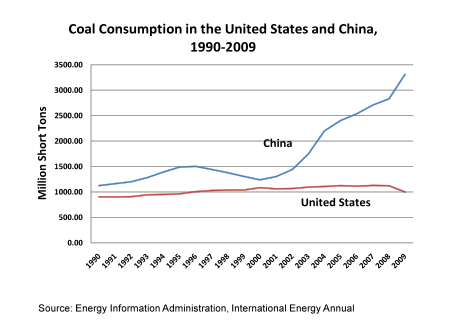
 These proposed coal exports, which are very controversial here -- the Northwest's equivalent of the fight over the Keystone XL pipeline -- are about one thing: coal companies looking at declining U.S. coal consumption and seeing how they can keep their profits up.
U.S. coal production recently dropped below the milestone mark of 1,000,000 K short tons annually, and on a per capita basis has dropped 20% from its peak in just six years:
(A short ton is the old 2,000 lbs = 0.908 metric tons. When the hell is the U.S. finally going to get with the rest of the entire world on this?)
In a letter to the President's Council on Environmental Quality, John Kitzhaber (D-OR) and Jay Inslee (D-WA) wrote:
Increasing levels of greenhouse gases and other pollutants resulting from the burning of coal, including pollutants other than CO2, are imposing direct costs on people, businesses and communities in the U.S. and around the world. These costs include the public health costs of increased atmospheric deposition of mercury in drinking water sources, as well as costs resulting from ocean acidification, rising sea levels, wildfires, and shrinking snow packs that are key sources of water for the western U.S....
We believe the federal government must examine the true costs of long-term commitments tosupply coal from federal lands for energy production, whether that production occurs domestically or in Asia. We cannot seriously take the position in international and national policymaking that we are a leader in controlling greenhouse gas emissions without alsoexamining how we will use and price the world's largest proven coal reserves.
 Carbon dioxide emissions from the exported coal would total about 250 million tonnes a year.
They also scolded the government for giving the coal away cheaply:
As the major owner of coal reserves in the western U.S., the federal government must consider whether it has appropriately priced the coal leases that it continues to grant, including the practice of granting non-competitive leases. Senators Ron Wyden and Lisa Murkowski recently asked the U.S. Department of the Interior for information concerning alleged industry practicesusing in-house trading affiliates to avoid paying royalties that reflect actual export sales. These issues raise significant concerns that we are subsidizing the export of coal at the same time we are winding down domestic consumption due to serious environmental and health concerns.
 These proposed coal exports, which are very controversial here -- the Northwest's equivalent of the fight over the Keystone XL pipeline -- are about one thing: coal companies looking at declining U.S. coal consumption and seeing how they can keep their profits up.
U.S. coal production recently dropped below the milestone mark of 1,000,000 K short tons annually, and on a per capita basis has dropped 20% from its peak in just six years:
 |
| U.S. per capita coal production (short tons/yr) |
(A short ton is the old 2,000 lbs = 0.908 metric tons. When the hell is the U.S. finally going to get with the rest of the entire world on this?)
Monday, March 25, 2013
NASA Suspends All Public Outreach
In response to the budget sequester, NASA has suspended all education and public outreach programs.
Not only can't the U.S. get back to the moon, we can't even tell you about it.
Not only can't the U.S. get back to the moon, we can't even tell you about it.
Sunday, March 24, 2013
"Oregon...Ought to Play a Little Hard to Get"
 |
| Flowers on a Camellia Tree in my sister's backyard, Portland Oregon |
"Oregon is demure and lovely, and it ought to play a little hard to get. And I think you'll be just as sick as I am if you find it is nothing but a hungry hussy, throwing herself at every stinking smokestack that's offered."
-- former Oregon Governor Tom McCall
(I recounted a good Tom McCall story here.)
Saturday, March 23, 2013
Missing Energy Claimed to be Found
A paper just out in GRL by Balmaseda, Trenberth and Källén claims to have affirmed the location of the "missing energy" in the climate system -- it's (as suspected) in the deep ocean (the 300-2000 m layer, and especially below 700 m).
You can read the abstract here; this is from the paper's conclusion:


Finally, here is their summary of trends for the different layers over different times, which makes it clear why the surface temperature jumped up so much in the 1990s -- the ocean was actually losing energy (heat), mostly because of the big 1997-1998 El Nino -- and why it's been on "haitus" during the last decade -- the ocean took up a huge amount of heat, at a rate far higher even than in the 1980s, with most of it going below 700 meters.

(The number 0.708 is simply the total surface area of all the planet's oceans divided by the planet's total surface area, viz. 70.8% of the surface is ocean.)
You can read the abstract here; this is from the paper's conclusion:
The deep ocean has continued to warm, while the upper 300 m OHC appears to have stabilized. The differences in recent trends among the different ocean layers are profound. The small warming in the upper 300 m is belied by the continuing warming for the ocean as a whole, with considerable warming occurring below 700 m. However, this raises the question of whether this result is simply because of the new Argo observing system? The results shown here suggest otherwise, although Argo clearly is vitally important quantitatively. Instead changes in surface winds play a major role, and although the exact nature of the wind influence still needs to be understood, the changes are consistent with the intensification of the trades in subtropical gyres. Another supporting factor is the uniqueness of the radiative forcing associated with global warming.Here are some figures from the paper:
The magnitude of the warming trend is consistent with observational estimates, being equivalent to an average 0.47 ± 0.03 W m-2 for the period 1975–2009. There is large decadal variability in the heat uptake, the latest decade being significantly higher (1.19 ± 0.11 W m-2) than the preceding record. Globally this corresponds to 0.84 W m-2, consistent with earlier estimates [Trenberth et al., 2009]. In an observing system experiment where Argo is withdrawn, the ocean heating for the last decade is reduced (0.82 ± 0.10 W m-2), but is still significantly higher than in previous decades. The estimation shows depths below 700 m becoming much more strongly involved in the heat uptake after 1998, and subsequently accounting for about 30% of the ocean warming.


(The number 0.708 is simply the total surface area of all the planet's oceans divided by the planet's total surface area, viz. 70.8% of the surface is ocean.)
Thursday, March 21, 2013
How Deniers Enfore Solidarity
Here's what you get for trying to comment at Watts:

See how easy it is to enforce unanimity of thought?Stalin Lysenko would be proud.

See how easy it is to enforce unanimity of thought?
New GISS Data Just In
We are in trouble -- GISS just posted their new anomaly numbers for February -- +0.49°C.
That makes the past 12 months 0.06°C warmer than the previous 12 months.
People, that's a warming rate of 11°F per century.
We are doomed (according to people like this)!
Seriously: the 15-yr trend -- which, remember, is for suckers -- is +0.07 ± 0.04°C/decade (2σ), which is totally significantly significant and not all that small.
Just 5 months ago it was +0.05°C/decade.
I told you it would be increasing as the 1997-98 El Nino slides out the back end of the 15-year window.
Live by crappy insignificant trends, die by crappy insignificant trends.
A climatologically relevant trend -- say, 30-years, in case anyone still cares about actual climate science anymore and not just point-scoring -- is still 0.17 ± 0.02°C/decade(*).
*Uncertainties are 2-sigma basic OLS statistical uncertainties. Autocorrelation increases them; see here for more details, but certainly not all of them. Or even half of them. Use the SkS trend calculator if you need to.
That makes the past 12 months 0.06°C warmer than the previous 12 months.
People, that's a warming rate of 11°F per century.
We are doomed (according to people like this)!
--
Seriously: the 15-yr trend -- which, remember, is for suckers -- is +0.07 ± 0.04°C/decade (2σ), which is totally significantly significant and not all that small.
Just 5 months ago it was +0.05°C/decade.
I told you it would be increasing as the 1997-98 El Nino slides out the back end of the 15-year window.
Live by crappy insignificant trends, die by crappy insignificant trends.
A climatologically relevant trend -- say, 30-years, in case anyone still cares about actual climate science anymore and not just point-scoring -- is still 0.17 ± 0.02°C/decade(*).
*Uncertainties are 2-sigma basic OLS statistical uncertainties. Autocorrelation increases them; see here for more details, but certainly not all of them. Or even half of them. Use the SkS trend calculator if you need to.
First they Came for the Political Scientists....
...and I didn't speak out
because I wasn't a political scientist.
Yesterday the U.S. Senate voted to restrict NSF funding for political science. An amendment that was submitted by Tom Coburn (R-OK) reads:
In a March 12th letter to NSF, Colburn wrote:
After the voice vote approving the amendment, Colburn said in a statement:
 To me it looks like Colburn is attacking knowledge itself? (To you?) If it were just about the budget, he's issue a statement saying something like "we regret our inability to fund the valuable work of the many dedicated scholars across our nation, but these are dire times for the federal government and we must cut back where we can."
Even if federal receipts are at a 60-year low (because, you know, we can't fairly tax millionaires).
But Colburn isn't saying that, is he? No, he's saying the very essence of their scholarship isn't valuable.
And that's dangerous. What will he next decide isn't worth it? Theoretical physics? Mathematical biology? Climate science?
This is how nations decline, people. It's exactly how they decline.
because I wasn't a political scientist.
(H/T/ Martin Niemöller)
Yesterday the U.S. Senate voted to restrict NSF funding for political science. An amendment that was submitted by Tom Coburn (R-OK) reads:
Purpose: To prohibit the use of funds to carry out the functions of the Political Science Program in the Division of Social and Economic Sciences of the Directorate for Social, Behavioral, and Economic Sciences of the National Science Foundation, except for research projects that the Director of the National Science Foundation certifies as promoting national security or the economic interests of the United States.Of course, "the economic interests of the United States" is a nebulous, undefined term, which is perhaps the way Coburn prefers it.
In a March 12th letter to NSF, Colburn wrote:
"Studies of presidential executive power and Americans' attitudes toward the Senate filibuster hold little promise to save an American's life from a threatening condition or to advance America's competitiveness in the world." Coburn wrote in a letter to NSF director Subra Suresh last week explaining his proposal.Of course, that's true of much of the research intended to develop pure knowledge. Do grants to differential geometers promise to save anyone's life or advance America's competitiveness in the world? They do, but not perhaps for decades, but the likes of people like Colburn cannot see that far.
After the voice vote approving the amendment, Colburn said in a statement:
"I’m pleased the Senate accepted an amendment that restricts funding to low-priority political science grants. There is no reason to spend $251,000 studying Americans' attitudes toward the U.S. Senate when citizens can figure that out for free."Yes, Americans are certainly serious students of the intracicies of Congress, the shifts in Executive power, the knowledge of other political systems (especially "American Idol"). Aren't they?

Even if federal receipts are at a 60-year low (because, you know, we can't fairly tax millionaires).
But Colburn isn't saying that, is he? No, he's saying the very essence of their scholarship isn't valuable.
And that's dangerous. What will he next decide isn't worth it? Theoretical physics? Mathematical biology? Climate science?
This is how nations decline, people. It's exactly how they decline.
More Properties of Your Universe
Here's just one of the papers containing the Planck results, with more authors than there stars in some globular clusters.
The Hubble constant, describing the expansion of the universe:
P.S.: See, there is more to life than AGW.
Besides the results I mentioned earlier, here are some of the big ones:
No evidence of cosmic strings
No evidence for more than three families of neutrinos: Neff = 3.30 ± 0.27 families, as are in the Standard Model.
Upper limit on the sum of neutrino masses is 0.23 eV.
The Hubble constant, describing the expansion of the universe:
H0 = 67.3 ± 1.2 km/s/Mpc
More detailed results than you probably want to know about can be found here.
You can't help but be really impressed about how far cosmology has come and how much it's been able to tell about not just the overall structure and history of the universe, but about the parameters of elementary particles and their interaction. The last 35 years or so, since the dawn of cosmic inflation -- the exponential expansion of the very early universe -- have been a true scientific revolution. Alan Guth (at least) really ought to win a Nobel Prize now (in 2006, in the wake of the WMAP results, Sean Carrol said it was a little early still).
More: Cosmologist Richard Easther, who live-blogged NASA's announcement, has much more here.
P.S.: See, there is more to life than AGW.
Universe Older, Less Frightening Than it Was Yesterday
 The Universe just got 100 million years older -- or, rather, it's 100 Myr older than previously thought -- according to the Planck satellite results released today.
That makes it 13.8 billion years instead of 13.7 Byr.
There's also a little less dark energy (68.3%, compared to the previous 71.4%) and a little more dark matter (26.8%; was 24.0%). Since no one has a clue what dark energy is, that makes the Universe just a little less scary than it was yesterday. Of course, no one knows what the dark matter is either, but it's matter, which is somehow less intimidating than some invisible spooky energy field that repels and reaches everywhere.
But normal matter is now known to comprise 4.9%, up from 4.6%. (That rumor that the difference is due to terrestial carbon emissions is untrue.)
Still, we don't know what 95% of the Universe is composed of. It's astonishing if you think about it, especially at night if you look up at the stars. I really don't think this has sunk into the public conscoiusness yet, who fret about more prosaic concerns like American Idol or health care.
(I wrote about the Planck mission, before it was launched, for Scientific American.)
Here's a nice comparison showing the progress in satellite measurements of the temperature fluctuations in the cosmic microwave background:

Still no evidence of any gods, though (unless they're made of dark energy).
Wednesday, March 20, 2013
The Greening Arctic
Here's a map from NASA that shows the amount of vegetative growth in the western hemisphere of the Arctic over the past 30 years. (The eastern hemisphere is even more impressive.)

 It's mostly tundra and tiaga.
These images accompany a new paper in Nature Climate Change, that says latitudinal shifts in vegetation in the Arctic -- essentially, how fast the greening is moving north -- is 4-7° in 30 years. If I figured correctly, that's 445-778 km in 30 years, or about 50 meters a day, or about 2 meters an hour.
The paper says climate models predict the shift will be 20° more by the end of the century. That's about 1400 miles.
Denver will move to Mexico City. Saskatchewan will move to Houston. Fairbanks, Alaska will move to Portland, Oregon, and Portland will move somewhere equivalent to Miami's latitude. Unless someone can find a way to alter the molecular properties of carbon dioxide. I hope someone, somewhere, is working on that.
It's mostly tundra and tiaga.These images accompany a new paper in Nature Climate Change, that says latitudinal shifts in vegetation in the Arctic -- essentially, how fast the greening is moving north -- is 4-7° in 30 years. If I figured correctly, that's 445-778 km in 30 years, or about 50 meters a day, or about 2 meters an hour.
The paper says climate models predict the shift will be 20° more by the end of the century. That's about 1400 miles.
Denver will move to Mexico City. Saskatchewan will move to Houston. Fairbanks, Alaska will move to Portland, Oregon, and Portland will move somewhere equivalent to Miami's latitude. Unless someone can find a way to alter the molecular properties of carbon dioxide. I hope someone, somewhere, is working on that.
Who Cares What Daily Mail Readers Think?
Maybe we have entered an era where scientists have to write an op-ed or FAQ every time they are misrepresented by a journalist or blogger. (That is, you know, going to but into their time doing science.)
Which is what Myles Allen did today in The Guardian, after being misrepresented by David Rose. You can read Allen's specific response to Rose's characterization of his views, but what I find more interesting is the near the end of his column:
Conservatives/feptics can only put their fingers in their ears for so long -- CO2 isn't going to stop absorbing infrared radiation, and the Earth isn't going to stop emitting it. Meanwhile their explanations look increasingly absurd, and the world will move on without them. Which is too bad, because the problem is so huge and so hard it needs all the brains it can get, and if a (so-called) free market can do that best, so much the better.
Which is what Myles Allen did today in The Guardian, after being misrepresented by David Rose. You can read Allen's specific response to Rose's characterization of his views, but what I find more interesting is the near the end of his column:
Many Guardian readers might be inclined to shrug "who cares what Mail readers think, anyway?" Well, I care. We all deserve an informed and democratic discussion about what to do about climate change, whatever our political persuasion. How many Mail readers realise that one of our government's top climate policy advisers, Dieter Helm, is recommending what, to them, would be an eye-wateringly high carbon tax. This might do wonders for the deficit (interested, George?) but, I would argue, won't solve the problem (we didn't save the ozone layer by taxing CFCs).This is the same message Scott Denning told a Heartland Conference audience.
This is an interesting discussion: subsidies for renewables versus carbon tax versus (my personal preference) upstream regulation of the fossil fuel industry to drive the development of carbon capture. Mail readers should be part of it. But they are firmly excluded by headlines dismissing the whole of climate science as a "great green con" – despite their correspondent certainly giving me the impression he understands the problem better than that....
Conservatives/feptics can only put their fingers in their ears for so long -- CO2 isn't going to stop absorbing infrared radiation, and the Earth isn't going to stop emitting it. Meanwhile their explanations look increasingly absurd, and the world will move on without them. Which is too bad, because the problem is so huge and so hard it needs all the brains it can get, and if a (so-called) free market can do that best, so much the better.
"We Didn't Tax CFCs"
"...we didn't save the ozone layer by taxing CFCs."
-- Myles Allen, The Guardian
Yeah, but....
Please Adjust Your Climate Accordingly
 The Spring Equinox just happened, at 11:02 am UT. (That's 7:02 am Pacific Time.)
Welcome to spring. It's raining cats and dogs here. (The dogs are handling it better than the cats.)
Gravity apparently still works the way we thought it did. (There's a "consensus" on that, you know.)
Starting today, the North Pole begins to receive sunlight, and its ice-albedo feedback moves into its final seasonal gear. Please adjust your climate accordingly.
[Of course, the opposite (in sign) feedback change occurs in the Antarctic, but there it matters less (over the course of a year). More reason to be concerned about Arctic melting.]
Tuesday, March 19, 2013
Oregon could ban genetically engineered fish, require labeling of genetically modified foods
Oregon's legislature is considering 8 bills that would either require labeling of food that contained genetically modified ingredients, prohibit GE fish, or put restrictions on the planting of GM crops.
http://www.oregonlive.com/politics/index.ssf/2013/03/oregon_could_ban_genetically_e.html
One country is going to vote on banning GM crops altogether.
If this comes to pass, people are going to be surprised about how much of the food in the grocery store is GM. (Essentially all processed foods contain GM ingredients.)
Liberals, too, have their own problems with science.
Again With the David Rose Hole
David Rose has another feptic article in the Daily Mail, with false claims about global warming not meeting projects, etc. Phil Plait does a thorough debunking here. One thing Rose wrote is
If you take the HadCRUT4 global data, the ordinary least squares linear regression trend since January 1997 is 0.045 ± 0.036 C/decade, where the uncertainty is the OLS uncertainty representing the 5-95% confidence level.
That's positive (i.e warming) and statistically significant.
This wasn't true just few months ago, when I wrote about the David Rose hole.
It's now true.
If you include autocorrelation (as you ought to), the trend (from the handy SkS trend calculator) is 0.046 ± 0.124 C/decade, where the uncertainty is 2σ.
That's warming, but with a statistical significance of only 54%. Canonical climate science usually considers 95% to be the standard, though if you're worrying about the future of civilization you might relax that a little.
The large uncertainty that accompanies the autocorrelated result says that your time interval is too short to make statistically meaningful conclusions.
A short time interval is always going to have large trend uncertainties like this -- because, you know, the climate has noise in it -- and unless your warming is always greater than about 0.124 C/decade, or your cooling is always less than about -0.124 C/decade, you're usually not going to be able to make statistically significant conclusions about the trend. Period.
Here is some history of the 15-yr trend for the Hadley data:

It varies a great deal. That makes it not very useful. What would feptics have said in 2007, when it was 0.29 C/decade? I suspect they would have said, yabbit it's abnormally high because you had an El Nino in 2002 and 2004 and 2006 a big one in 1998, and those are skewing the results upward.
Well, now the 15-yr trend is abnormally low, because there was a large warming El Nino on the back end of the interval, and a big La Nina on the front end, and this is skewing the results downward.
The 15-year trend is for suckers. It measures weather, not climate, except the weather is in the fluid ocean and not just the fluid atmosphere.
This is all going to change in 6-12 months, when the 1997-98 El Nino falls out the backend of the 15-year window. In fact, looking at the chart above you see this already starting.
Like I said, the 15-year trend is for suckers. [And of course it's a lousy place to look for an energy imbalance anyway.]
The graph confirms there has been no statistically significant increase in the world’s average temperature since January 1997 – as this newspaper first disclosed last year.This is misleading in two ways.
If you take the HadCRUT4 global data, the ordinary least squares linear regression trend since January 1997 is 0.045 ± 0.036 C/decade, where the uncertainty is the OLS uncertainty representing the 5-95% confidence level.
That's positive (i.e warming) and statistically significant.
This wasn't true just few months ago, when I wrote about the David Rose hole.
It's now true.
If you include autocorrelation (as you ought to), the trend (from the handy SkS trend calculator) is 0.046 ± 0.124 C/decade, where the uncertainty is 2σ.
That's warming, but with a statistical significance of only 54%. Canonical climate science usually considers 95% to be the standard, though if you're worrying about the future of civilization you might relax that a little.
The large uncertainty that accompanies the autocorrelated result says that your time interval is too short to make statistically meaningful conclusions.
A short time interval is always going to have large trend uncertainties like this -- because, you know, the climate has noise in it -- and unless your warming is always greater than about 0.124 C/decade, or your cooling is always less than about -0.124 C/decade, you're usually not going to be able to make statistically significant conclusions about the trend. Period.
Here is some history of the 15-yr trend for the Hadley data:

It varies a great deal. That makes it not very useful. What would feptics have said in 2007, when it was 0.29 C/decade? I suspect they would have said, yabbit it's abnormally high because you had an El Nino in 2002 and 2004 and 2006 a big one in 1998, and those are skewing the results upward.
Well, now the 15-yr trend is abnormally low, because there was a large warming El Nino on the back end of the interval, and a big La Nina on the front end, and this is skewing the results downward.
The 15-year trend is for suckers. It measures weather, not climate, except the weather is in the fluid ocean and not just the fluid atmosphere.
This is all going to change in 6-12 months, when the 1997-98 El Nino falls out the backend of the 15-year window. In fact, looking at the chart above you see this already starting.
Like I said, the 15-year trend is for suckers. [And of course it's a lousy place to look for an energy imbalance anyway.]
Monday, March 18, 2013
Feptic Falsehoods About "Global Warming"
An interview of renowned climate science expert Anthony Joules-per-second by OilPrice.com goes astray right from the very start:
Likewise, the IPCC has never gone by the name "International Panel on Global Warming."
The 1965 report to the Johnson Administration, “Restoring the Quality of Our Environment,” has a chapter titled "Atmospheric Carbon Dioxide" that reads (pg 113)
I've never heard a (real) scientist say AGW implies a steady linear increase in temperature, for a good reason: it's ridiculous. But it's a convenient meme for fake skeptics ("feptics?") -- as long as there is some downward jog in surface temperatures they can cry "foul" and claim it means something.
Skeptical Science has a much longer deconstruction of this interview, which, based on its first sentence, you should not waste your valuable time reading.
Speaking of short-term trends, a recent paper in Nature Geosciences finds little change in global radiative forcing from aerosols (at least for clear-sky conditions):
The 15-year haitus (which isn't real anyway) isn't going to last much longer, because soon the 1997-98 El Nino is going to fall out the back of the 15-year window, and that will pull down the back end of the linear regression line and quickly make the slopes less negative/more positive.
Besides, using a short interval like 15 years is a sucker's game. Just a few years ago, in spring 2007, the 15-yr trend for HadCRUT4 was 0.29 C/decade. That wasn't any more meaningful on the high end than the current value (0.04 C/decade) is on the low end.
In a few years (unless they're a big volcanic eruption) feptics will be the ones shouting about too-short intervals (or maybe, much like this, complain that it didn't warm from one year to the next, or that yesterday was warmer than today). That should be fun.
Oilprice.com: We see a lot of confusion among readers over the terminology here. What is the difference between “Climate Change” and “Global Warming”? Which is the more loaded term, and why?In fact, the UNFCCC dates from 1992, and was never called the "United Nations Framework Convention on Global Warming."
Anthony Watts: “Global warming” suggests a steady linear increase in temperature, but since that isn’t happening, proponents have shifted to the more universal term “climate change,” which can be liberally applied to just about anything observable in the atmosphere.
Likewise, the IPCC has never gone by the name "International Panel on Global Warming."
The 1965 report to the Johnson Administration, “Restoring the Quality of Our Environment,” has a chapter titled "Atmospheric Carbon Dioxide" that reads (pg 113)
"The possibility of climatic change resulting from changes in the quantity of atmospheric carbon dioxide was independently proposed by the American geologist T.C. Chamberlain (1999) and the Swedish chemist S. Arrhenius (1903), at the beginning of this century." [Emphasis mine](American-centric, they overlooked Arrhenius's 1896 paper, didn't they?)
I've never heard a (real) scientist say AGW implies a steady linear increase in temperature, for a good reason: it's ridiculous. But it's a convenient meme for fake skeptics ("feptics?") -- as long as there is some downward jog in surface temperatures they can cry "foul" and claim it means something.
Skeptical Science has a much longer deconstruction of this interview, which, based on its first sentence, you should not waste your valuable time reading.
==
Aerosols both scatter and absorb incoming solar radiation, with consequences for the energy balance of the atmosphere. Unlike greenhouse gases, atmospheric aerosols are distributed non-uniformly around the Earth. Therefore, regional shifts in aerosol abundance could alter radiative forcing of the climate. Here, I use multi-angle imaging spectroradiometer (MISR) satellite data and the Atmospheric and Environmental Research radiative transfer model1 to assess the radiative effect of the spatial redistribution of aerosols over the past decade. Unexpectedly, the radiative transfer model shows that the movement of aerosols from high latitudes towards the Equator, as might happen if pollution shifts from Europe to southeast Asia, has little effect on clear-sky radiative forcing. Shorter slant paths and smaller upscatter fractions near the Equator compensate for more total sunlight there. Overall, there has been an almost exact cancellation in the clear-sky radiative forcing from aerosol increases and decreases in different parts of the world, whereas MISR should have been able to easily detect a change of 0.1 W m−2 per decade due to changing patterns. Long-term changes in global mean aerosol optical depth or indirect aerosol forcing of clouds are difficult to measure from satellites. However, the satellite data show that the regional redistribution of aerosols had little direct net effect on global average clear-sky radiative forcing from 2000 to 2012.That is to say, you can't blame the "haitus" on China.
The 15-year haitus (which isn't real anyway) isn't going to last much longer, because soon the 1997-98 El Nino is going to fall out the back of the 15-year window, and that will pull down the back end of the linear regression line and quickly make the slopes less negative/more positive.
Besides, using a short interval like 15 years is a sucker's game. Just a few years ago, in spring 2007, the 15-yr trend for HadCRUT4 was 0.29 C/decade. That wasn't any more meaningful on the high end than the current value (0.04 C/decade) is on the low end.
In a few years (unless they're a big volcanic eruption) feptics will be the ones shouting about too-short intervals (or maybe, much like this, complain that it didn't warm from one year to the next, or that yesterday was warmer than today). That should be fun.
Sunday, March 17, 2013
The Very Opposite of a Eureka! Moment?
At the Huffington Post, John Heilprin writes:
Seriously, has any scientific discovery ever beenmilked strung out to such lengths? (Maybe the announcement of the sequencing of the human genome -- how many of those were there?) From Wikipedia:
 Frankly by this point, when it's finally confirmed, it's very anticlimatic -- it would have been more exciting if they'd concluded, no, that's not it at all. Never mind. Sorry.
I realize a lot was a stake: a Nobel Prize, the PR value of a major discovery in an age of diminished funding, the need to justify all the money that was spent on CERN, etc. Maybe in this day and age, when universities and national laboratories have more public information officers (PIOs) than there are journalists, and where insiders leak rumors to bloggers, hype of every detail, every sigma increase in uncertainty was inevitable.
But it seems to me to have been overdone -- the opposite of a Eureka! moment, which I associate with something instanteous like Newton getting clunked on the head with an apple, or at least something everyone wasn't expecting. (But then, why am I expecting scientific accuracy from The Huffington Post?)
Sean Carroll said,
In what could go down as one of the great Eureka! moments in physics – and win somebody the Nobel Prize – scientists said Thursday that after a half-century quest, they are confident they have found a Higgs boson, the elusive subatomic speck sometimes called the "God particle."Really?? It's been more like E................................ur...............e.............k................a, with the exclamation point left off for the sake of politeness.
Seriously, has any scientific discovery ever been
Data collection at the LHC finally commenced in March 2010. By December 2011 the two main particle detectors at the LHC, ATLAS and CMS, had narrowed down the mass range where the Higgs could exist to 115–130 GeV. In addition, both experiments were starting to see hints of a new particle that could be the Higgs with a mass around 125 GeV [Dec 2011] It was therefore widely expected around the end of 2011, that the LHC would provide sufficient data to either exclude or confirm the finding of the Standard Model Higgs boson by the end of 2012, when their 2012 collision data (with slightly higher 8 TeV collision energy) had been examined.[13 Dec 2011]
 Frankly by this point, when it's finally confirmed, it's very anticlimatic -- it would have been more exciting if they'd concluded, no, that's not it at all. Never mind. Sorry.
I realize a lot was a stake: a Nobel Prize, the PR value of a major discovery in an age of diminished funding, the need to justify all the money that was spent on CERN, etc. Maybe in this day and age, when universities and national laboratories have more public information officers (PIOs) than there are journalists, and where insiders leak rumors to bloggers, hype of every detail, every sigma increase in uncertainty was inevitable.
But it seems to me to have been overdone -- the opposite of a Eureka! moment, which I associate with something instanteous like Newton getting clunked on the head with an apple, or at least something everyone wasn't expecting. (But then, why am I expecting scientific accuracy from The Huffington Post?)
Sean Carroll said,
Finding a Higgs more or less as expected is actually a bit deflating, Carroll said, because physicists had also hoped that an unexpected type of Higgs might open windows into yet more mysteries of the universe.(Except climate scientists never get that luxury, do they?)
"Scientists always want to be wrong in their theories. They always want to be surprised," he said. "It's a bittersweet victory when your theory turns out to be right, because it means, on the one hand, you're right, that's nice, but on the other hand, you haven't learned anything new that's surprising."
 |
| Peter Higgs |

Global Warming Causing Sinkholes (Really??)
I'm extremely dubious. Christina Reed writes:
Increasing carbon dioxide in the atmosphere leads to rainwater containing higher levels of carbon dioxide, otherwise known as acid rain. When carbon dioxide in water is given a carbonate ion, it prefers to make bicarbonate ions rather than staying happily in the water minding its own business. Any rock or shell made of carbonate then becomes more at risk of dissolution as the ocean and rainwater become more acidic, much like tooth enamel dissolves away when soaked in a glass of soda pop.I just can't believe that a small change in rain acidity caused by higher CO2 is enough to make a difference in sinkhole formation (I would guess more rain would be a bigger issue, or local issues like drainage), or that if rainfall acidity is increasing, it wouldn't have been noticeable in many other places (forests, for one) like now.
Once the bedrock starts to dissolve and erode away, the type of surface sediment makes the difference as to whether the sinkhole will be catastrophic or not.
I really don't want to have to lookup up the changes in pH or changes in weathering reaction rates, because this seems like obvious baloney. Anyone disagree?
Update: Discover links to this USGS page about sinkholes, which doesn't mention acidity but does say this about human induced sinkholes:
New sinkholes have been correlated to land-use practices, especially from groundwater pumping and from construction and development practices. Sinkholes can also form when natural water-drainage patterns are changed and new water-diversion systems are developed. Some sinkholes form when the land surface is changed, such as when industrial and runoff-storage ponds are created. The substantial weight of the new material can trigger an underground collapse of supporting material, thus causing a sinkhole.
The overburden sediments that cover buried cavities in the aquifer systems are delicately balanced by ground-water fluid pressure. The water below ground is actually helping to keep the surface soil in place. Groundwater pumping for urban water supply and for irrigation can produce new sinkholes In sinkhole-prone areas. If pumping results in a lowering of groundwater levels, then underground structural failure, and thus, sinkholes, can occur.
Thursday, March 14, 2013
When Paul Ryan was in Favor of Stimulus
2002.
My God, how do these politicians live with themselves?
What a bald-faced liar.
Really -- how do they do this, turn from one position to another depending on whatever they think will get them somewhere?
I can't comprehend this at all, and I can't imagine living with myself for more than about 48 hours if I lied like this.
What property of our system tolerates such outright liars? Elevates them, even?
This question should be a priority among social scientists. Has it been?

A Number Too Big for Your Head
Here's an interesting skit about Graham's Number g64, the largest number ever to appear "constructively" in a mathematical proof (except maybe for g64+1). The part up front about why it wouldn't fit into your head is also clever:
Mathematicians really are some of the most interesting people I have ever met. In graduate school I fell into a crowd of them during my last year, and it was the most probably the funnest year of my whole life. (Somehow, I managed to get my thesis written too.)
Via io9.
Mathematicians really are some of the most interesting people I have ever met. In graduate school I fell into a crowd of them during my last year, and it was the most probably the funnest year of my whole life. (Somehow, I managed to get my thesis written too.)
Via io9.
Subscribe to:
Posts (Atom)