|
Monday, March 28, 2016
NSIDC: "The Arctic sets yet another record low maximum winter extent"
Friday, March 25, 2016
Them That Can't Learn: Doctor Norman Page, PhD
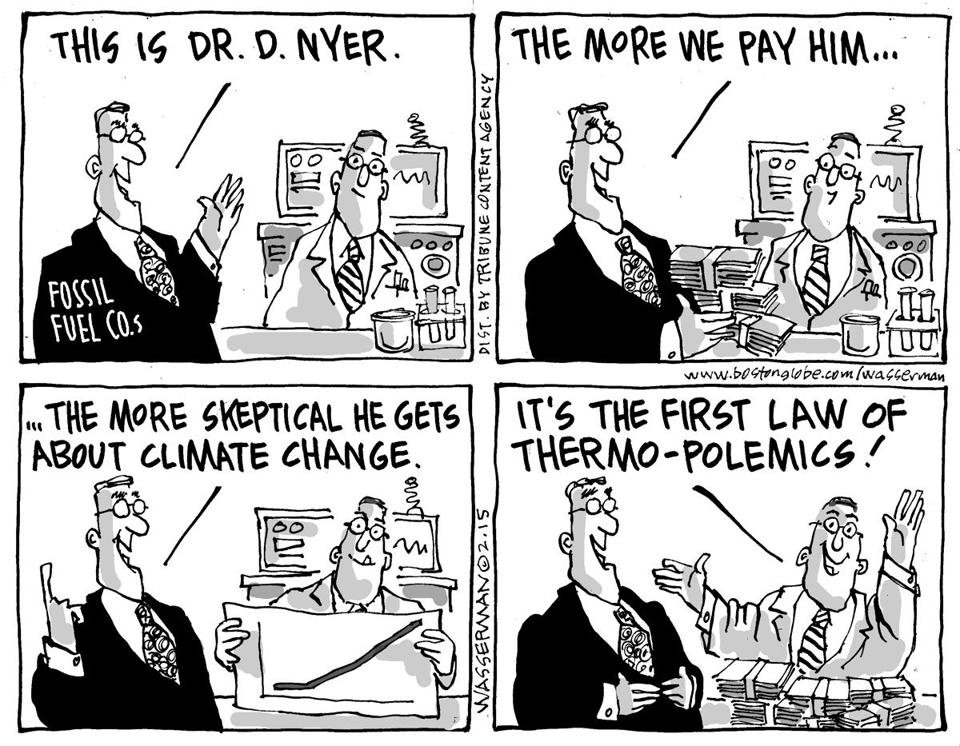
Climate deniers have no shame.
At least, Dr. Norman Page has none. After a 2012 prediction that was disastrously wrong, the Doctor is back with yet another prediction of cooling. It's always just around the corner, you know.
He has apparently learned nothing.
Rule #1 of PhD's: Be wary -- very wary -- of people who include "Dr." in front of their name. Page's doctorate is in geology, but using "Dr" is just a cheap attempt to grasp a smidgen of legitimacy before he has earned it. So you got a doctorate Norman. Big deal.
Page's 2012 prediction was that "the earth is entering a cooling phase which is likely to last about 30 years and possibly longer." That was about as wrong as could possibly be:
Did the doctor learn anything at all from his disastrous prediction? Clearly not, because now he's back making essentially the same prediction again:
There will never be an end to climate denial. Ever. There will always be contrarian kooks who think the moon landing was faked and Sandy Hook was a false flag and manmade global warming is a hoax. Even if we do serious mitigation and avoid the worst of it, these kooks will be whining that we wasted all that money on a phenomenon that didn't exist and couldn't based on their kooky interpretation of the second law of thermodynamics.
Norman Page didn't even fool us once. And already he's back trying to fool us again? Doctor, have a little pride, would you?
At least, Dr. Norman Page has none. After a 2012 prediction that was disastrously wrong, the Doctor is back with yet another prediction of cooling. It's always just around the corner, you know.
He has apparently learned nothing.
Rule #1 of PhD's: Be wary -- very wary -- of people who include "Dr." in front of their name. Page's doctorate is in geology, but using "Dr" is just a cheap attempt to grasp a smidgen of legitimacy before he has earned it. So you got a doctorate Norman. Big deal.
Page's 2012 prediction was that "the earth is entering a cooling phase which is likely to last about 30 years and possibly longer." That was about as wrong as could possibly be:
Did the doctor learn anything at all from his disastrous prediction? Clearly not, because now he's back making essentially the same prediction again:
What is the basis for the doctor's new prediction? First there is this interlude:
The modelling approach is inherently of no value for predicting future temperature with any calculable certainty because of the difficulty of specifying the initial conditions of a sufficiently fine grained spatio-temporal grid of a large number of variables with sufficient precision prior to multiple iterations.
That's actually correct! Climate models, which solve partial differential equations that describe the physics of climate, aren't initialized to an exact, existing set of initial conditions -- because no one knows the inital conditions, which would require detailed information on atmospheric and deep ocean currents, which we do not have (especially the latter).
This is exactly why modelers say their models make projections (not predictions) for the equilibrium state, after all forcing and feedbacks have played out -- which takes centuries, at least. Trying to interpret their results after 10 or 20 years is meaningless, because these models were never built to make such predictions.
So Page has that part right, though naturally it goes right over the heads of WUWT readers. But this hardly means that we expect cooling by 2020, or 2050 pr 2100, or pick whatever future point you want. More atmospheric CO2 warms the planet, whether you know the initial conditions or not.
Page wants to rely on supposed long-term climate cycles of 60 years and 1000 years. But he doesn't realize that anthropogenic forcings have changed everything.
60 years? OK, we have the PDO and AMO cycles, with something like this period for a full cycle. But these cycles don't create long-term warming -- just look at how much warming has happened since 60 years ago.
A thousand-year cycle? Based on what? Page doesn't say. Instead he is stuck in the past, not realizing that manmade forcings have changed everything.
But the climate forcings we're creating are far faster than any 1000-yr cycles, any Milankovitch cycles, or fuzzy millenium solar cycles.
This shouldn't be hard to understand, especially for a "Dr." But Page misses this completely. Perhaps he is angling for the vacant Bob Carter climate denial chair -- Carter was also a geologist.
If so, he might fit right in -- and be just as wrong as Carter was. And just as wrong as he was last time.
Norman Page didn't even fool us once. And already he's back trying to fool us again? Doctor, have a little pride, would you?
What Is Left for the Devil?
“In the end, when you see what can be done in the name of God, it makes you wonder what is left for the devil.”
-- a handwritten note on the makeshift memorial for this week's bombings in Brussels, as reported by the New York Times.
Wednesday, March 23, 2016
Two Deaths
I am getting old enough that I (perhaps a little prematurely) pay attention to who dies and am surprised at some of them.
Today brought two: Ken Howard and Joe Garagiola.
I have to admit I was very surprised to hear about both.
I mean, just a month ago I was listening to Joe Garagiola and Tony Kubek call Saturday afternoon baseball games on our black-and-white television in the living room of the house I grew up in, the house with a coal furnace and well water and a little bathroom my dad carved out underneath the stairs.
It was an older wooden house that my grandparents owned and my mom and dad were -- and I'm not even sure about this -- paying rent on. I incessently threw a rubber ball against the side of that house. I don't know how my mother put up with it for all those years, the thump thump thump until evening, but she did and I only broke the kitchen window twice before they bought me a pitchback.
I knew of Kubek because he took a ground ball to the throat in the famous 7th game of the 1960 World Series, the Pirates versus the Yankees, the game that Bill Mazeroski won and that somehow my grandfather and father got tickets to. That was the kind of thing my grandfather did.
I kept score on a little pad I kept near the clothesline post in the middle of the yard, some other team always against the Pirates. Willie Stargell played for the Pirates then, still in the outfield, and Al Oliver, and Matty Alou and little Freddie Patek. And of course Roberto Clemente played out in right field -- Clemente, can you imagine him in your boyhood, throwing out runners at third base with arrows from right field, shockingly dying in a plane crash on a rescue mission to Nicaragua just a couple of months after he was granted his 3000th hit in his last regular season game. 3000 hits and then taken away. Observe that and try to tell me are no Gods who watch over our fates.
Clemente was buried at sea.
Even with Roberto Clemente in right field, my hero was Manny Sanguillen, the Pirates catcher. Sanguillen had this very cool way of catching while sitting on his haunches, like at the right, when there were no runners on base. Lord knows how he could sit like that. He was #35. I picked that when I started playing football. My dad bought me a catcher's mitt, but I never did play catcher, except in the yard bouncing a ball off the house.
Ken Howard wasn't an athlete, but if you grew up then you watched The White Shadow. There weren't a million channels on TV like there are now, and it one of the only things on when you got home from school. I remember him as far, far too young to have died yesterday, at only 71. He was big and could have been a galoot, but was always a little too smart for that, and a bit too big to fit comfortably into whereever the high school tried to shove him. But his character cared for all his players, through thick and thin, including Salami (who is now a big-time movie director, but if you listen to him talk still has some Salami in him), and Coolidge and the trouble-maker Vitaglia, and they still seem like the kids you were in school with two periods ago.
It's not possible either Joe Garagiola or Ken Howard died yesterday, so I don't know why I'm writing this. There will be time to write about them later, and even if they're not directly on television these days, and even if I don't even own a television anymore, I'm sure they'll still be there when I find the dial again and turn it to their channels. I mean, I can hear their voices clear as day. So don't tell me they've gone anywhere. I'm not fooled that easily.
It was an older wooden house that my grandparents owned and my mom and dad were -- and I'm not even sure about this -- paying rent on. I incessently threw a rubber ball against the side of that house. I don't know how my mother put up with it for all those years, the thump thump thump until evening, but she did and I only broke the kitchen window twice before they bought me a pitchback.
I knew of Kubek because he took a ground ball to the throat in the famous 7th game of the 1960 World Series, the Pirates versus the Yankees, the game that Bill Mazeroski won and that somehow my grandfather and father got tickets to. That was the kind of thing my grandfather did.
I kept score on a little pad I kept near the clothesline post in the middle of the yard, some other team always against the Pirates. Willie Stargell played for the Pirates then, still in the outfield, and Al Oliver, and Matty Alou and little Freddie Patek. And of course Roberto Clemente played out in right field -- Clemente, can you imagine him in your boyhood, throwing out runners at third base with arrows from right field, shockingly dying in a plane crash on a rescue mission to Nicaragua just a couple of months after he was granted his 3000th hit in his last regular season game. 3000 hits and then taken away. Observe that and try to tell me are no Gods who watch over our fates.
Clemente was buried at sea.
Even with Roberto Clemente in right field, my hero was Manny Sanguillen, the Pirates catcher. Sanguillen had this very cool way of catching while sitting on his haunches, like at the right, when there were no runners on base. Lord knows how he could sit like that. He was #35. I picked that when I started playing football. My dad bought me a catcher's mitt, but I never did play catcher, except in the yard bouncing a ball off the house.
Ken Howard wasn't an athlete, but if you grew up then you watched The White Shadow. There weren't a million channels on TV like there are now, and it one of the only things on when you got home from school. I remember him as far, far too young to have died yesterday, at only 71. He was big and could have been a galoot, but was always a little too smart for that, and a bit too big to fit comfortably into whereever the high school tried to shove him. But his character cared for all his players, through thick and thin, including Salami (who is now a big-time movie director, but if you listen to him talk still has some Salami in him), and Coolidge and the trouble-maker Vitaglia, and they still seem like the kids you were in school with two periods ago.
It's not possible either Joe Garagiola or Ken Howard died yesterday, so I don't know why I'm writing this. There will be time to write about them later, and even if they're not directly on television these days, and even if I don't even own a television anymore, I'm sure they'll still be there when I find the dial again and turn it to their channels. I mean, I can hear their voices clear as day. So don't tell me they've gone anywhere. I'm not fooled that easily.
Hyping Hansen's Paper
Eric Holthaus at Slate wrote:
I'm sorry, but this is complete bullshit.
No single paper, by Hansen or anyone else, becomes part of the "canon" a day after it is published. (Nor does it based on the version published in July of last year.)
I haven't even read the new version of Hansen et al in detail yet. But it is certainly not part of the canon, for the same reason that a play of Shakespeare's wasn't part of the literary canon less than a year after it was first published -- only time can tell. It takes a good bit of time for scientific papers to be anointed, and this paper's conclusions are certainly far from the mainsteam.
There are some extreme and improbable scenarios in Hansen et al. Sure, maybe we could pass a tipping point by 2050 -- but I think it's more than likely we will not.
Hansen anymore seems interested in promoting alarmism at all costs. There's been a whiff of this throughout his entire career, but this latest paper is just too much to take seriously.
Relative to sea level today, that works out to a rise of...16 inches.
(CU's data is even slower, showing an acceleration/SLR of 0.45%/yr.)
And the reactions Holthaus gets from other scientists, who weren't co-authors on the paper, aren't very convincing:
I don't see any reason to take this paper seriously. Sure, there could be tipping points in the future. That's easy to claim, and you can be wrong without consequence. But are they likely? I don't see any evidence presented there that they are likely by 2050, let alone 2100.
I'm afraid science writers are giving this paper coverage only because (1) they prefer alarmism, which is way to easy at the top of a big El Nino, and (2) they feel they need to give fealty to any work of Hansen's.
Maybe I'm wrong, and maybe I'll change my mind after I get into the details of the new version of the paper. But I don't expect so.
(I also feel that this paper was rushed out last summer before it was ready in order to influence the Paris talks. But then I also think the same about UAH's data version 6 "beta.")
PS: Robinson Meyer at The Atlantic more or less agrees with me:
Except I wouldn't call this paper "nobel." It's just another paper, and one that goes out on a limb that the science can't necessarily support.
I'm sorry, but this is complete bullshit.
No single paper, by Hansen or anyone else, becomes part of the "canon" a day after it is published. (Nor does it based on the version published in July of last year.)
I haven't even read the new version of Hansen et al in detail yet. But it is certainly not part of the canon, for the same reason that a play of Shakespeare's wasn't part of the literary canon less than a year after it was first published -- only time can tell. It takes a good bit of time for scientific papers to be anointed, and this paper's conclusions are certainly far from the mainsteam.
There are some extreme and improbable scenarios in Hansen et al. Sure, maybe we could pass a tipping point by 2050 -- but I think it's more than likely we will not.
Hansen anymore seems interested in promoting alarmism at all costs. There's been a whiff of this throughout his entire career, but this latest paper is just too much to take seriously.
Doubling times of 10, 20 or 40 years yield sea level rise of several meters in 50, 100 or 200 years.But there's no evidence of a doubling time of 10, 20 or 40 years. The latest Aviso sea level data now shows, over the satellite era, an acceleration of 0.026 mm/yr2 over a sea level rise of 3.36 mm/yr -- that's an acceleration/SLR of 0.72% per year, or a doubling time of 97 years.
Relative to sea level today, that works out to a rise of...16 inches.
(CU's data is even slower, showing an acceleration/SLR of 0.45%/yr.)
And the reactions Holthaus gets from other scientists, who weren't co-authors on the paper, aren't very convincing:
In an email to Slate, Ruth Mottram, a climate scientist who was skeptical of the initial draft, calls the final study “considerably improved.” Mottram, who specializes in studying the Greenland ice sheet, said “the scenario they sketch out is implausible, though perhaps not impossible … it’s frankly terrifying.”"Perhaps not impossible" isn't exactly a ringing endorsement that says the paper deserves to be part of any "canon."
Richard Alley, a key figure in the polar research community, also gave the Hansen study cautious praise. “It usefully reminds us that large and rapid changes are possible,” Alley said in an email, and that “uncertainties are clearly loaded on the “bad” side.” Alley stressed, though, that the Hansen result was only a single study, and wasn’t detailed enough to be used as a firm prediction.
Kim Cobb, a climate scientist specializing in ancient climate change, agrees that the Hansen study is useful mostly because it explores the worst-case scenario. “My bet is on non-linearities kicking in that we cannot yet measure adequately,” Cobb said in an email. “In that way I think it’s important to explore the upper limits.”Instead of the support Holthaus apparently thinks these give to the canonization for Hansen's paper, these are actually quite tepid remarks that duly show respect for the paper's authors without going anywhere close to endorsing their conclusions.
I don't see any reason to take this paper seriously. Sure, there could be tipping points in the future. That's easy to claim, and you can be wrong without consequence. But are they likely? I don't see any evidence presented there that they are likely by 2050, let alone 2100.
I'm afraid science writers are giving this paper coverage only because (1) they prefer alarmism, which is way to easy at the top of a big El Nino, and (2) they feel they need to give fealty to any work of Hansen's.
Maybe I'm wrong, and maybe I'll change my mind after I get into the details of the new version of the paper. But I don't expect so.
(I also feel that this paper was rushed out last summer before it was ready in order to influence the Paris talks. But then I also think the same about UAH's data version 6 "beta.")
PS: Robinson Meyer at The Atlantic more or less agrees with me:
Except I wouldn't call this paper "nobel." It's just another paper, and one that goes out on a limb that the science can't necessarily support.
Saturday, March 19, 2016
Guess Who Said This
Guess, then scroll down:
— Ronald Reagan
"If we’ve learned any lessons during the past few decades, perhaps the most important is that preservation of our environment is not a partisan challenge; it’s common sense. Our physical health, our social happiness, and our economic wellbeing will be sustained only by all of us working in partnership as thoughtful, effective stewards of our natural resources."
— Ronald Reagan
The Day After Loretta Lynch's RICO Case Concludes
I've been doing better things and traveling home, but here's a thought: suppose Loretta Lynch (or her successor) sues the fossil fuel companies, wins, and they pay several hundred billion dollars in a settlement that feeds into the bottomless pit. Because, you know, their investors would have had no clue whatsoever, none at all, about the consequences of CO2 unless they read about it in the glossy annual report from the fossil fuel company there were invested in.
Say that happens in, oh, 2020.
And then what? Then the very next day all of us, including Loretta Lynch and Sheldon Whitehouse, will set our thermostats for the day and fill up our tanks again and drive to work or the grocery store or our doctor's appointment, because there isn't much of any alternative right now and we just have to -- have to -- use that horrendous coal and oil that are so easily available and so destructive to the environment and shareholder values that we just sued the coal companies -- if there are any left then -- and the oil companies about. But it's not our fault, you know.
That will be quite the day, won't it?
Say that happens in, oh, 2020.
And then what? Then the very next day all of us, including Loretta Lynch and Sheldon Whitehouse, will set our thermostats for the day and fill up our tanks again and drive to work or the grocery store or our doctor's appointment, because there isn't much of any alternative right now and we just have to -- have to -- use that horrendous coal and oil that are so easily available and so destructive to the environment and shareholder values that we just sued the coal companies -- if there are any left then -- and the oil companies about. But it's not our fault, you know.
That will be quite the day, won't it?
Wednesday, March 16, 2016
TCR of 2.0 C (from observations)
This paper, based on observations, not a model, finds a relatively high value of 2.0 C for the transient climate response -- the warming at the time of CO2 doubling.
Today's Issue of Stuff Worth Reading
LA Times: Arch Coal abandons plans for controversial mine in Montana
earlier (2013): In Montana, ranchers line up against coal
CNN: The largest U.S. coal company may go out of business. Peabody Energy has 7,600 employees. Its share price has dropped 98% in the last two years. (IMO Obama needs to announce a jobs retraining program for such workers instead of simply leaving them out to dry. Hillary already has, $30B for coal.)
From the Department of We Will Pay For Climate Change One Way or the Other: Inside Climate News: Native American Tribe Gets Federal Funds to Flee Rising Seas ($48M)
WMUR: It's been the warmest winter in Concord, New Hampshire since at least 1870.
Yale Climate Connections: In North Carolina, 'Seeing the fish move north' -- An eastern North Carolina seafood marketer points to the challenges to local fishers as they see prized fish moving north 'right under our noses.'
earlier (2013): In Montana, ranchers line up against coal
CNN: The largest U.S. coal company may go out of business. Peabody Energy has 7,600 employees. Its share price has dropped 98% in the last two years. (IMO Obama needs to announce a jobs retraining program for such workers instead of simply leaving them out to dry. Hillary already has, $30B for coal.)
From the Department of We Will Pay For Climate Change One Way or the Other: Inside Climate News: Native American Tribe Gets Federal Funds to Flee Rising Seas ($48M)
Since the 1950s, the tribe has lost 98 percent of its land to rising sea levels, coastal erosion and flooding. The island, about 50 miles south of New Orleans, once covered 15,000 acres, but the land has eroded to a tiny strip measuring a quarter-mile wide by a half-mile long, according to a report by Northern Arizona University....Also from Inside Climate News: Flood Damage Costs Will Rise Faster Than Sea Levels, Study Says; Research begins to show that damage will increase exponentially and aims to give coastal cities a way to prepare for them. (We need a term, akin to the "Singularity," for the moment people realize climate change is at their doorstep and it's too late to fix it.)
The threat to the tribe has come not only from climate change but from other human activities such as oil and gas development that has caused a decline in sediment deposits from the Mississippi River.
WMUR: It's been the warmest winter in Concord, New Hampshire since at least 1870.
Yale Climate Connections: In North Carolina, 'Seeing the fish move north' -- An eastern North Carolina seafood marketer points to the challenges to local fishers as they see prized fish moving north 'right under our noses.'
Tuesday, March 15, 2016
Loretta Lynch, Again
So I got shellacked by most commenters on yesterday's post and on Twitter.
But I still think Loretta Lynch is wrong and very misguided.
I'm at the spring meeting of the American Chemical Society. There was a very interesting session today titled Science and the Perception of Climate Change. The first speaker was Andrew Hoffman of the University of Michigan. He's the Professor of Sustainable Enterprise, "a position that holds joint appointments at the Stephen M. Ross School of Business and the School of Natural Resources & Environment. Andy also serves as Education Director of the Graham Sustainability Institute." He once worked for EPA, and the Amoco Corporation.
I asked him what he thought of Lynch's idea. Here are some of his reactions, paraphrased:
ExxonMobile now admits the reality of climate change, and is in favor of a carbon tax. From December of last year:
Attributing climate change harm to ExxonMobile, or any other big fossil fuel company, is nearly impossible -- just what is the damage from burning oil, per barrel? Richard Tol's ever-changing graph? It shows a benefit up to about 2 C. And don't its consumers share part of the blame? We all use fossil fuels, every day, even though we know the risks and potential consequences. I flew to San Diego and will fly back home. According to this calculator, my share of the emissions comes to 0.58 metric tons of CO2. Whose fault is that?
The drought in California -- whose fault is that? Where is the proof it is caused by AGW? Very warm temperatures certainly augment the drought by increasing evaporation rates. How much and where? Were these warm temperatures in California the result, in part or in whole, of AGW? What have been the monetary damages and to whom? Ten thousand farmers? How much each? Do we put ExxonMobile on trial, or its customers, or BP or Royal Dutch Shell or all of them? Chinese fossil fuel companies? Do we put the government on trial, for leasing land and sea for drilling and mining?
Why shouldn't we first hold the oil companies liable for the ground-level ozone created from car exhaust, or the health damages from burning coal, which causes 7,500 deaths each year attributable to fine particle pollution from U.S. power plants?
Finally, Lynch's suit would be exactly what climate contarians have been warning about for years -- the heavy hand of government putting a boot on their neck. That's the real issue surrounding climate change -- many people's set of values include suspicions of governments, of environmentalists, of scientists, of elites. Are they not allowed to have those values? (Of course they are.) Suing the likes of ExxonMobile or The Heartland Institute would make their case and exponentially increase the attention they get, the support they get, and the donations they get. I might even donate myself.
Loretta Lynch's idea is a big loser all around. She should drop it immediatly.
But I still think Loretta Lynch is wrong and very misguided.
I'm at the spring meeting of the American Chemical Society. There was a very interesting session today titled Science and the Perception of Climate Change. The first speaker was Andrew Hoffman of the University of Michigan. He's the Professor of Sustainable Enterprise, "a position that holds joint appointments at the Stephen M. Ross School of Business and the School of Natural Resources & Environment. Andy also serves as Education Director of the Graham Sustainability Institute." He once worked for EPA, and the Amoco Corporation.
I asked him what he thought of Lynch's idea. Here are some of his reactions, paraphrased:
"Who is the aggrieved party [from climate change]...? What are the monetary damages...? Lynch's suit would be unlike the tobacco settlement because there states were paying out large amounts of money for the health care of smokers.... [They had clear standing as an aggrieved party who suffered financially from the tobacco company's lies.]And he said
"demonizing people" would be a mistake.In a panel discussion in the last half-hour of the session I asked the panel for their reactions to Lynch's testimony. Hoffman was on the panel and called it a "horrible idea," "a similar tactic to what was done to Michael Mann," and that people are surely already coming up with "metaphors to Copernicus."
ExxonMobile now admits the reality of climate change, and is in favor of a carbon tax. From December of last year:
As I have mentioned on a number of occasions in this space, we believe the risks of climate change are real and those risks warrant constructive action by both policymakers and the business community.though who knows what ExxonMobile is saying (and doing) out of the other side of their mouth. A couple of decades ago, perhaps they thought the science was too uncertain to mention (and, despite what any of their internal scientists were saying, it was according to IPCC assessments I and II). Or they thought that any damage was small, or would be small, and offset by agricultural gains and other benefits. They might say that their oil used for personal and public transportation was and is a huge benefit to society? Or, in the time before electric cars, are people suffering an attack of appendicitis supposed to ride their bike to the ER? They could argue on all these points and more that their product gave more benefit than harm.
Attributing climate change harm to ExxonMobile, or any other big fossil fuel company, is nearly impossible -- just what is the damage from burning oil, per barrel? Richard Tol's ever-changing graph? It shows a benefit up to about 2 C. And don't its consumers share part of the blame? We all use fossil fuels, every day, even though we know the risks and potential consequences. I flew to San Diego and will fly back home. According to this calculator, my share of the emissions comes to 0.58 metric tons of CO2. Whose fault is that?
The drought in California -- whose fault is that? Where is the proof it is caused by AGW? Very warm temperatures certainly augment the drought by increasing evaporation rates. How much and where? Were these warm temperatures in California the result, in part or in whole, of AGW? What have been the monetary damages and to whom? Ten thousand farmers? How much each? Do we put ExxonMobile on trial, or its customers, or BP or Royal Dutch Shell or all of them? Chinese fossil fuel companies? Do we put the government on trial, for leasing land and sea for drilling and mining?
Why shouldn't we first hold the oil companies liable for the ground-level ozone created from car exhaust, or the health damages from burning coal, which causes 7,500 deaths each year attributable to fine particle pollution from U.S. power plants?
Finally, Lynch's suit would be exactly what climate contarians have been warning about for years -- the heavy hand of government putting a boot on their neck. That's the real issue surrounding climate change -- many people's set of values include suspicions of governments, of environmentalists, of scientists, of elites. Are they not allowed to have those values? (Of course they are.) Suing the likes of ExxonMobile or The Heartland Institute would make their case and exponentially increase the attention they get, the support they get, and the donations they get. I might even donate myself.
Loretta Lynch's idea is a big loser all around. She should drop it immediatly.
Monday, March 14, 2016
Loretta Lynch's Horrible Idea
| Loretta Lynch |
Sheldon Whitehouse (D-RI) was quite happy to encourage her.
What an awful, ridiculous, unAmerican, outrageous thing to even suggest. Such prosecution would surely be illegal under the First Amendment, would amount to a witch hunt at least as bad as anything Joseph McCarthy ever did, and wouldn't solve a damn thing.
It's hard to believe that no one in the Department of Justice or FBI told her, in no uncertain terms, that this idea is both illegal and crazy. Especially crazy.
Unlike what Whitehouse said in the video clip, climate science isn't "settled." We all know of dozens of open questions about the details of how climage change works.
But climate science is, as Raymond Pierrehumbert wrote, settled enough. Warming so far is in line with expectations, and there is a clear risk of it becoming quite serious if we do not stop the carbon track we're on. At this point it's about managing risk.
Don't get me wrong. I think climate deniers (quote-unquote) are wrong, unscientific, often dishonest, unethical, and can even be dangerous. It's a matter of degrees -- some not so bad, some worse than most. I don't think the science of climate change is anywhere near as "settled" as was the medical science about tobacco when the tobacco companies were prosecuted in the 1990s. Probably it never will be -- the climate system is far too complicated. But it's settled enough now for the US (especially) to take serious action to curtail its carbon emissions.
Disappointing. Chilling. Stupid. Atrocious. Pick a synonymn. Villanious sounds about right to me.
Sunday, March 13, 2016
Holy Celsius, Batman! GISTEMP Smashes Previous Record
GISTEMP for February was by far the warmest month in their records: +1.35°C. (Note added: that means the highest anomaly; February itself wasn't the warmest absolute temperature of all 12 months in the record.)
It feels weird just to write that. This smashes the old record, set the previous month, of +1.14°C.
The northern hemisphere anomaly is downright scary: +1.90°C. That's the 10th-straight month the NH has set a record.
The southern hemisphere was +0.81°C, the warmest February but only the 5th-warmest SH month ever. Only.
Friday, March 11, 2016
Peter Sinclair video: "Satellite or Surface Temps: Which is More Accurate?"
Recommended Reading
Heidi Cullen, NY Times: What Weather Is the Fault of Climate Change?
National Academy of Sciences: Attribution of Extreme Weather Events in the Context of Climate Change
Scientific American: Widely Used Herbicide Linked to Cancer:
The World Health Organization's research arm declares glyphosate a probable carcinogen. What's the evidence?
Pacific Standard: Why Political Compromise Is So Hard: When issues get moralized, making concessions becomes nearly unthinkable
ThinkProgress: 60% of Americans are represented by a climate denier. (59 percent of the Republican House caucus and 70 percent of Republicans in the Senate. No Democrats.) Bribes from coal, oil and gas industry total $73,294,380.
Sondre BÃ¥tstrand, Policy and Politics: the US Republican party is the only conservative party in the world which denies the reality of climate change.
Miami Herald: Genetically modified mosquitoes clear key hurdle for Key West test. GMOs are coming. Here's a better way.
An Excellent Graphic, from Bloomberg Business: What's really warming the world?
Perhaps more later....
National Academy of Sciences: Attribution of Extreme Weather Events in the Context of Climate Change
"The ability to understand and explain extreme events in the context of climate change has developed very rapidly over the past decade. In the past, a typical climate scientist’s response to questions about climate change’s role in any given extreme weather event was “we cannot attribute any single event to climate change.” The science has advanced to the point that this is no longer true as an unqualified blanket statement. In many cases, it is now often possible to make and defend quantitative statements about the extent to which human-induced climate change (or another causal factor, such as a specific mode of natural variability) has influenced either the magnitude or the probability of occurrence of specific types of events or event classes."EOS: Scientists Find the Point of No Return for Antarctic Ice Cap -- about 600 ppmv
Scientific American: Widely Used Herbicide Linked to Cancer:
The World Health Organization's research arm declares glyphosate a probable carcinogen. What's the evidence?
Pacific Standard: Why Political Compromise Is So Hard: When issues get moralized, making concessions becomes nearly unthinkable
ThinkProgress: 60% of Americans are represented by a climate denier. (59 percent of the Republican House caucus and 70 percent of Republicans in the Senate. No Democrats.) Bribes from coal, oil and gas industry total $73,294,380.
Sondre BÃ¥tstrand, Policy and Politics: the US Republican party is the only conservative party in the world which denies the reality of climate change.
Miami Herald: Genetically modified mosquitoes clear key hurdle for Key West test. GMOs are coming. Here's a better way.
An Excellent Graphic, from Bloomberg Business: What's really warming the world?
Perhaps more later....
Sunday, March 06, 2016
A Couple of Interesting Videos
What would Earth look like if all the ice melted, and what if the Earth really was flat (link only; not embeddable).
Saturday, March 05, 2016
Scary Drumpf
Jacob Weisberg in Slate summarizes succinctly something I've been feeling too:
How can these people be so blind, so ignorant of history, so absolutely heedless?
An America in which Trump can represent one of the major parties feels like a very different country from the one many of us thought we lived in. Like a lot of people, I was much too complacent. It can happen here, and it might.Here is picture from today's Trump rally, in Florida, covered by Slate, where he (Drumpf) asked people to raise their hand to pledge to vote for him.
How can these people be so blind, so ignorant of history, so absolutely heedless?
Thursday, March 03, 2016
Oregonian Not Covering Oregon's Historic Energy Vote
Update: 1:56 pm, and still nothing.
As of 10:18 a.m., the Oregonian -- Oregon's largest newspaper -- still hasn't covered yesterdays's ground-breaking, historic vote in the state Senate on the Clean Electricity and Coal Transition Plan, except for this piece which was more about the politics and machinations at the state's capital than the bill itself.
Yet, the NY Times has, as has NPR, Oregon television stations, the Portland Tribune, the Seattle Times, the Associated Press, and many other news organizations.
Is it possible (let alone ethical) for an entire newspaper to throw a snit because its Editorial Board is opposed to a bill that passed? Seems so.
As of 10:18 a.m., the Oregonian -- Oregon's largest newspaper -- still hasn't covered yesterdays's ground-breaking, historic vote in the state Senate on the Clean Electricity and Coal Transition Plan, except for this piece which was more about the politics and machinations at the state's capital than the bill itself.
Yet, the NY Times has, as has NPR, Oregon television stations, the Portland Tribune, the Seattle Times, the Associated Press, and many other news organizations.
Is it possible (let alone ethical) for an entire newspaper to throw a snit because its Editorial Board is opposed to a bill that passed? Seems so.
Wednesday, March 02, 2016
Oregon Makes Historic Move Away From Coal
Today the Oregon Senate passed a bill, the Clean Electricity and Coal Transition Plan, which the Governor will surely sign (she was integral to its drafting) that makes us the first state to mandate a transition away from coal power. The Onymous Guy says thanks. Me too.
Oregon gets most of its power from hydro, but coal is the second largest source at about 33%. The Boardman Coal Plant is the only one in the state, and is slated to close in 2020, but that didn't mean we wouldn't import coal-generated power from out of state.
The NRDC writes (in an email):
The bill, The Clean Energy and Coal Transition Act, wassomewhat controversial, because it passed in a short, 35-day legislative session and because it was written by the governor's office, the state's two largest utilities, and a collection of environmental groups and renewable energy advocates. The Oregonian's Editorial Board (OEB) -- which has become surprisingly conservative in recent years -- was vehementally against this bill from the outset, for one reason or another -- they said it was too complex to be adequately vetted in the short legislative session, was written by select groups with (they said) little transparency, that rates for consumers would rise, and because the governor declined to include the state's Public Utility Commission (PUC) in the negotiations (the OEB claims she told them to keep silent on the issue). Etc. For some reason they seem to like having coal around, and they often dismiss any action on climate change because, they say, nothing Oregon could contribute to solving the problem.
They especially hammered about the PUC after emails from a FOIA showed the PUC board not very happy about being shut out of the discussion. My view is that while the PUC certainly has energy expertise, (1) it's up to the governor, an elected official, to decide whom she wants creating a long-term energy plan she wants and supports, and (2) the PUC's job is to regulate existing tariffs with the utilities, not to determine long-term energy policy. Because that policy involves more than just keeping rates as low as possible -- it requires eliminating negative externalities, and coal has a truckload of them. Those externalities don't show up on consumer's monthly bills, but they cost money in health costs and premature deaths and environmental damage. (Here's a nice summary sheet from the EPA on the projected savings from Obama's Clean Action Plan -- "public health and climate benefits estimated at $55 billion to $93 billion per year in 2030, far outweighing the costs of $7.3 billion to $8.8 billion" -- and see this post I wrote the other day.
The Oregon's Editorial Board only saw costs, and not savings, and I think their opposition leaked into how their journalists covered this issue.
I would have liked more transparency from the negotiating groups, but passing significant legislation is never pretty, hence the analogy to making sausage. (Irrelveant side note: I once made sausage as kid, after my dad and a few other guys killed a pig behind someone's garage. They didn't let me see the killing, but I did spend the rest of the evening cranking a sausage grinding machine. Crafting legislation is probably less memorable.) Someone always complains they are left out, especially the people who don't like the principles and vision behind the bill is trying to promote. Has any significant bill not been muscled through the political process while the other side whines about it? Doubtful.
Oregon gets most of its power from hydro, but coal is the second largest source at about 33%. The Boardman Coal Plant is the only one in the state, and is slated to close in 2020, but that didn't mean we wouldn't import coal-generated power from out of state.
The NRDC writes (in an email):
The Oregon Legislature just voted today to eliminate coal generation [and ban its import, after 2030] from the state's future and committed its largest utilities to supply at least half of their electricity from renewable resources by 2040. Combined with Oregon's existing hydroelectric base, that means the state will be on track for an electricity system that's 70 to 90 percent carbon-free by that date. The legislation will make Oregon's energy among the cleanest in the country, and puts the state in the growing top tier of renewable energy standards, along with California, New York and Hawaii.More at the NRDC's blog.
The bill, The Clean Energy and Coal Transition Act, was
They especially hammered about the PUC after emails from a FOIA showed the PUC board not very happy about being shut out of the discussion. My view is that while the PUC certainly has energy expertise, (1) it's up to the governor, an elected official, to decide whom she wants creating a long-term energy plan she wants and supports, and (2) the PUC's job is to regulate existing tariffs with the utilities, not to determine long-term energy policy. Because that policy involves more than just keeping rates as low as possible -- it requires eliminating negative externalities, and coal has a truckload of them. Those externalities don't show up on consumer's monthly bills, but they cost money in health costs and premature deaths and environmental damage. (Here's a nice summary sheet from the EPA on the projected savings from Obama's Clean Action Plan -- "public health and climate benefits estimated at $55 billion to $93 billion per year in 2030, far outweighing the costs of $7.3 billion to $8.8 billion" -- and see this post I wrote the other day.
The Oregon's Editorial Board only saw costs, and not savings, and I think their opposition leaked into how their journalists covered this issue.
I would have liked more transparency from the negotiating groups, but passing significant legislation is never pretty, hence the analogy to making sausage. (Irrelveant side note: I once made sausage as kid, after my dad and a few other guys killed a pig behind someone's garage. They didn't let me see the killing, but I did spend the rest of the evening cranking a sausage grinding machine. Crafting legislation is probably less memorable.) Someone always complains they are left out, especially the people who don't like the principles and vision behind the bill is trying to promote. Has any significant bill not been muscled through the political process while the other side whines about it? Doubtful.
Pause Also Vanishes With Latest RSS Lower Troposphere Data
Warning: Numerology Ahead
Note Added 8:50 pm: This February data is for RSS TLT version 3.3, not the new version v4.0 (see below). The middle troposphere (TMT) and lower stratosphere (TLS) have both been updated to the new version 4.0, but the lower troposphere data (TLT) won't be updated for about six months, I was told.
The "pause" in lower troposphere data -- the one Ted Cruz was so passionate about -- also disappears with the latest RSS data for the lower troposphere.
They also found February 2016 to be the warmest month (compared to baseline) in their 37+ year record. Translated to a common baseline -- UAH's, Jan 1981 - Dec 2010 -- RSS's LT February anomaly is +0.88°C -- UAH's was 0.83°C.
Reminder: UAH and RSS don't quite measure the same thing, since RSS misses area around the poles -- 0.9% in the northern hemisphere, and 6.0% in the southern hemisphere. But this may change with their new version 4 (see below).
Andrew Dessler has a thought about this.
Even WUWT can't deny it, though it tries, of course.
By the way, Carl Mears and Frank Wentz of RSS have a new paper in J Climate, introducing their new dataset, version 4. (They properly published a paper when introducing their new version, unlike ______.) They write:
I'll try to get a copy of the paper and post some graphs from it. Tamino has the relevant graph.
For today's update, here is RSS's graph.:
Note Added 8:50 pm: This February data is for RSS TLT version 3.3, not the new version v4.0 (see below). The middle troposphere (TMT) and lower stratosphere (TLS) have both been updated to the new version 4.0, but the lower troposphere data (TLT) won't be updated for about six months, I was told.
The "pause" in lower troposphere data -- the one Ted Cruz was so passionate about -- also disappears with the latest RSS data for the lower troposphere.
They also found February 2016 to be the warmest month (compared to baseline) in their 37+ year record. Translated to a common baseline -- UAH's, Jan 1981 - Dec 2010 -- RSS's LT February anomaly is +0.88°C -- UAH's was 0.83°C.
Reminder: UAH and RSS don't quite measure the same thing, since RSS misses area around the poles -- 0.9% in the northern hemisphere, and 6.0% in the southern hemisphere. But this may change with their new version 4 (see below).
Andrew Dessler has a thought about this.
Even WUWT can't deny it, though it tries, of course.
By the way, Carl Mears and Frank Wentz of RSS have a new paper in J Climate, introducing their new dataset, version 4. (They properly published a paper when introducing their new version, unlike ______.) They write:
The new dataset shows substantially increased global-scale warming relative to the previous version of the dataset, particularly after 1998. The new dataset shows more warming than most other middle tropospheric data records constructed from the same set of satellites. We also show that the new dataset is consistent with long-term changes in total column water vapor over the tropical oceans, lending support to its long-term accuracy.
For today's update, here is RSS's graph.:
Tuesday, March 01, 2016
Ding Dong! The Pause is Dead (UAH edition)
UAH's calculation of the average temperature anomaly of the lower troposphere for February is the largest ever seen in their records, +0.83°C.
That kills the "pause," which was always a cheery-picked construction anyway -- the interval was chosen for the result it gave, not because that interval had some scientific or climatological signifiance.
Here's the warming from any point in the past to the present; error bars are the 95% confidence limits, no autocorrelation:
Finally, here's the length of the pause, in years, defined as the time between the last data point and the earliest starting point which gave a negative trend. Data points before Jan 2012 were calculated only annually.
What's a denier to do? They could note that a quadratic fit to the UAH LT record is slightly better than a linear fit, and it's concave down. 'Course, such a fit, if projected into the future, implies that at some point temperatures will be below absolute zero, but why start getting all scientific at this point?
Monday, February 29, 2016
How to Avoid 300,000 American Premature Deaths By Addressing Climate Change*
* and 36,000 a year thereafter.
--
A paper by Drew Shindell and others in the latest Nature Climate Change finds significant benefits to Americans if the United States does its part to hold global warming to 2°C.
The annual reduction in emissions needed for the US contribution's to 2°C by 2050 is, they find, -2.7% per year. (Details in their Supplementary Material.) That translates into
The cost of these reductions? They write that the EPA (Environmental Protection Agency) estimated implementation costs for the proposed Clean Power Plan are US$7 billion to US$9 billion. This plan, they say, "achieves roughly half of the CO2 emission reductions of our energy scenario."
For the other half of reductions needed?
--
A paper by Drew Shindell and others in the latest Nature Climate Change finds significant benefits to Americans if the United States does its part to hold global warming to 2°C.
The annual reduction in emissions needed for the US contribution's to 2°C by 2050 is, they find, -2.7% per year. (Details in their Supplementary Material.) That translates into
US transportation emissions reductions avoid ~0.03 °C global warming in 2030 (0.15 °C in 2100), whereas energy emissions reductions avoid ~0.05–0.07 °C 2030 warming (~0.25 °C in 2100).The important numbers are lives saved, mostly from chocking down less in airborne particulates:
By 2030, clean energy policies could prevent ~175,000 premature deaths, with ~22,000 (11,000–96,000; 95% confidence) fewer annually thereafter, whereas clean transportation could prevent ~120,000 premature deaths and ~14,000 (9,000–52,000) annually thereafter. Near-term national benefits are valued at ~US$250 billion (140 billion to 1,050 billion) per year, which is likely to exceed implementation costs. Including longer-term, worldwide climate impacts, benefits roughly quintuple, becoming ~5–10 times larger than estimated implementation costs.Most of the lives saved would, ironically, be in the region of the country most opposed to action on climate change (being among and downwind of coal plants):
The cost of these reductions? They write that the EPA (Environmental Protection Agency) estimated implementation costs for the proposed Clean Power Plan are US$7 billion to US$9 billion. This plan, they say, "achieves roughly half of the CO2 emission reductions of our energy scenario."
For the other half of reductions needed?
"Although costs might increase as reductions deepen, this suggests that at least for the first half of the energy sector emissions reductions the net societal benefits are roughly 20–80 times the implementation costs. Furthermore, an analysis with emissions reductions similar to ours estimated 2030 economy-wide additional costs of ~US$110 billion to US$210 billion. Another study found that provision of all energy by renewables could leave energy costs virtually unchanged. Hence, benefits seem to outweigh costs by at least a factor of 5–10 even for deep decarbonization with costs more than tenfold greater than the Clean Power Plan. The air quality-related health benefits are realized almost immediately and are primarily domestic, so that the near-term national gains alone (Fig. 5) are also larger than the implementation costs in contrast to the temporal and spatial mismatches between emissions controls and benefits typical of climate policies."What's not to like? Only that the reductions make far too much sense for idiotic, dumb-as-dogs U.S. legislators perpetually on their knees before fossil fuel interests.
Wednesday, February 24, 2016
Today's Head Thumper, Courtesy of the WTO
http://www.foe.org/news/news-releases/2016-02-trade-agreement-trumps-climate-accord-wto-rules-against-ndia-solar
For Immediate Release: February 24, 2016
Trade agreement trumps climate accord: WTO rules against India solar program
Bill Waren, senior trade analyst at Friends of the Earth had this statement:
Friends of the Earth fights to create a more healthy and just world. Our current campaigns focus on promoting clean energy and solutions to climate change, ensuring the food we eat and products we use are safe and sustainable, and protecting marine ecosystems and the people who live and work near them.

Friends of the Earth is dismayed that climate policy is being made by an international trade tribunal. The government of India reasonably provided some preferences for local producers of solar energy in order to convert from a carbon economy to a green economy. The WTO decision, finding India's solar energy program a violation of international trade law, is an outrage. Trade law trumps the Paris climate accord.
###
Friends of the Earth fights to create a more healthy and just world. Our current campaigns focus on promoting clean energy and solutions to climate change, ensuring the food we eat and products we use are safe and sustainable, and protecting marine ecosystems and the people who live and work near them.
Monday, February 22, 2016
The Introduction of a New Order of Things
"It ought to be remembered that there is nothing more difficult to take in hand, more perilous to conduct, or more uncertain in its success, than to take the lead in the introduction of a new order of things. Because the innovator has for enemies all those who have done well under the old conditions, and lukewarm defenders in those who may do well under the new. This coolness arises partly from fear of the opponents, who have the laws on their side, and partly from the incredulity of men, who do not readily believe in new things until they have had a long experience of them."
- Machiavelli, The Prince (1513)
Friday, February 19, 2016
McDonald's is Lobbying Government to Crackdown on Sales of Fruits and Vegetables
Well, not really.
But, in fact, General Motors has been heavily lobbying governments -- local, state and federal -- in the last year, asking them to tear out bike lanes and bike paths in most major American cities.
GM thinks it will help it sell more cars.
OK. Not really.
But did you hear that the Koch Brothers are gearing up to lobby government on its tax breaks for electric cars? And looking to reduce how much solar power is generated in the US?
Yes, both these are in fact true.
What's the difference between the latter and and my made-up stories about McDonald's and GM? Nothing at all. Yet the Koch Brothers are actually trying to obstruct the adoption of electric vehicles, simply because they don't run on oil.
They're out to get solar power, too:
And yet Charles Koch has the gall to write this in the Washington Post:
They are the opposite of capitalists.
These men are worth about $100 billion dollars. Their greed is clearly infinite in size. That -- and their actions that result from it -- are evil.
Yes, a strong word, but, I think, the right one.
"The Kochs Are Plotting A Multimillion-Dollar Assault On Electric Vehicles,"
They're out to get solar power, too:
"The Koch Brothers' Dirty War on Solar Power,"
Rolling Stone, 2/11/16
And yet Charles Koch has the gall to write this in the Washington Post:
The senator [Bernie Sanders] is upset with a political and economic system that is often rigged to help the privileged few at the expense of everyone else, particularly the least advantaged. He believes that we have a two-tiered society that increasingly dooms millions of our fellow citizens to lives of poverty and hopelessness. He thinks many corporations seek and benefit from corporate welfare while ordinary citizens are denied opportunities and a level playing field.These men can't simply seek to do better in their own market; they have to destroy all other markets that might compete with it, regardless of how that affects even a single person on Earth now or far into the future.
I agree with him.
They are the opposite of capitalists.
These men are worth about $100 billion dollars. Their greed is clearly infinite in size. That -- and their actions that result from it -- are evil.
Yes, a strong word, but, I think, the right one.
Thursday, February 18, 2016
Global Sea Ice Sets a Record: Lowest Annual Minimum for Extent
Global sea ice extent is just the sum of Arctic SIE and Antarctic SIE. Since 1979, the trend in the annual minimum of global SIE is -320,000 km2/decade (-1.8% per decade). This year's minimum could still go lower.
(The data are from NSIDC, and are preliminary ("recent," see below) since 1/1/15.)
Data sources:
Long-term Arctic sea ice extent
Recent Arctic sea ice extent
Long-term Antarctic sea ice extent
Recent Antarctic sea ice extent
Here's how the daily anomalies look:
The trend here is -230,000 km2/decade. Baseline is 1981-2010.
NOAA: "January was the 9th Consecutive Month of a Record Warm Globe"
From NOAA's monthly media briefing:
Other: Alaska in 3rd consecutive warm winter with no deep cold, statewide.
"Regarding El Nino:
- El Niño is now past its peak intensity in term of SST anomaly values
- transition to ENSO neutral is anticipated during the late spring or early summer 2016
- Enhanced odds of La Niña are forecast by late summer and early fall" [about 50%; too soon to make forecasts of how strong a La Nina might be].
Still uncertain if convection from this El Nino will bring record warmth in troposphere.
Drought Outlook: drought to persist in most of Oregon, Idaha, and northern and southern California. Drought to persist in central California but with some improvement.
Wednesday, February 17, 2016
A Great Article on Temperature Adjustments
If you're still confused, puzzled or unsure about temperature adjustments -- and who the hell isn't -- and you're looking for just one article to read, this one by Scott K. Johnson in Ars Technica is the best, most understandable and most thorough one I've come across. It covers both surface and satellite measurements, too. Very worth the time to read carefully.
When Will We Pass 2 °C?
Here's an interesting result, from Jiang, Sui and Lang -- the time when global temperatures will past 2°C, based on each RCP:
"...we perform an analysis of all pertinent experiments within the framework of the Coupled Model Intercomparison Project Phase 5 (CMIP5). Considering equally all available CMIP5 models, the probability of crossing the 2 °C target before the year 2100 is 26, 86, and 100% for the Representative Concentration Pathways 2.6 (RCP2.6), 4.5 (RCP4.5), and 8.5 (RCP8.5) scenarios, respectively, with the median years of 2054 for RCP4.5 and 2042 for RCP8.5."It's looking more inevitable all the time....
Monday, February 15, 2016
The Speed of Gravitational Waves Based on LIGO's Observation
Since last week's announcement of the direct detection of gravitational waves, several little papers have shown up on the arXiv about what it means.
He's a nice one, constraining the difference in speeds of gravitational waves relative to light speed.
Einstein didn't assume the gravitational waves predicted by his equations moved at the speed of light -- his equations predicted it.
How? What did his equations of gravity know about light? Nothing, per se. But he did know his equations had to match Newton's equation for the force of gravity, the familar F=Gm1m2/r2 for weak gravitational fields.
Sure enough, for low speeds and in small gravitational fields, Einstein's equations reduced to Newton's equation to a very close good approximation, provided a free parameter of Einstein's, a constant, was a certain simple function of G and c, Newton's gravitational constant and the speed of light.
That let Einstein write his equations as
There's no point here in getting into what these 16 equations mean (only 10 after symmetries) -- basically they say the geometry of spacetime is proportional to the energy density in that spacetime.
Anyway, the 8*pi*G/c4 was the constant Einstein deduced from comparing the low energy form of his equations to Newton's.
Given that, he shows his equations predicted gravitational waves with a speed of c -- though these waves aren't the simple sinusoids we are familar with from electromagnetism.
The LIGO observation of gravitational waves allowed this to be checked. They did this by comparing the timing of LIGO's wave with independent observations of gamma ray photons from the same black hole-black hole merger, seen in the Fermi Gamma-Ray Burst Monitor and published only four days ago, seen 0.4 seconds after the gravitational wave event was detected.
The black hole merger was 1.3 billion light years away, and the grav waves showed up 0.4 seconds before the time that EM wave took to get here -- about 4e16 seconds. That's about one part in 1017. So the Ellis et al paper concluded the speed of gravitational waves and electromagnetic waves differ by, at most, only 1 part in 1e17:
It really is amazing how much Einstein was able to deduce -- well, make very smart guesses about -- from thinking clearly and deeply of very general principles about how light and gravity should behave.
He's a nice one, constraining the difference in speeds of gravitational waves relative to light speed.
Einstein didn't assume the gravitational waves predicted by his equations moved at the speed of light -- his equations predicted it.
How? What did his equations of gravity know about light? Nothing, per se. But he did know his equations had to match Newton's equation for the force of gravity, the familar F=Gm1m2/r2 for weak gravitational fields.
Sure enough, for low speeds and in small gravitational fields, Einstein's equations reduced to Newton's equation to a very close good approximation, provided a free parameter of Einstein's, a constant, was a certain simple function of G and c, Newton's gravitational constant and the speed of light.
That let Einstein write his equations as
There's no point here in getting into what these 16 equations mean (only 10 after symmetries) -- basically they say the geometry of spacetime is proportional to the energy density in that spacetime.
Anyway, the 8*pi*G/c4 was the constant Einstein deduced from comparing the low energy form of his equations to Newton's.
Given that, he shows his equations predicted gravitational waves with a speed of c -- though these waves aren't the simple sinusoids we are familar with from electromagnetism.
The LIGO observation of gravitational waves allowed this to be checked. They did this by comparing the timing of LIGO's wave with independent observations of gamma ray photons from the same black hole-black hole merger, seen in the Fermi Gamma-Ray Burst Monitor and published only four days ago, seen 0.4 seconds after the gravitational wave event was detected.
The black hole merger was 1.3 billion light years away, and the grav waves showed up 0.4 seconds before the time that EM wave took to get here -- about 4e16 seconds. That's about one part in 1017. So the Ellis et al paper concluded the speed of gravitational waves and electromagnetic waves differ by, at most, only 1 part in 1e17:
It really is amazing how much Einstein was able to deduce -- well, make very smart guesses about -- from thinking clearly and deeply of very general principles about how light and gravity should behave.
Saturday, February 13, 2016
My Favorite Story About Scalia
Supreme Court Justice Antonin Scalia has died, and condolences to his family.
Yippee for the rest of the country -- one less activist, heartless, arrogant judge with a penchant for saying and writing vile things.
My favorite story about Scalia is this:
We need more impertinent questions in America, not fewer.
Added 2/15 6:12 pm: More of Scalia's wit:
Yippee for the rest of the country -- one less activist, heartless, arrogant judge with a penchant for saying and writing vile things.
My favorite story about Scalia is this:
WHEN U.S. Supreme Court Justice Antonin Scalia spoke Tuesday night at NYU's Vanderbilt Hall, "The room was packed with some 300 students and there were many protesters outside because of Scalia's vitriolic dissent last year in the case that overturned the Texas law against gay sex," our source reports. "One gay student asked whether government had any business enacting and enforcing laws against consensual sodomy. Following Scalia's answer, the student asked a follow-up: 'Do you sodomize your wife?' The audience was shocked, especially since Mrs. Scalia [Maureen] was in attendance. The justice replied that the question was unworthy of an answer."Of course, the question was worthy of an answer...and at least temporarily, Scalia was shamed....
We need more impertinent questions in America, not fewer.
Added 2/15 6:12 pm: More of Scalia's wit:
Many Americans do not want persons who openly engage in homosexual conduct as partners in their business, as scoutmasters for their children, as teachers in their children's schools, or as boarders in their home. They view this as protecting themselves and their families from a lifestyle that they believe to be immoral and destructive.By that logic, America would have never freed its slaves.
Subscribe to:
Posts (Atom)