Wednesday, November 20, 2019

What If You Removed All Greenhouse Gases*

This animation by Chris Colose of NASA GISS shows what would happen to the Earth if all noncondensing greenhouse gases* (CO2, CH4, N2O...but not water vapor) were removed from the atmosphere: most of the planet would freeze over:

Raymond Pierrehumbert has a nice paragraph in his textbook that explains more:
"One sometimes hears it remarked cavalierly that water vapor is the 'most important' greenhouse gas in the Earth's atmosphere. The misleading nature of such statements can be inferred directly from Fig 4.31.... If water vapor were the only greenhouse gas in the Earth's atmosphere, the temperature would be a chilly 268 K [< 0°C], and that's even before taking ice-albedo feedback into account, which would most likely cause the Earth to fall into a frigid Snowball state.... With regard to Earth's habitability, it takes two [water vapor and CO2] to tango."

- Raymond Pierrehumbert, Principles of Planetary Climate, (2011) p. 271

Monday, November 18, 2019

What Bothered Serge Lang

Serge Lang.jpgBesides being a great mathematician in (but not limited to) number theory, Serge Lang was an activist who spoke out on a great many topics. For example, in 1971 he resigned his position at Columbia University to protest their treatment of anti-war protestors without having another job lined up. (A year later Yale offered him a position). He also disliked the use of sloppy mathematics in the social sciences -- for example, he successfully lobbied (twice) against a membership in the National Academy of Scientists for Harvard political scientist Samuel P Huntington, who used pseudo-mathematical arguments to prove that 1960s South Africa was a "satisfied society." In an earlier protest (1981) of the 1979 book The 1977 Survey of the American Professoriate, he wrote this, which is not just very elegant but unfortunately seems exponentially more relevant today in all areas of society:
I don't like the nonsense that passes for rational discourse so often in our society. I am very much bothered by the inaccuracies, ambiguities, code words, slogans, catch phrases, public relation devices, sweeping generalizations, and stereotypes, which are used (consciously or otherwise) to influence people.

I am bothered by the inability of many to recognize these for what they are. I am bothered by the way people fudge issues, or are unable to clarify them, sometimes because they are inhibited by "collegiality" and other forms of intimidation (sometimes subtle, sometimes not). Most people put up with the nonsense without doing anything about it (unable or unwilling, for whatever reason - inertia, lack, of energy, lack of interest, lack of time, etc.), often falling into cynicism and despair.

I am bothered by the misinformation which gets disseminated uncritically through the media and by the obstructions which prevent correct information from being disseminated. These obstructions come about in many ways - personal, institutional, through self-imposed inhibitions, through external inhibitions, through outright dishonesty, through incompetence - the list is a long one.

I am bothered by the way misinformation, disguised as scholarship, is used in social, political, and educational contexts to affect policy decisions.

I am bothered by the way misinformation is accepted uncritically, and by the way people are unable to recognize it or reject it.

Friday, November 15, 2019

GISS: Temperature Rise Accelerating?

NASA GISS reported their surface temperature numbers for October.
globally: 2nd warmest October (1.04°C)
Northern Hemisphere: warmest October (1.34°C)
Southern Hemisphere: 3rd warmest October (0.75°C)
land-only: warmest October (1.34°C)
The graphs are looking alarming. For the globe:


That sure looks like an acceleration.... So does this, also for the globe:


Land-only warming is now 1.33°C (2.39°F). It's 30-yr trend is +0.28°C. It also looks to be accelerating:


Climategate Retrospective

Tempus fugit. It's been 10 years since the hacked emails of Climategate were released. (Wikileaks has the files.)

It was an interesting chapter, and it may have scuttled anything meaningful coming out of the 2009 Copenhagen Summit, which was held only a few weeks after the hack, which was its apparent goal. IFIRC there was a lot of hope going into that conference, and maybe the world was ready then to follow Al Gore and do something meaningful to address climate change. Would it have mattered? I don't know, but given that it's 10 years later and we're still struggling to do anything meaningful about climate might indicate a solid agreement at Copenhagen wouldn't have mattered much -- or, at least, not more than the Kyoto Protocol, whose targets were blown right past. I think the world would still be doing as little as it is today to address climate change even if the hacked emails hadn't been released -- the people making the big decisions aren't motivated by the science or what scientists wrote to each other about the science, they're motivated by (it seems to me) keeping the fossil fuel industry happy. (Even Obama, who wanted it both ways.) But maybe I'm wrong.

I was mentioned four times, I think, in the Climategate emails. They were very minor and I'm not going to pretend I mattered and I only got a couple of harassing emails from it. (Who know what it would be like if it happened in today's Internet environment.)
From: "Chris de Freitas" <c.defreitas@auckland.ac.nz>
To: Inter-Research Science Publisher <ir@int-res.com>
Date: Wed, 18 Jun 2003 13:45:56 +1200
Subject: Re: Climate Research
Reply-to: c.defreitas@auckland.ac.nz
CC: m.hulme@uea.ac.uk
Priority: normal
X-mailer: Pegasus Mail for Win32 (v3.12c)
Otto (and copied to Mike Hulme)
I have spent a considerable amount of my time on this matter and had my integrity attacked in the process. I want to emphasize that the people leading this attack are hardly impartial observers. Mike himself refers to "politics" and political incitement involved. Both Hulme and Goodess are from the Climate Research Unit of UEA that is not particularly well known for impartial views on the climate change; The CRU has a large stake in climate change research funding as I understand it pays the salaries of most of its staff.  I understand too the journalist David Appell was leaked information to fuel a public attack.
Presumably this pertains to an article I was reporting for Scientific American about the 2003 Soon and Baliunas paper that came out 6 days after De Freitas's email. But his claim was untrue -- I was never leaked any information. (If only I was so fortunate.) Any information I had I received by simple reporting -- making phone calls and sending emails. I don't consider that article an "attack," just journalism. You can see that in another email, by Ross McKitrick:
From: Tim Osborn <t.osborn@uea.ac.uk>
To: "Phil Jones" <p.jones@uea.ac.uk>,"Keith Briffa" <k.briffa@uea.ac.uk>
Subject: Fwd: Re: McIntyre-McKitrick and Mann-Bradley-Hughes
Date: Fri, 07 Nov 2003 16:12:53 +0000
<x-flowed>
>From: "Sonja.B-C" <Sonja.B-C@hull.ac.uk>
>Date: Fri, 7 Nov 2003 15:58:06 +0000
>To: Steve McIntyre <smcintyre@cgxenergy.com>
>Subject: Re: McIntyre-McKitrick and Mann-Bradley-Hughes
>Cc: L.A.Love@hull.ac.uk, Tim Osborn <t.osborn@uea.ac.uk>,
>         Ross McKitrick <rmckitri@uoguelph.ca>
>Priority: NORMAL
>X-Mailer: Execmail for Win32 5.1.1 Build (10)
>
>Dear Steve
>Please send your material for comment direct to Tim, Osborne.I
>would like to publish the whole debate early next year, but
>'respectful' comments in the meantime can only help and the CRU people
>seem genuinely interested and have integrity. I have never heard of
>such bad behaviour here as appears to have been the case between
>Sallie and Soon and the rest..the US adversarial system and too many
>egos??
>As you know ,the  contact is Tim Osborn <t.osborn@uea.ac.uk> and I take
>the liberty to forward this to him now. You seem to suggest that this
>is welcome and are making make direct comments on his remarks to me
>concerning your paper.
>
>We shall get the printed proof, as a  single electronic file today, and
>shall look through it early next week. I am sure you do not want to see
>your paper again?  I think that adding anymore now (the exchanges
>between you and Mann/Bradley and perhaps now Tim as well)  is  premature
>and we shall wait until the next issue. Mann is said to be writing
>something, but he has not yet contacted me, though I just hang up on
>that journalist Appell who keeps on ringing. I told him that I will
>deal only directly with Mann. What cheek, after threatening me with
>litigation...Just keep me in the loop. Thanks.
The other mention was something I'm proud of:
From: Keith Briffa To: "Michael E. Mann" , Tom Wigley , Phil Jones
, rbradley@geo.umass.edu
Subject: Re: Soon et al. paper
Date: Tue May 20 16:07:41 2003
Cc: Jerry Meehl
, Caspar Ammann , mann@virginia.edu

Mike and Tom and others
My silence to do with the specific issue of the Soon and Baliunas conveys general strong agreement with all the general remarks (and restatement of many in various forms ) by Tom Crowley, Mike Mann, Neville Nichols and now Tom Wigley regarding the scientific value of the paper and its obvious methodological flaws. I have to say that I tended towards the "who cares" camp , in as much as those who are concerned about the science should see through it anyway . I also admit to thinking that some of you seem a little paranoid (especially in the implication that Climate Research is a pro sceptic journal) but I am changing my mind regarding the way the "meaning" of the BS paper is being presented to the wider public - in response to some very poor recent reporting in the British press and several requests from the US that indicate that those of you who work there can not simply rely on the weight of good science eventually showing through as regards the public perception . As Tom W. states , there are uncertainties and "difficulties" with our current knowledge of Hemispheric temperature histories and valid criticisms or shortcomings in much of our work. This is the nature of the beast - and I have been loathe to become embroiled in polarised debates that force too simplistic a presentation of the state of the art or "consensus view". Having read Tom W's and Mike's latest statements I now agree about the need to make some public comment on BS . (I too have given my personal view of the work to David Appell who I assume is writing a balanced view of this paper for Scientific American).
I'm proud that a good scientist like Briffa assumed I would be writing a balanced article, because that's what I always try to do. ("Balanced" doesn't mean a 50-50, he-said she-said article type.)

--

Finally, when Climategate v2.0 broke in November 2011, I wrote some things that were way wrong and I don't mind admitting it. I regret not taking more time to think about things. I wrote:
On a second reading of the stolen UAE UEA emails leaked today, and just reading the README file emails, these sound worse than I thought at first – their impact will be devastating.
Their impact wasn't anything like "devastating." I should have known better.

Thursday, November 14, 2019

Andrew Yang's Statistics(?)

Andrew Yang isn't going to win the Democratic presidential primary and probably not even be asked to be run as vice-president on the ticket. (Alas.) But he is doing a good job of pointing out the risks of automation.

But I can't follow some of his statistics. In an opinion piece in today's NY Times he wrote
Our economic numbers need to measure what matters. We know stock market prices don’t mean much to the 78 percent of workers in this country who are living paycheck to paycheck or the 40 percent of workers who are a $400 bill away from financial crisis.
But if 40% of workers are $400 away from a bill that will put them in a financial crisis, then 60% of workers aren't in that position -- they apparently have at least $400 in savings, so are not living paycheck to paycheck.

How then can 78% of workers be living paycheck to paycheck, if 60% of workers aren't?

Am I missing something?

PS: I sympathize greatly with anyone who can't afford the health care they need. This is just a technical question.

Saturday, November 09, 2019

Movie Recommendations

I watched a couple of good sci-fi movies recently that are worth recommending.

Anymore it seems like sci-fi movies are the only movies I'm interested in. (But not books, so far.) I'm not sure why, since I didn't grow up steeped in sci-fi. I watched and liked Star Trek (the original series), and read books like 1984 and Animal Farm and Brave New World, but not Asimov's fiction or Heinlein or pulp sci fi. (I did read a lot of Asimov's nonfiction during my teens.) I never got into comic books or superheroes or such. I still can't get into them. The harder the sci-fi, the more I like it.

I did read a lot of Heinlein's fiction later in my 20s. Saw Asimov at a sci-fi con in Stony Brook. Looked kinda like a sad gig for him.

The two films I saw recently that I'll recommend are Apollo 18 and Automata.

Apollo 18 (2011) is about a last, secret Apollo mission to the Moon -- "found footage" (like the Blair Witch Trial) -- that tells the story of one last Moon landing on behalf of the Department of Defense. It's a little cliched in terms of (...spoiler alert...) what the astronauts find there, which are extraterrestrials but not an especially interesting kind. (They creep and crawl, and can exist in a vacuum. Boo.) But it's a good story with a great deal of verisimilitude, which is what these recovered footage films live or die on. This one lives. 7.5 of 10.

Automata (2014) is a film I saw a while back but forgot about, so watching it again was a pleasant surprise. It's really quite innovative with a hard, realistic edge, about (...spoiler alert...) an insurance adjuster who must find out why a robot in his dystopian era of manmade robots has started to self-repair. Such repairs and improvements are a violation of the "second protocol" of the robot's programming (similar to Asimov's laws of robotics, but with only two). But the automata have been learning and growing and evolving and getting rather creepy, with, in the end, nothing humans can do to stop them. Antonio Banderas is really excellent in this movie, and so unlike what I remember seeing of him in the '90s. He carries the entire movie, which is set in a novel environment, with some great minor characters played by pre lip job Melanie Griffith and by Dylan McDermott from The Practice. 8.5 out of 10.

Other than these, you can always watch another episode of Firefly. They never get old. Afterward you can cry (again) that so few episodes were ever made.

Ocean Acidification is Accelerating...

...in the western north Pacific. Not a surprise:
In the Subtropical Frontal zone, we found that the mean rate of acidification tracked the acceleration of the atmospheric CO2 increase; during 2008–2017 the rate of acidification was 30% faster than during 1983–2017.
However, using the monthly Mauna Loa CO2 readings, I find its average from 2008-2017 was 395.5 ppm, while its average from 1983-2017 was 371.6 ppm. An increase of only 6.4%.

Hmm.

Thursday, November 07, 2019

An El Nino This Winter?

It was a very cold October here in Oregon -- the statewide average was 4th-lowest since 1895, according to NOAA's data. 2019's average temperature will very likely be below the 1980-2010 baseline, which hasn't happened since 2011.

In other news, German organizations are forecasting an El Nino this winter by the end of 2020 and spring. This is the first I've seen of such a call.
Early warning: Physicists from Giessen, Potsdam and Tel Aviv forecast "El Niño" for 2020

Researchers at Justus Liebig University Giessen (JLU), the Potsdam Institute for Climate Impact Research (PIK) and Bar-Ilan University in Ramat Gan, Israel, find that there will probably be another "El Niño" by the end of 2020. The prediction models commonly used do not yet see any signs of this.
Take that for what it's worth. The NINO 3.4 region has been all over the place in recent months, but not above 0.5 C, the threshold for El Nino events:


Wednesday, November 06, 2019

My Apology to Nic Lewis

Today I sent the following email to Nicolas (Nic) Lewis. I'm posting it here with his permission. Also, I've amended my Nov 15th post of last year to note this apology.
Dear Mr. Lewis,

I'd like to apologize to you for a comment I made after you critiqued Resplandy et al. I wrote a blog post on Nov 15th titled "Nic Lewis Owes Resplandy et al an Apology." I thought you were quick to criticize them for a lack of a quick response, and somewhat still do, but that now seems minor in light of their retraction. I regret my blog post and extend an apology to you.

With your permission I'll post this email to on my blog, and also point to it right under the title of my Nov 15th post, so Google searches see it.

Sincerely,

David
He has kindly accepted my apology.

Monday, October 28, 2019

Ocean Heat Content and a Lost Island in Chesapeake Bay

The 3rd quarter numbers for ocean heat content are in. Needless to say, the trend continues.

Both the 0-700 m region and the 0-2000 m region will very likely set records for the year, which is usually the case these days.

Also, an educational center on Fox Island in the Chesapeake Bay is closing due to sea level rise. The Fox Island Environmental Education Center run by the Chesapeake Bay Foundation has been on the island for 40 years, but due to "sea level rise and erosion" protective salt marshes have washed away; they had reduced the impact of wind and waves on the center. "Over the past 50 years, more than 70 percent of the island’s land area washed away."

Fox Island is only about 5 miles from Tangier Island, which is also being lost despite strong denialism there and the promises of President Trump.

Here's a 25-year comparison:


Sunday, October 27, 2019

Carbon Savings From the Internet

This is a little interesting: a plot of real US GDP (in 2012 dollars) versus miles driven by all Americans:


It shows a clear shift around 1995, just when the Internet came up -- US GDP took off relative to the miles driven by Americans.

Friday, October 25, 2019

Oops on Older Comments

I have to apologize -- I failed to sort through the comments here that were flagged as possible spam, and found several that were real comments. I just approved them. I only moderate comments that are > 14 days old, to reduce spam, but get about 2-4 flagged comments a day, 90+% of which are spam. But I neglected to look for a few months. There were over 900 there, so I might have missed a few from several months back. Sorry.

I'll try to do better.

Guest Post: Climate Implications of the Canadian Election

Guest post by: Layzej

In a recent episode of "Patriot Act", Hassan Minhaj took Canadian Prime Minister Justin Trudeau to task for the Liberal government's apparently inconsistent position on climate change.

Speaking to the United Nations General Assembly in New York, Trudeau proclaimed "There is no country on the planet that can walk away from the challenge and reality of climate change."

But Minhaj pointed out that just months earlier at an energy conference in Texas he said, "No country would find 173 billion barrels of oil in the ground and just leave them there."

"Does he think you can just do both of those things?" Minhaj asked "Because we did the math and there is no overlap."

On policy the Liberal government appears just as conflicted. On the one hand they have implemented a revenue neutral carbon tax to curb demand for fossil fuels. The tax would encourage consumers to adopt alternatives to fossil fuels and stimulate the development of alternative technologies. Since the tax is revenue neutral, all profits generated would be returned to the taxpayer in the form of rebates. Economists largely agree that a carbon tax offers the most cost-effective lever to reduce carbon emissions at the scale and speed that is necessary.

But at the same time the Trudeau government is working aggressively on an oil pipeline expansion that would triple the existing pipeline's capacity to 890,000 barrels a day and bring Alberta's oil to an international market. This effort included nationalizing the pipeline project at a cost of $4.5 billion, after the company that owned the pipeline threatened to cancel the project in the face of mounting opposition.

Canada's oil sands are the third largest oil reserves in the world -- they account for 10% of the world's oil reserves. Some have argued that fully exploiting the Canadian reserves would mean "game over" for the climate. According to Prof James Hansen, "We are getting close to the dangerous level of carbon in the atmosphere and if we add on to that unconventional fossil fuels, which have a tremendous amount of carbon, then the climate problem becomes unsolvable."

In the “Patriot Act” interview, Trudeau justified the apparent contradiction by claiming that the intent was not to increase production, but only to ship the product more efficiently. While it is true that a pipeline is a more efficient means of delivery than tuck or rail, it is not true that tripling pipeline capacity would not result in increased production. Trudeau did not provide a coherent defense of his government’s position.

But the position is defensible. Canada is doing its part to curb its own fossil fuel demand. If every country followed Canada’s lead and implemented a carbon tax, we could start to move more aggressively towards the new energy economy. It is true that Canada could diminish the global supply of oil by leaving its resources in the ground, but eliminating 10% of the world’s oil would not go far in diminishing the global appetite for fossil fuels.

It seems unreasonable for Americans Hansen and Minhaj to ask Canadians to not only address their own fossil fuel consumption, but to bear the burden of reducing global consumption as well. The United States is a country without a national climate strategy. Canada has demonstrated a strategy that can work. It’s time for America, and the world, to catch up.

Layzej is a long-time commenter on this site.

Sunday, October 20, 2019

Annual Increases in CO2 Emissions

BP has released its Statistical Review of World Energy 2019, which always looks authoritative because there are many pages of numbers all neatly aligned in rows and columns, and that's what counts, right.

They give lots of data on energy generation, such as
  •  renewable energy generation in 2018 was up 14.5% compared to 2017, but that's only 1/3rd of the total power increase.
  • Coal consumption was up 1.4%.
  • "Global energy demand grew by 2.9% and carbon emissions grew by 2.0% in 2018, faster than at any time since 2010-11." 
  • "The United States recorded the largest-ever annual production increases by any country for both oil and natural gas, the vast majority of increases coming from onshore shale plays."
Here are some CO2 emission numbers. The US annual increase was greater than both China's and the world's. For energy we were even hoggier than we were before.


Thursday, October 10, 2019

The Mess in California

The power outage in California is making a mess of some people's lives.

  • a woman had to spend the night in her wheelchair because her special air mattress with circulating air to avoid pressure wounds deflated. She thought the outage wasn't going to happen to the next day.
  • a man with COPD who relies on an oxygen generator was feeling congested and short of breath.
  • a paraplegic with a bone disease that requires a powered wheelchair, and a pump to keep blood circulating in his legs, said he won't be able to withstand a few hours without power. “I can’t be moving around too much because my wheelchair will die within a couple hours.”
This seems especially believable:
Napa resident Gina Biter-Mundt said that’s a common problem among people who have health issues — they lack the mobility or the money to prepare appropriately, even if they are well informed.
But the article does say "there had been no reports of individuals in immediate danger due to the outages."

Cost estimates range from $65 M to $2.5 B, though some economists say it's not calculable. PG&E has no plans to reimburse anyone.

To the extent climate change is involved in this -- deeper drought perhaps, hotter temperatures and hotter win -- this might open some eyes. Perhaps Hurricane Katrina did as well, and maybe Hurricane Maria and this year's Hurricane Humberto in the Bermudas and 40 inches of rain dumped onto Houston -- twice in three years. This is an interesting thought:
“It’s not worth the risk to them,” Alan Scheller-Wolf said about PG&E’s decision to preemptively shut off power. He said the utility “might be signaling to the powers that be that the business environment of providing power to people is fundamentally changing and they need help adjusting to it.”

Wednesday, October 09, 2019

CA Blackout: "Another version of the problem"

An article in Slate by April Glaser, a Californian, gives a good picture of the blackout situation in California and failures of the power company, PG&E.
It’s true that the lights can go off at any time due to a storm. This happens to all of us at some point in our lives. But this feels different. It usually happens because of a natural disaster, like a snow or thunderstorm. This is primarily an unnatural disaster, a disaster of neglected maintenance of power lines owned by PG&E. It feels like the company doesn’t want to be blamed for another tragedy, so it’s just shutting the whole thing down. It also feels like the company doesn’t realize that real people are trying to live here—that this is not a solution, but another version of the problem.

California Shutting off Power!

If it comes to a dystopia this will seem one early step down the road. Power companies in California are shutting off power to 800,000 people in 31 counties because of the potential for wildfires in the current windy, dry conditions.

That's difficult to believe, but it started today at midnight -- about 513,000 customers without power in 22 counties. A second phase starts at noon today for another 234,000 customers, and the remainder later. Officials don't know how long it will last -- it could be several days, as they inspect every inch centimeter of their power lines .

There have actually been two previous shutoffs this year, one iSeptember and last weekend, but on a much smaller scale (just three counties). I haven't read about what the impacts might have happened for those.

But this seems kind of crazy. Just imagine: no hot showers. No hot food. Everything in your refrigerator could spoil. No easy way to charge your cell phone (you can always do it in your car, assuming you have one). No use of medical equipment like CPAP machines and ventilators. No Internet, unless perhaps if cell towers are still working. Street lights? Presumably hospitals already have generators, but what about grocery stores and gas stations? How many businesses will this close temporarily? It could well have an effect on California's GDP. Schools are closed in the Bay area.

I realize big wildfires are dangerous (especially when power companies aren't properly trimming the conditions around their lines), with winds tonight in the Bay Area expected at up to 65 mph. but cutting power like this seems almost as dangerous.

Anyone in California affected by this? (DiC?) Does it seem as difficult, even scary, as it looks to me?

PS: And there's this:
Pacific Gas and Electric Co. diverted more than $100 million in gas safety and operations money collected from customers over a 15-year period and spent it for other purposes, including profit for stockholders and bonuses for executives, according to a pair of state-ordered reports released Thursday.


Sunday, October 06, 2019

Friday, October 04, 2019

Greta for Peace Prize, and More Record Warmth

(I'll probably add to this post as the day goes by.)
**
If you're looking for the latest PDO data (Pacific Decadal Oscillation), it moved here.
**
Some European (and British!) bookies are putting Greta Thunberg as the favorite to win this year's Nobel Peace Prize. The winner will be announced early next Friday. Announcements start on Monday, with the Physics prize announced on Tuesday.
**
Of the 607 Nobel prizes awarded for science, only 20 have gone to women, says today's Nature Briefing (email).

I know of at least two thefts: Rosalind Franklin for the discovery of the structure of DNA, and Jocelyn Bell for the discovery of pulsars. Bell is still alive -- at least half this year's prize should be hers. But, sadly, won't be.
**
Probably you know by now, but both UAH and RSS calculated the lower troposphere to have the warmest September in their records, which start in 1979. Roy Spencer did some analysis and says it was Mother Nature, not an instrument problem. So did Carl Mears of RSS. RSS also found the troposphere as a whole to be the warmest September. Here are RSS's September anomalies for the total troposphere:


**
The Copernicus Climate Service in the EU finds that September was the warmest September for surface temperatures, too, 1.02°C above the 1981-2010 baseline. Since the world had already warmed by the time of this baseline, global warming is now moving past 1.0°C.

Wednesday, October 02, 2019

Dave Werth

David F. Werth ObituaryI have been avoiding some text messages on my phone for over nine months.

They were from Dave Werth, who lived here in Salem. He commented here on this blog, and elsewhere, as "Riverrat."

He liked to travel down rivers on inflatable rafts -- hence his nickname. Dave got in touch because he read my blog, and after I moved to Salem, where he lived, we had beers several times, and once went to Portland together to see James Hansen speak.

He was a software programmer for Garvin, who makes GPS devices. Later he invited me on a rafting trip down the Snake River, but I couldn't make -slash- was afraid I couldn't make it.

We didn't know each other well. My fault mostly. I do not make new friends easily, a bane of mine, a painful difficulty.

The last time I saw him, sometime in spring 2018, we met at a McMenamins -- a pub -- in suburban Salem. We commiserated about our various ailments -- being two lonely single guys in our 50s -- and he told me he had cancer, and it was consuming his insides, and it was pretty serious. Sadly, I'm not really sure I knew him well enough to understand its full extent.

And then, just before Christmas last year, December 18th, I was in my bathroom trimming my pathetic little beard to go somewhere and I received this text message:
(1/3) David, we haven't been in contact much lately but I want to let you know they found a big cancerous tumor in my liver and it's not likely I'll survive much past Christmas. But we had a few interesting times together like the Hansen lecture and I felt like I owe you something before I just disappeared. Thanks for some good memories, Dave Werth.
I called him immediately. I didn't know what to say. He was surprisingly forthright about it all. We talked, about the few times we had together, and also about global warming, something we had often talked about, because we knew each other through my blog. I remember us agreeing that global warming had turned a corner due to Hurricanes Garvey in Houston and Maria in Puerto Rico the previous year.

We only talked for a few minutes. Our friendship wasn't deep. Perhaps that was my failing. What do you say in such a situation? I said I was thankful I knew him and I had fond memories and I regretted I wasn't able to raft with him down the Snake River.

Then it seemed his illness lingered and he was going to live past Christmas. A few days later he send a group text:
(1/2) Folks, turns out things are not quite as dire as I was making out earlier today and I'm not going to die tonight or not likely in the next several days.

(2/2) I'm making this generic message so I can copy and paste and save some energy.
He was so open and direct.... He lived until the new year. Dave died on January 12th in the presence of both of his sisters. I think, from what I can tell, that that was a happy situation for him.

I didn't know him well enough to go to his funeral, I thought, but now I think I did and I made a mistake by not going and I'm kicking myself. Knowing me, I will kick forever.

I haven't been able to fully look at Dave's text messages until today -- I've been carrying them on my phone since December.

But today I was able. Again I didn't know him well. But Dave was special because he was astonishingly willing and able to look his death straight in the face and accept it. I didn't know a lot about him, but wish I did. He had a lot of dignity and bravery in his final weeks. He didn't have a wife or kids but he had his sisters and he had courage. He really impressed me. He moved me. No one else in that situation has ever done exactly the same.

And I've been thinking about it, and about him, ever since, with his text messages on my phone. Until today. Today I was able to read them. Today I was finally able to write this.

Monday, September 30, 2019

The Greta Thunberg Helpline

Tuesday, September 24, 2019

Fox News Apologizes

Ken Rice (@theresphysics)
Fox News apologises to Greta Thunberg for pundit's 'disgraceful' remark theguardian.com/media/2019/sep…

The Acceleration

Or, "the surge."

but:

Monday, September 23, 2019

"How Dare You."

Maybe she tried just a little too hard to appear angry here, or maybe the rest of us aren't angry enough. I honestly don't know.

Economics as if People Mattered

“What is the meaning of democracy, freedom, human dignity, standard of living, self-realization, fulfillment? Is it a matter of goods, or of people? Of course it is a matter of people. But people can be themselves only in small comprehensible groups. Therefore we must learn to think in terms of an articulated structure that can cope with a multiplicity of small scale units. If economic thinking cannot grasp this it is useless. If it cannot get beyond its vast abstractions, the national income, the rate of growth, capital/output ratio, input-output analysis, labour mobility, capital accumulation; if it cannot get beyond all this and make contact with the human realities of poverty, frustration, alienation, despair, breakdown, crime, escapism, stress, congestion, ugliness, and spiritual death, then let us scrap economics and start afresh.

“Are there not indeed enough ‘signs of the times’ to indicate that a new start is needed?”

-- E.F. Schumacher, Small is Beautiful: Economics as if People Mattered (1973)
I read this book ages ago, but picked it up recently for a second go at it. It's a bit dated in that some of the defining issues of that age were pollution and nuclear weapons and overpopulation (all still problems, just submersed in lieu of larger problems), but its underlying philosophy is still relevant, and even more relevant.

Here are a few more quotes from Small is Beautiful.

Sunday, September 22, 2019

The Heartland Institute's Boycotted "Debate"

Tomorrow the Heartland Institute is having a "debate" in Times Square, NY at 7 pm EDT, 4 pm PDT: "Realists vs. Alarmists."

It will be livestreamed on Youtube.

It looks like no real scientists have agreed to participate.

The "debate" is the same day the Climate Summit begins at the UN begins. HI writes:
The Heartland Institute will host a debate on what is happening to our climate and what we can do about it. That's a debate long-delayed, but never more important than now.

We've cordially invited some of the country's most-prominent advocates for taking immediate action on climate change: Kevin Trenberth, Michael Mann, Don Wuebbles, Katharine Hayhoe, Brenda Ekwurzel, and Rep. Alexandria Ocasio-Cortez. They blame human activity for global warming,  insist it will be catastrophic to life on Earth, and demand big changes to the way Americans live, work, eat, travel, and build.
Despite listing all these scientists in order to project the appearance of a two-sided debate, none of these invitations have been excepted, as far as I know. Mann said on Twitter that the rejected them, and Alan Robock, though not on the list above, was asked and said no on Twitter and on a geoengineering list I read, writing "I also don't debate gravity." (Here's the emailed invitation the Heartland Institute sent him.) Mann also wrote that Hayhoe and Ekwurzel turned them down.

[Brenda Ekwurzel is senior climate scientist and the director of climate science for the Climate & Energy Program at the Union of Concerned Scientists.]

For the deniers: Patrick Michaels, David Legates, and Willie Soon. Ho hum.

I certainly hope the boycott holds until tomorrow night. They deserve it.

Saturday, September 21, 2019

Date of the Arctic Sea Ice Extent's Annual Minimum

Here's a plot of the date of the annual Arctic sea ice extent minimum, using NSIDC's data:


There does seem to be a tendency toward later dates as the years go by.

[Numerology alert] If you buy the trendline and its R2, the trend is +2 hr 16 min per year, for a total of 3.8 days later in 40 years.

Friday, September 20, 2019

Tim Ball's Video

Tim Ball put up a video that I hadn't seen until now.

Curiously, he seems to think he won his case against Mann on merits -- that his criticisms, never expressed in scientific language, never published anywhere, were somehow meaningful and are what swung the case.

After reading the final judgement, I don't see how that can be true in any sense at all. There was nothing whatsoever in the termination judgement that said anything at all about the hockey stick or its validity. Ball is delusional. That's exactly as Mann's lawyer said, and it shows that all the denying bloggers who claimed so were flat-out wrong. I'm sure they are too cowardly to apologize, but if they had any integrity they would.

Arctic SIE Minimum: 2nd Lowest

Now it's clear that this year's minimum of Arctic sea ice extent will be the 2nd-lowest in the satellite era, after 2012. But still nothing close to 2012's storm-aided plunge.

There's no real competition either from above or from below, according to both JAXA v2 and NSIDC v3 datasets.

To-date 2019's average SIE is on track to be second lowest to, not 2012, but to 2016.

That is, even though 2012 has so far had the lowest daily minimum, it hasn't had the lowest annual daily average. That seems significant. It's not at all impossible that 2019 won't break that number.


My projected annual daily average for 2019 is currently 0.09 Mkm2 above 2016's annual daily average, or +0.9%. With about 1/3rd of the year to go.

Friday, September 06, 2019

India's Moon Landing (Today)

India is about to land a craft on the moon, in an hour or two. (4-5 pm EDT, 1-2 pm PDT). You can watch it here. The New York Times has other options.

Added 1:39 pm - it looks like the landing has failed.

Thursday, September 05, 2019

US Oil Exports Increasing Exponentially

Or, at least, it looks close to exponential.

I wonder if oil companies aren't looking for one last hurrah $10 trillion before carbon is regulated and/or taxed.


Data from EIA's This Week in Petroleum.

Wishlist

I wish I was a messenger and all the news was good
I wish I was the full moon shining off a Camaro's hood.

Pearl Jam, Wishlist

Monday, September 02, 2019

Brazil's Geography Problem

This video gave me a better understanding of Brazil and its issues with the Amazon rainforest -- most of the big cities in Brazil are near the coast, there's little farmland there, Brazil is a net food importer and they need agricultural land.


I've watched several geography videos from Wendover Productions and they've all been worth it.

Wednesday, August 28, 2019

Follow-up Statement From Mann's Lawyer


But Tim Ball Didn't Need Mann's Files To Accuse Him

This is such a good point, made in the comments of the last post, that I'm making it a post of its own.

Marco wrote:
Perhaps also of relevance to this point: according to one of my lawyer-friends (disclaimer: not knowledgeable on the Canadian system, but he would be surprised if it were that different there), you cannot use the argument that one's defamatory statements were truthful (or fair based on available knowledge at the time) if one needs information from the aggrieved party in order to find out whether they were indeed truthful.
In short: Ball didn't need Mann's files to accuse him of skullduggery. So why does he need them now?

Sunday, August 25, 2019

Statement from Mann's Lawyer

A very different view of what happened in the BC court Friday in Mann v Ball.

Added: I believe Ball was awarded legal costs, but haven't officially confirmed this yet.

Saturday, August 24, 2019

A Decision in Mann v Ball

There has apparently been a decision in Michael Mann's court case against Tim Ball.

I've yet to see anything that's even semi-official, but the two sides are posting their own versions of what happened.

Tim Ball, a prominent climate denier, says
“Michael Mann’s Case Against Me Was Dismissed This Morning By The BC Supreme Court And They Awarded Me [Court] Costs.”
Ball was sue by Mann in a Canadian court on March 25, 2011, for Ball’s allegedly libelous statement that Mann “belongs in the state pen, not Penn State.”

I've never seen any papers by Ball that supported his claim, or any evidence from him that the hockey stick is fraudulent or in any way false. (Indeed, it has been verified a few dozen times by how, most recently by PAGES 2K last month.) Ball isn't a scientist or an expert, which was admitted in an earlier court case by The Calgary Herald, who had contracted for his writing. (Their admissions were pretty brutal.)

Mann seems to have a completely different version of events, which he published on Facebook:

George RR Martin's Favorite Scene

From an interview with George RR Martin in The Guardian: "Game of Thrones finishing is freeing, I’m at my own pace" by Sarah Hughes:


Here's that speech, which didn't appear in the TV series:


Friday, August 23, 2019

Are the Brazilian Wildfires Abnormal?

I don't anything more than what I read in the papers (+Twitter, blogs, etc), but this tweet is interesting. It comes from someone who says he's President, Founder, Senior Scientist @EarthInnovate and follows Amazon forest, climate change, low-carbon devt. The Earth Innovate seems to be a one-man show. Not to say he isn't credible. Unfortunately he doesn't give the source for his NASA data. (Added 8/23: source seems legit.) (Added 8/24: see the comments below)


Thursday, August 22, 2019

Another View of Arctic Sea Ice Extent Minimums

Monday, August 19, 2019

And Now Our Watch Has Ended

2019's Arctic sea ice extent was on a roll -- downward -- for longer than usual. But now it's pulling up short and looks very unlikely to fall below 2012's minimum (JAXA data):


2019 is still only a slight deviation, but 2012 was still melting rapidly at this time of the year, and I don't just can't see 2019 making headway against that.

(Added 10 pm Pacific Time: the JAXA number for 8/19/2019 SIE has decreased from -258 km2 below 2012 yesterday, to, now, -309 km2. That's a huge jump in one day. Puts a record even further out of reach. It's not going to happen.)

So when might 2012's record low be broken?

Below I've taken the annual lows since 1979, using NOAA's daily data, and, leaving 2012 out of the equation, calculated the trend in the annual minimum. (I'm switching between JAXA and NOAA data only because of where I have the relevant graphs; they don't differ by much, but the graphs not so easy to replicate):


This trend for the min is -78,000 km2/yr. Given 2018's min of 4.55 Mkm2, the trendline won't fall below 2012's min (3.34 Mkm2) for 16 years after 2018 -- that is, in 2034.

2012's summer was clearly extraordinary. There was a summer cyclone that chewed the ice up, meaning it had more surface area exposed to the air and sea and so melted faster. (Ice chips in your restaurant water melt faster than ice cubes.)

Of course, my calculation assumes no years between now and then will be extraordinary lows due to, say, the same kind of natural variability that was seen in 2012.

2012 was extreme natural variability in action. Similar to the average USA48 temperature that saw 1934 the warmest year for many decades after. (Probably aided some by [anthropogenic] Dust Bowl conditions.) It was only with the 1997-98 El Nino that its annual average was surpassed. But now 1934 ranks only 7th highest of USA48 average temperatures. There same will eventually happen with 2012's record SIE low.

Added 8/22: Here's the situation as of 8/21:


Sunday, August 18, 2019

"The Sillier It Looks"

I've never seen this particular quote before. It still seems true:
"The more success the quantum theory has, the sillier it looks."

- Einstein, 1912
from Pais A. (1982). ’subtle is the Lord...’: The Science and the Life of Albert Einstein. Oxford: Clarendon.

Thursday, August 15, 2019

GISS Also Find Hottest Month Ever

NASA GISS also found July 2019 to be the hottest month globally, 1.14°C above the 1880-1909 average.
  • GISS's land-only anomaly for July is 0.90°C relative to 1951-1980.
  • The YTD average land-only anomaly relative to the older baseline is 1.65°C.
  • That's 2.98°F!
  • With a 2nd-order fit, GISS's acceleration for the global average is 0.016°C/decade2.

NOAA: July Hottest Month in Their Records

NOAA says July was the warmest month in their records, which begin in 1880.

Relative to 1880-1909's average temperature, July was 1.18°C higher. (Same number as June.) NOAA hasn't had an anomaly less than 1°C since November 2014, using that baseline. This year's average-to-date is 1.20°C. Their warmest year was 2016 at 1.24°C (2.23°F). 

Warming above the 1°C benchmark is here, now, for good.


Wednesday, August 14, 2019

Things I've Noticed

The human side of the decline of coal.
*
In the first of the Big Boys to report, the Japan Meteorological Association finds July 2019 to be tied with July 2016 for the warmest July (and therefore the warmest month of any month), 1.05°C above the 1891-1920 baseline. Six of seven of this year's temperatures are above 1°C, using that baseline, and 3 of the last 4 years. NOAA reports tomorrow.
*
A very interesting op-ed in the New York Times saying that if we live in a simulated world (and are simulations ourselves), we shouldn't do any experiments to try to discover this.
*
Greta's influence: Swedes are flying less and taking more trains, even though it's more expensive and takes longer: "Passenger [train] numbers were up 10 percent in the first quarter of this year compared to the same time last year..... Meanwhile, the number of passengers at Swedish airports fell by 4.4 percent in the first three months of this year, the Swedish Transport Agency said."

Meanwhile, Greta Thunberg will be taking a zero-emissions yacht to the UN Climate Summit in September.

She's also been nominated for the Nobel Peace Prize. (I saw that coming.)
*
A machine learning water model correctly predicted the melting point of ice. And more. I find that very impressive.
*
Hockey stick confirmed again: The latest results from the PAGES 2k Consortium of the last 2000 years' average global temperature, using seven different statistical methods:


No global Medieval Warm Period. About -0.2°C cooling for a global Little Ice Age. They write, "A substantial portion of pre-industrial (1300–1800 ce) variability at multidecadal timescales is attributed to volcanic aerosol forcing."

Tuesday, August 13, 2019

The Invisibility of Relativistic Length Contraction

I have a feature article in the August issue of Physics World magazine: "The invisibility of length contraction," about how viewing relativistic length contraction is not at all the same as measuring it.

In actuality, a rapidly moving object (one with a speed a sizable fraction of that of light) would appear rotated instead of contracted.

Monday, August 12, 2019

Climate Data All in One Glance

Today AMS pubished their annual report State of the Climate in 2018, and Plate 1.1 page 52 has a nifty collection of graphs of climate data all in one place. I had to break their figure up into 3 pieces to capture it fully; the bottom figure shows the time scale (in years). Feel free to laminate this.


Thursday, August 08, 2019

Land vs Ocean Warming

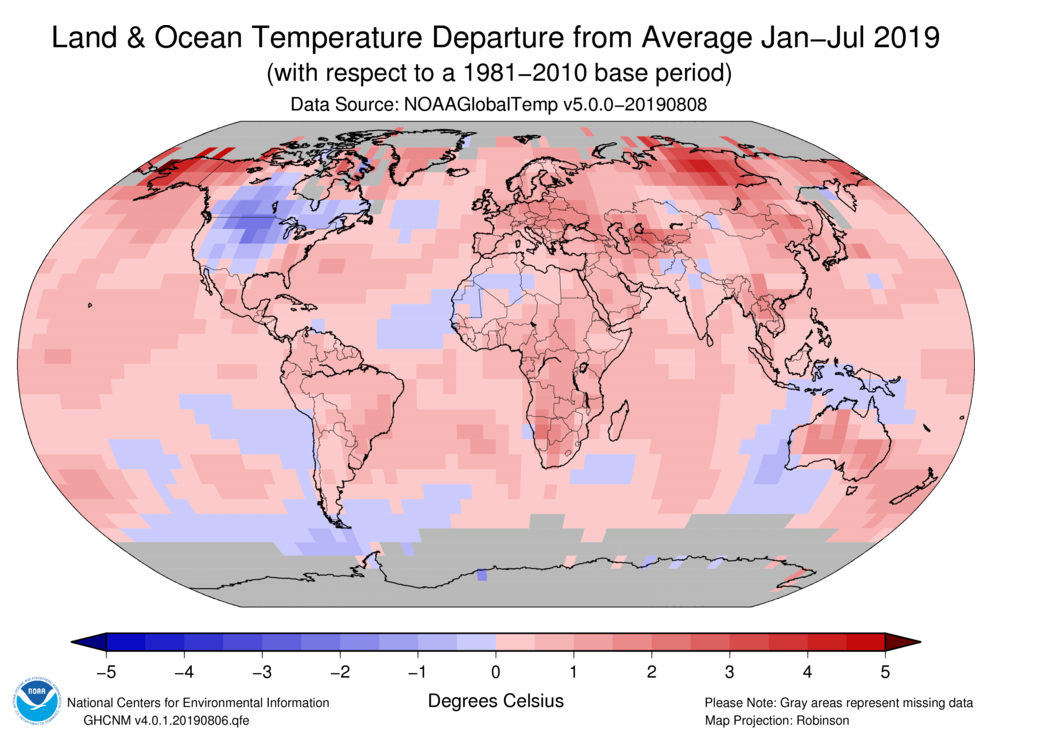
Just posting a nice graph via Robert Rhode of BEST. It's often forgotten than land globally is warming about twice as fast as the ocean surface, because land has a smaller heat capacity. (To put it another way, heat more easily penetrates through the sea surface than through the land surface, and ice.) So we're now seeing a global land average of about 1.7 - 2.0°C relative to the 1850-1900 average. That's 3.0 - 3.6°F. More as you go northward, less in the tropics. Oregon has seen a temperature rise of 2.7°F since 1895. Alaska, which just had its warmest July ever, has warmed by 4.5°F since 1960. (I'm using Fahrenheit because it's more familiar to Americans, including me.) The continental US, which had only its 27th warmest July (of 125 years) has warmed by 1.8°F since 1895.

And so it goes.


Wednesday, August 07, 2019

Nick Stokes Finds July 2019 Was the Warmest


Tuesday, August 06, 2019

What RCP is the World Actually On?

(Skip to the bottom if you want to know the answer right away.)

As you probably know, the IPCC established four Representative Concentration Pathways (RCPs) for their 5th Assessment Report. The number after each "RCP" is the assumed amount of radiative forcing, in watts per square meter, from all greenhouse gases in the year 2100.

The pathways cover many variables all across the board, and are the inputs climate modelers use to do their calculations. Here are the actual numerical values of all the parameters that go into each RCP.

So which pathway will the world follow, at least approximately? Which pathway are we on so far?

I'm going to simplify this by looking only at atmospheric CO2 concentrations, because this is a blog, not a journal paper.

The RCPs don't begin to differ until about 2009 (and go all the way to 2500, when RCP 8.5 assumes CO2 would be 1,962 ppm), and then differ slowly, but by 2018 we have this:


I got the CO2 values for the year by taking the annual CO2 radiative forcing (RF) from NOAA's Global Radiative Forcing results and using the equation

RF=(5.35 W/m2)*ln(C/C0)

to calculate C, which here means CO2 and C0=278 ppm. (The latter is the value the RCPs take for their first year, 1765.)

So we're between RCP 6.0 and RCP 8.5. To find an actual value, I linear interpolated between their values for each year to get our actual RCP value:


The values were small in the beginning because there wasn't much variance between RCP 6.0 and RCP 8.5 in the beginning -- the difference is now 4.5 ppm CO2 -- and because our path was below RCP 6.0 in the beginning. But we made up for it and now the value is stabilized, for now at least, at 6.8.

So we're at RCP6.8.

Monday, August 05, 2019

Neil deGrasse Tyson's Stupid Tweet

Distressingly, 266,000 people have liked this tweet so far.

It's hard to understand how Tyson couldn't see his tweet's lack of empathy and its smart aleck-iness. Or his poor reasoning -- all of those problems are amenable to preventative actions except walking down an aisle at Walmart.

Tyson should apologize. Instead of his qualified apology (which are never real apologies).