Wednesday, January 29, 2020

Wuhan Coronavirus Spreading Exponentially, But....

So far the spreading of the Wuhan coronovirus -- the scientific label is 2019-nCoV, n for "novel," as in new -- has been on an uncannily tight exponential:


Source: John Hopkins University.

The data have a doubling time of just 2.0 days. Of course, it's early still, and this kind of increase can't continue forever. (If it does, the entire population of the planet will be infected by March 7th of this year.)

And the number of deaths is relatively small, at least so far:


which accords with the "2-4%" number I heard this morning on NPR. But the epidemiologist they interviewed this morning said we should be much more worried about the flu:
BRANDON BROWN: Last year we had 34,000 deaths from the flu. The year before, we had 61,000 deaths. And this is just the United States. So the one thing that we should really be focusing on right now is the flu. We're in the flu season.
I can easily believe that. I had the flu in early 2001, as a healthy adult, and it was the worst illness I've ever had in my life. I was completely bedridden for two weeks, and out-of-sorts for another two weeks after that. (Thanks to my girlfriend-at-the-time Ann, who took very good care of me.) But if I get the same when I'm 70....

I have been very sure to get a flu shot every year since.

Another doctor they interviewed said:
MICHAEL ISON: The mortality for MERS was about 34%. Mortality for SARS was about nine to 10%. And currently, it's somewhere between two and 4% for this novel coronavirus.

AUBREY: That's an estimate, and it could change. But the bottom line for those of us who live in the U.S...

ISON: The risk of catching flu is exponentially higher than catching the novel coronavirus.
So as usual the media are missing the message, and unduly creating panic in the meantime.

I understand that a new disease with no known cure or vaccine is scary. But it's a matter of risk, which the media by-and-large never communicate well.

Friday, January 24, 2020

When to Launch a Spaceship to Another Star

I came across a charming little calculation recently, with a counter-intuitive result, that's too good not to pass along -- it's called the "wait calculation." It's the kind of thing you might kick yourself for not thinking of yourself. Anthony Kennedy published it in 2006. (Maybe this is a well known paper, but I just discovered it.) I wanted to do the calculation for myself before I looked at his solution, and almost got it right. Here's what I came up with.

Q: When should we launch a spaceship to another star system?

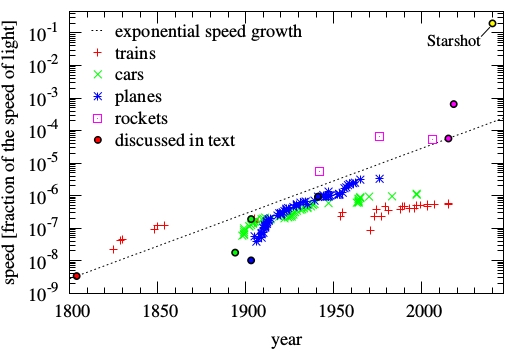
For example, we could launch a generation or hibernation ship today that would take tens of thousands of year just to reach Proxima Centauri with current technology, the nearest star to us at a distance of 4.2 light-years. (That star might even have a orbiting planet in its habitable zone.) Here's a graph from a section of the interesting site Atomic Rockets:


Or should we wait, and, if so, how long? Technology has been getting better for centuries, with an exponential increase in the maximum velocity we can attain. Let's assume this exponential trend continues.

Kennedy used some assumed values for velocity, but I'll try to make it bit more real.

A straight line on a log-linear plot represents exponential growth. The trendline goes from 8e-8*c in 1800 to 8e-3*c in 2010. (Beyond that is speculation.) These speeds are 27 m/s in 1800 to 24,000 m/s in 2010, which are reasonable -- from the speed of a good horse to the speed of the Juno space probe. 

With these two points you can do an exponential fit for speed, v = v0*exp(at) and get a=0.0069/yr and v0 = 0.021 m/s. (Strictly speaking v0 would be the speed when t=0, viz. 2010 years ago. Not quite right, but it won't matter much.)

Kennedy assumed the perhaps simpler formula v = v0*2t/h, which makes the velocity doubling time obvious. But I'm a student of physics, so e-exponentials it will be. In my calculation the doubling time is ln(2)/a = 100 yrs.

Let's set up the timeline:


t0 is when v=v0. In the above figure, the Δ's are time intervals. On them, subscript 0 is for the past interval, subscript L is when the last ship leaves the Earth, and subscript D is when the last ship arrives at its destination. W is for wait.

 ΔW is how long we should wait, starting today (well, from 2010) to launch the last ship. ΔL is how long the last ship takes to reach the destination.

Let ΔT be the time interval that a ship launched today would take to get to Proxima Centauri. At today's maximum velocity of 24,000 m/s it equals 53,000 yrs.

Here's where I went astray. I thought we wanted to minimize ΔL, but actually, as Kennedy says, we want to minimize ΔW + ΔL.

By taking the ratio of ΔT to ΔL, we get

ΔL = ΔT*exp(-aΔW)

where a and ΔT are given via the initial data. So

ΔW + ΔL = ΔW + ΔT*exp(-aΔW)

We minimize the right-hand side by differentiating with respect to ΔW and setting the derivative equal to 0. Doing so gives

aΔW = ln(aΔT) = 5.91
so ΔW= 852 years

Surprisingly (to me at least, initially), we can wait 852 years before launching a spaceship to the nearest star system, assuming our maximum attainable velocity keeps increasing exponentially.

Then we substitute to get
ΔL = 144 years

at which point the velocity of the last ship will be vL = 8.8 M m/s = 0.029 c. That doesn't seem unreasonable. It would arrive in the year 3007.

Surprisingly, waiting even longer to depart after the last launch means an arrival at the destination at a later time than does the last launch. An even faster ship doesn't compensate for a longer wait time. And waiting longer increases the chance that humans will go extinct, either by a natural disaster, a manmade disaster, disease, or warfare. But still, travelers might wait if they want to reach their destination in their own lifetime.

So if we wait we could be at the nearest star in 852+144 = 996 yrs, just under a millenium. The generation ship launched today takes 53,000 yrs, so the ship launched in 852 yrs would pass the generation ship almost immediately after it launches. In fact, it would pass it in (using the above numbers) just 2.3 years after it launched! How dispirating for the generation ship, which would have already been sloging on for 852 years, with a couple of scores of generations having come and gone. This calculation shows there isn't much incentive to launch anytime soon, if a later launch seems socioeconomically feasible.

You might wonder about acceleration and deceleration of the ships, but these are small. Even at the speed of the last launch, it would only take 10 days to start or stop if you desire a rate of ±g. You can add special relativity if you want, but it only affects the time intervals on board the ships, not the amount of time you have to wait on Earth.

However...the sticky point is the assumption that maximum attainable velocity will continue to increase exponentially, forever, or according to whatever function you want to pick. Kennedy has a lot of interesting thoughts on the durability of economic growth (vs available resources) and incentives, and his paper is worth reading just for that. He writes:
Using simple equations of growth, it can be shown that there is a time where the negative incentive to travel turns positive and where departures will beat departures made at all other times. Waiting for fear future technology will make a journey redundant is irrational since it can be shown that if growth rates alter then leaving earlier may be a better option. It considers that while growth is resilient and may follow surprising avenues, a future discovery producing a quantum leap in travel technology that justifies waiting is unlikely.
Kennedy also writes about the the social implications of waiting vs not waiting, and what travelers will find when they land. I'm not going to go into that, but read his paper.

Anyway the math isn't difficult; thinking up the problem was the hard part, and realizing it could be easily solved. I think it's a fun little problem. And, you get to think about space travel.

Note: slight corrections made from the original version of this post.

Wednesday, January 22, 2020

I Would Like to Work Here

The Jungfraujoch research station in Switzerland, which monitors the atmosphere:


Friday, January 17, 2020

The Testable, Falsifiable Science That Supports Human Causes of Warming


About Temperature Changes in the Ocean

Every time changes in ocean heat content make it into the news -- and it reached another high again in 2019, as it does almost every year -- woefully uninformed people like Willis Eschenbach complain that the temperature changes are oh so small, so what can it matter??

It's true that the ocean is vast and has a high mass -- 0.02% of the Earth's mass, in fact. It does not warm or cool easily. But:

a) that does not mean any change in its heat content is small, and

b) it certainly does not mean that the temperature changes by the same amount at all depths.

Exactly because the ocean is so massive, it takes a lot of heat to change its temperature -- in any region. Since 1955, the average temperature of the top 2000 meters of the ocean -- about 1/2 its average depth -- has increased by about 0.10°C. From the heat angle, that means the change in that region's heat content is about 300 ZJ (1 ZJ = 1021 J).

Exercise for the reader: compare this to the rate at which the Earth receives energy from the Sun, either at the top of the atmosphere or at the surface.

So who cares, right? Besides the question of the effect on marine life -- which I'm working on understanding, check back later, but let's point out that at equilibrium there will be little change at all -- what does this mean about the temperature change at various depths? It means it can still change by a lot by depth.

Using NOAA's data on ocean temperature anomalies and ocean heat content, we can calculate the temperature and heat changes in average regions. It's pretty simple; just recall that ΔQ = mc*ΔT (definition of specific heat). The data gives:


Put another way, here is the average temperature change as a function of ocean depth:


There's your thermocline. Calculating temperature change from changes in ocean heat content makes no sense unless you do it as a function of ocean depth.

Thursday, January 16, 2020

edX Course on Global Warming Science

This looks like a good course for anyone who wants to learn the basic science of global warming. It's a step beyond the course Michael Mann taught a few years ago; this one requires knowledge of calculus, mechanics and electromagnetism -- that is to say, college freshman physics. It's taught by Kerry Emanuel (et al) of MIT, and consists of video lectures. It's free to audit. If you haven't wanted to read a climate science textbook but want to go beyond the zeroth-order energy balance equation, this looks like a good opportunity.

Wednesday, January 15, 2020

Pct of Earth with Warmest and Coldest Decade

Here's an interesting result from climatologist Brian Brettschneider -- the percentage of Earth with the warmest and coldest decade since 1900:


BTW, GISS found 2019 was the 2nd warmest year for the globe in their records. Easily the warmest ENSO-neutral year. And it was the warmest year in the southern hemisphere. Northern hemisphere and land-only were the 2nd warmest year. This is the 5th year in a row that the land-only anomaly was > 1°C -- for 2019 it was 1.3°C (2.3°F). For Dec-19 it was a high 1.52°C (2.74°F) -- the 3rd warmest month ever (viz. third highest anomaly).

Friday, January 03, 2020

Greta Thunberg on Living Sustainability

This really hits the nail on the head, and very simply:
Greta Thunberg: "It is impossible to live sustainably today, and that needs to change."
I don't think I've ever said this so simply. Or came close.

Record UAH Temperatures

Here we are, in a non El Nino year, and UAH calculates that the lower troposphere was at a record high temperature for December in their records (starting in 1978).

It was also a record high meteorological autumn (Sept-Nov).

The year ranked 3rd highest in their records, making it a record high ENSO-neutral year.

Who ordered that?

PS: One genius at Spencer's blog, Bob Weber, thinks we're in a "mini-ice age."


The 2020s are going to be a contest to see which denier can make the laughable statement possible. Starting out, I nominate this.

US Exporting More Oil Than It Imports

This past week the US had net negative imports of oil -- that is to say, more exports than imports. It's the least net exports since at least 1990:

Click to Enlarge
Of course I don't know what's going on behind the scenes, but I wonder if US oil companies, abetted by the Trump administration, aren't engaged in a last gasp of oil drilling before climate considerations put an end to it. Making us an "energy superpower," in the words of former DOE chief Rick Perry. The gasp might last 10 years or even twenty, but they've gotta see it on the horizon, something coal saw too late.

Thursday, January 02, 2020

Australian PM Gets a Firehose of Criticism

The prime minister of Australia, Scott Morrison, visited New South Wales yesterday, which has seen some of the devastating, scary wildfires. In this jaw-dropping clip, the people there gave him a good piece of their mind:


Notice the fireman near the clip's end who refuses to shame Morrison's hand. Notice Morrison feebly trying to address climate change. It was so bad Morrison scambered home.

The fires are expected to get worse.

Tuesday, December 31, 2019

Saturday, December 28, 2019

Dogs, Nature’s Supreme Suck-ups

Nick Greene, at Slate, beginning to answer the reader question "I Want a Dog, but My Husband Refuses. Should I Just Do It?"
Humans didn’t always like dogs. According to one widely believed theory, history’s greatest friendship began thousands of years ago when packs of relatively docile wolves began loitering near hunter-gatherer camps to nosh on the leftovers and trash. These proto-pups realized this strategy was far easier than hunting, and so the species began its millennia-long effort to enter our good graces. Wolves evolved into dogs, and nature’s supreme suck-ups now live inside our houses and eat specially formulated food that we invented just for them. Playing the long game worked.

Nevertheless, some Homo sapiens, like your husband, have managed to resist dogs’ charm offensive. You may find it annoying, but you should be happy he’s doing this now and not thousands of years ago. If he had been one of those hunter-gatherers hanging around the campfire, he might have chased away those affable wolves and changed the course of human and canine history forever. Who knows, we could all be snuggling with our domesticated possums right now.
Nick Greene usually cover sports at Slate, and he's an interesting, funny, off-kilter writer who I always read.

Monday, December 23, 2019

Trump on Wind (Oy Vey)

On Saturday impeached President Trump gave a speech to the conservative student group Turning Point USA. He talked about wind power, and it went like most things do with Trump:
“I never understood wind,” Trump said, according to Mediaite. “I know windmills very much, I have studied it better than anybody. I know it is very expensive. They are made in China and Germany mostly, very few made here, almost none, but they are manufactured, tremendous — if you are into this — tremendous fumes and gases are spewing into the atmosphere. You know we have a world, right?”
Suddenly Trump is the world's expert on wind. Suddenly he notices we have a world. Apparently doesn't connect that to his administration's policies on the environment.
“So the world is tiny compared to the universe. So tremendous, tremendous amount of fumes and everything. You talk about the carbon footprint, fumes are spewing into the air, right spewing, whether it is China or Germany, is going into the air,” the president added.
Suddenly Trump cares about something's carbon footprint.
“A windmill will kill many bald eagles,” he said, according to Mediate. “After a certain number, they make you turn the windmill off, that is true. By the way, they make you turn it off. And yet, if you killed one, they put you in jail. That is OK. But why is it OK for windmills to destroy the bird population?”
Suddenly Trump cares about birds.

As The Hill pointed out, wind turbines kill about 1/6th the number of birds that cats do. And coal and oil and gas kill many millions.

PS: That first sentence, "I know windmills very much" -- sounds like something a 3rd grader would say. Help us.

Sunday, December 22, 2019

Reading of the Urgenda Verdict

Here's an abbreviated reading of the Urgenda case in the Netherlands, with English subtitles. It's only 18 minutes long, and clearly stated (as far as legal language goes). It's a dream for anyone wanting reductions in greenhouse gas emissions -- the court took the science into account (which the two parties did not dispute), explained why it has jurisdiction, then gave the verdict, ruling the government must cut its greenhouse gas emissions by at least 25% by the end of 2020 (compared to 1990 levels). (Court costs are to be paid by the Dutch government, but they didn't look too high.) I don't yet know the numbers or how onerous and difficult these cuts will be.

Update: According to the BP Statistical Review 2019, the Netherlands emitted 196 Mt CO2 in 1990 and 203 Mt CO2 in 2018. So they have their work cut out for them. A 25% drop from 1990 would be 2020 emissions of 147 Mt CO2, so it's actually a 28% drop from 2018. That seems near impossible.

Watching this, it seems to me that the ruling was made on the basis of Dutch civil law, not on their adherence to the European Convention on Human Rights. But I'm not lawyer and would be happy to hear from anyone who is, or others here who followed the verdict better than I did.

Friday, December 20, 2019

Historic Urgenda climate ruling upheld by Dutch Supreme Court

"The Netherlands' Supreme Court upheld the landmark ruling in Urgenda v. the Netherlands, announcing its decision on Friday that governments have a human rights duty to protect their citizens from climate change."

https://www.climateliabilitynews.org/2019/12/20/urgenda-climate-ruling-netherlands-supreme-court/

Stoat has more, and some opinions.

Wednesday, December 18, 2019

And....

Oh yeah, and Australia had its warmest day on record -- a national average of 40.9°C. Beat the old record by 0.6°C, which was set in 2013.

For nonmetricians, that's 105.6°F and an old record of 104.5°F.

Forecasters say it may be broken today or tomorrow.

"Extreme heat is the number one weather-related killer in Australia."

+drought +wildfires. Good think global warming is a hoax.

Sperm Whale Sockets and Other Interesting Things

Nature lists its "ten people who mattered in science in 2019" (with interesting stories for each one). The only two I recognize are Great Thunberg and Sandra Díaz, a co-chair on the big biodiversity report that came out this year.

A climate donnybrook in Congress involving familiar names. Soon they're going to have to ban swords, hatchets and axes.

From 2015: "New analysis of records stretching back 400 years to the observations of Renaissance scientist Galileo shows that global warming is not the result of solar activity."

This NY Times photo-essay on clouds photographed by members of the Cloud Appreciation Society is interesting and even moving.

A economics textbook by Harvard economist Gregory Mankiw sells for $280. He may have made as much as $42 million from sales of this book.

Did you know that sperm whales don't have upper teeth, but sockets for their lower teeth?


Monday, December 16, 2019

November Temperatures

November surface temperatures are in. NOAA, GISS and JMA all found November 2019 to be the 2nd warmest in their records, after the big El Nino season in 2015.

2019 will be the 2nd warmest year in the records. The last five years have been the last five warmest years.

Of note: the GISS land-only temperature anomaly for November is +1.78°C relative to 1880-1909 (= +3.20°F). It smashed the old November record by a whopping 0.18°C.

Friday, December 13, 2019

The Expanse Season 4

The Expanse season 4 is now on Amazon Prime. I watched a lot of it last night. It's very good -- humans have started to go through to Ring Gates to the many solar systems (1,700 it said somewhere) on the other side. Much of S4 takes place on an alien planet called "Ilus." The planet is too jacked-up to be representative of hard science fiction, which I prefer, but there are market considerations to be made.

At this point a lot has gone on in the previous three seasons -- you might want to watch a recap, which I didn't do but wish I had. By now there's a lot to remember and a lot of alliances and enemies to keep track of. I think the problem is, for me, that binging on a show's season in a day or two doesn't register the details inside me as does a week-by-week show where everything is doled out more slowly (it seems). Maybe it's the I'm just a dumb boomer (but only by a few years!) and will never quite think on Internet time. Maybe I just have a bad memory.

All the main characters are back, including my favorite, Camina Drummer, played by Cara Gee. She's now an OPA (Outer Planets Alliance) leader, who seems to have gotten a promotion this season to a central position. The Roci's Amos is as big a loveable, muscular, dead-eye golute as ever, who takes ever more responsibilities but never disappoints. At least not yet. (The Expanse is much less quick to kill off characters than Game of Thrones, for sure. Even some -- well, one -- of those who die, didn't really.)

Also, props to Bobbie, an alert, aware, hard-core cool marine to her core. Maybe.

Events move pretty fast through the S4 episodes, and if you can watch only one episode at a time you're a better person than I am.

To finish, I'll comment finally on some of the quick transitional screenshots shown between scenes -- the large seawall around Manhattan (to the right), the even larger seawalls around Denmark, and a very quick shot of the southeastern US at night, showing Florida broken up into several islands. Is saving Manhattan really going to be as simple as erecting humongous steel walls along all its coasts and rivers, going up, for the Hudson, many miles I'm guessing? (Dozens of miles?) Alas, I'll likely never get to know.

PS: I miss Naomi's S1 haircut.

Thursday, December 12, 2019

The Bigots and Misogynists Come Out in Force Against Thunberg

Sure enough, the bigots showed up to denigrate and smear Greta Thunberg for being chosen as Time magazine's Person of the Year. Here's Eric Worrall at WUWT:


with a picture of Thunberg mocked up to show a halo around her. Of course there are vile comments from vile commenters, whom 99% are cocksure global warming is false, is a hoax, is about to end, has ended, etc (despite the fact that it keeps getting warmer).


This guy thinks he knows just what's wrong with her:


This guy thinks the real problem is that she's...talking. He just wants her to shut up:


Here's a real women-hater:


And finally, there's this inevitable, unoriginal comparison:


The misogynists at Gateway Pundit gang up to denigrate her, and for good measure Chelsea Clinton too:


and of course the Misogynist-in-Chief can't handle losing to a 16-year old girl, gives her advice that he himself should take:


This is about all the hate I can handle right now....


Wednesday, December 11, 2019

Greta Thunberg Time's Person of the Year

Time magazine just made Greta Thunberg their Person of the Year.

Excellent choice, which brings attention not just to her but to the climate change problem in general.

And it ought to infuriate even more all the middle-aged white climate denying men who can't abide someone speaking their mind -- especially when it's a female. They'll only look more foolish (than they already have) attacking a 16-year old girl. They're turning from climate change deniers to bigots -- or more likely, their bigotry was there all along, but it's now coming out their every pore.

Good.

Added: And she was chosen over Trump, who was one of three finalists not chosen. Other two were Nancy Pelosi and the U.S. whistleblower. Whatcha wanna bet he can't simply congratulate her sincerely?

Tuesday, December 10, 2019

Help Me Understand the AMOC

I'm confused about the AMOC, the Atlantic Meridional Overturning Circulation. I thought it carried heat from the Gulf of Mexico northward to Europe, like this:


But now I see this University of Washington press release about a Nature paper, and the press release gives this view of the AMOC:


The directions seem reversed. So which is it??


The Problem of Space Debris

I like this quote. Read about the Kessler Syndrome if you don't know about it. I wrote about it for Yale Climate Connections several years ago, as an example of a big problem that was long foreseen but ignored until (perhaps) it's too late.


Image from Nature Briefing.

Saturday, December 07, 2019

Castigating Greta

On Watts' blog Eric Worrall calls Greta Thunberg a "climate messiah."

Delingpole calls her a "climate puppet" and a "Marxist." Earlier he called her St Greta of Thunberg."

In August Aaron Banks in England wrote "Freak yachting accidents do happen in August..."

And of course there have been many insults about her mental health, simply because she is on the autism spectrum and has been open about it.

Sometimes I think these hard core deniers are just worse people human beings.

Thursday, December 05, 2019

US Coal Production Under Trump

It's not going up:


When he campaigned in 2016, Trump said:
On Thursday, Trump drew wild applause in Charleston, W.Va., by telling miners in hard hats and reflective stripes to get ready to be "working your asses off" in reopened mines if he's elected. Some people waved signs saying, "Trump digs coal," and the business tycoon joked about needing a spritz of hair spray after trying on a miner's helmet, the gift of an industry group.

"I'm thinking about the miners all over this country," Trump said. "We're gonna put the miners back to work. We're gonna put the miners back to work. We're gonna get those mines open."
It was another lie.

Tuesday, December 03, 2019

2019 Global CO2 Emissions, Up 0.6%

The Global Carbon Project says 2019's global CO2 emissions will be 0.6% higher than 2018's. An increase, but less of an increase than for the last two years.

The Way It Is, December Third, Two-Thousand Nineteen

UAH modeled November 2019 to be the warmest November in the lower troposphere in their records. UAH.

AVISO's latest global sea level number is the highest in their records. This is with "near real-time" data analysis. We'll see after it gets fully processed.

The reading and math scores of 15-year old US students have not improved in two decades. Their latest scores were "slightly above average in terms of reading ability but below the math skills level of peer nations." Which country's students came in first? Do you really have to ask?

I can't think of a better way to win the future than to have your 15-year olds lead the world in reading and math scores. Whatever your system of government.

A dead whale was found to have 220 pounds (100 kg) of debris in its stomach. How terribly sad.

Trump's tariffs on Chinese solar panel imports have cost about 62,000 US jobs. That's more than the entire employment of the coal industry here.

World per capita coal consumption is flat-to-declining again, after increasing about 30% last decade:


Data from BP's 2019 Statistical Review. Coal mass is converted to energy units using their value of 1 toe = 4.187e10 J for modern power plants. "toe" = ton of oil equivalent. 

PS: Apologies for the headline to Walter Cronkite.

Sunday, December 01, 2019

Subsidized Rebuilding and Subsided Insurance

Bay St Louis, Mississippi:


But some people are being forced to leave. Read this great article from CityLab, which also includes this table:

This is the highest value I've yet seen for lost property value.

Wednesday, November 27, 2019

Ronald Bailey Still Gets It Wrong!

I see that Ronald Bailey of Reason tried to correct his recent long article on climate change, after what I wrote here. But he still gets it wrong, and still shows he doesn't understand the basics.

His correction says:


The problem isn't with the thickness number! It's with the whole concept of acceleration!

His correction is very fuzzy and doesn't address the problem in any way.

The problem is that acceleration isn't measured in millimeters, or feet, or any unit of length. It's measured in units of length per time-squared (say, mm per year-squared).

Did Bailey take basic physics? Or did he forget it all?

How come people who don't know science get jobs writing for a place for decades, and I'm still struggling as a freelancer? Must be my noxious personality.

The First Big Pollution Event

I like this cartoon from Stoat:


If you don't get it, it refers to the "Great Oxidation Event" of about 2.3 B years ago, a situation sort of like 'your terrorist is my freedom fighter.'

Tuesday, November 26, 2019

Key West's Sea Level Rise

Perhaps you read the NYT article on sea level rise in Key West, Florida. (Or, as Esquire put it, "The Great Chinese Climate Hoax Is Recreating Venice in the Florida Key.") People there have been dealing with sea level for almost three months now. I looked for the sea level data for Key West, and October had the highest value ever.

click to enlarge

Sea level there is about 210 mm (8 inches) higher than last October. Another view is

click to enlarge

Right now I'm not in the mood to calculate the error bars. Calculation of error bars is left as an exercise for the reader.

Residents there want their roads raised:
Monroe County, Florida
Elevating a third of the county’s 300 miles of roads could cost $1 billion, Ms. Haag said. “We are the most vulnerable county in the state, if not the nation.”
That works out to $1,900 per foot. Monroe County, Florida has about 78,000 residents, but Key West is only 25,000. So a billion dollars to raise roads is $40,000 per resident. It seems to me difficult to justify that, for a place that is going under anyway. (If the roads don't, beaches and yards and parking lots will. What about freshwater? What about insurance? Who would write a mortgage on any building there put up for sale?) But I don't expect that would stop the federal government, who is going to face a lot of these situations and will want to look like they're doing something, at least to stop the clamor. And there'll be a lot of sympathy for vulnerable residents -- at least until the costs get too high. It's a difficult situation and will be ever more dire. In a hundred years the thing most remembered about Trump will be his idiocy and (by then) criminality on climate change.

What do you think?

PS: In 2016 Monroe County voted 51.0% for Trump, 44.1% for HClinton.

Monday, November 25, 2019

Mann Lawsuit Update: Supreme Court Declines to Hear

From Bloomberg Environment:
The Supreme Court won’t step into a legal dispute between a prominent climate scientist and a pair of conservative organizations that questioned his work and compared him to a convicted child molester.

The justices on Nov. 25 declined to review an appeal from the Competitive Enterprise Institute and the National Review, which want to stop climate scientist Michael E. Mann from pursuing defamation claims against them.
Mann is quoted:
“We are pleased with this nearly unanimous decision by the Supreme Court to deny the appeal” in the defamation case, he said in an email. “We are looking forward to the trial.”
From here:
The case goes back to the local-level Superior Court of the District of Columbia... The proceedings are currently in the discovery phase, with both sides collecting documents to support their arguments.

Sunday, November 24, 2019

One Ton of TNT

100 t TNT
Did you know that "one ton of TNT" = 1 billion calories, by definition?

I just stumbled on this when I used the Hiroshima bomb strength of 63 TJ = 15 kt TNT and found 1 t TNT = 4,184,000,000 J and I recognized the "4184" from converting joules to calories. Sure enough it's true.

And it seems this is a metric ton -- I always thought "ton of TNT" meant a British ton (2000 lbs).

Also, 1 t TNT = 1,162 kWh. I would have guessed it was a lot bigger. I used 0.75 t TNT of electricity last month. (Electric heat, unfortunately.)

Huh.

Friday, November 22, 2019

Ronald Bailey Can't Get the Simple Stuff Right

Ron Bailey at Reason wrote a long essay about global warming in which he saw fit to cite Tony Heller (aka Steve Goddard), the Washington Examiner and other drips who have no intersection with the scientific realm. Maybe he's been a denier at-heart so long he just can't help it.

Even still he couldn't get the most simple part of the science right:
A February 2018 study in the Proceedings of the National Academy of Sciences based on satellite altimeter data reported that sea-level rise at 3 millimeters per year has accelerated at a rate of +0.084 millimeters (about half the thickness of a penny) since 1993.
This isn't just a typo -- Bailey clearly does not understand what acceleration means. (It's not a length, i.e. acceleration isn't measured in units of length [millimeters]. It can't be compared to a penny, anymore than a quart can be compared to an hour.)

I'm a firm believer that if a science writer (or anyone) can't understand the most basic parts of the science, he/she gets no say on the more complicated stuff -- regardless of his/her ultimate conclusion.

The 9s Math Wall Clock

You can order here. (I don't get any money if you do -- just through this was a cool idea.) All 9s in base 10. All square roots taken as positive.


Thursday, November 21, 2019

Another Community Grappling with Sea Level Rise

I think the press has caught on, because I'm seeing more and more stories about east coast towns and cities dealing with sea level rise. The other day was this NYT story about Virginia Beach saying no to developers that wanted to build new homes in more frequently flooding wetlands. Today is this well crafted story and video by Tom Horton at Yale e360 about a community, Money Island, on the Delaware Bay in southern New Jersey.

The video isn't embeddable, so you'll have to go there to watch it. But it's worth the 15 minutes. It's a very visceral portrait of real people dealing with the economic and emotional consequences of the rising sea level that is slowly drowning their much loved community. Trump should watch it.

New Jersey's Blue Acres program has been buying out homes there, about 300 of 1500 in five years, after the devastation of Hurricane Sandy in 2012. This is going to happen along coasts everywhere -- it will be taxpayers who make home owners whole, because the homeowners can't be expected to just write off the value of their largest asset. It also shows how the demise of these communities will accelerate once it begins, as their tax base erodes as people begin leaving and the land left behind turns into tax-exempt open spaces. (Money Island has lost $15 million off their tax base so far.) That leaves less money to deal with the effects of rising tides on roads and other infrastructure. It's a downward spiral.

The operative word is "undevelopment." We're going to be seeing a lot more of that as time goes by.