Sunday, December 01, 2013

No, Climate Science Hasn't Lost It's Way

Judith Curry writes:


by linking to an LA Times article about medical science (which, let's stipulate, is not a physical science; see below).

In my opinion (and as I commented on Curry's blog), any scientist who has to ask “has science lost its way?” has just admitted that their ideas can’t compete in the arena of ideas. They are looking to win the argument by other (unscientific) means.

There is a simple way to win the scientific debate: produce better science. Period.

That has never, ever failed to win the day.

Ever.

But medical science is very different from the physical sciences like physics, chemistry, geology, mathematics, climate science, biology, etc.

For one thing, it's not nearly as rigorous. Yes, climate science deals with a very complicated beast -- the Earth's climate -- but medical science deals with one that is far more complicated -- the human body, or, more appropriately, the vertebrate body or even the organic organism.

That body is an immense bag of miracles, developed over billions of years of evolution, reaching a complexity we can barely begin to understand.

Not so for physics, or climate. We know, very well, the laws of blackbodies, and of quantum mechanics, and of radiation, and we know that the Earth will emit infrared radiation and that gases like CO2, CH4 and H2O have molecular energy levels that will absorb it.

Some of that absorption will be emitted back downward, towards the surface.

That is global warming. That's really about all you really need to know.

Global warming is required by the laws of physics. I think it was Michael Mann who said, during one of the times he was unjustifiably hauled before a Congressional committee, and then asked what it would take for him to admit that anthropogenic global warming was wrong, who replied, "Everything I know about physics and chemistry would have to be wrong."

And he was right. Completely.

Our world -- surface, oceans, sea ice, glaciers, and ice sheets -- must warm if we continue to emit greenhouse gases into the atmosphere.

Yet how that downward, extra heat gets distributed into the Earth's systems, and how it makes them evolve over time, is a very, very difficult problem. There are a great many variables, and the equations that describe these processes are very complicated, full of feedbacks.

But the planet will warm. It has to. It must. It will.

Attempts to parse that warming, by claiming that science is wrong because it can't yet describe the distribution of the warming, are inaccurate if they claim the Earth's many systems won't be affected, that they won't change.

Those systems will change, just in ways we can't yet predict, both in extent and in time.

But we can predict that they will change, somehow.

That's very, very different from medical studies where, primarily, a huge amount of money is at stake, from patents and partnerships and the results of clinical trials and how the science is interpreted.

If these clinical trials even are science. I once heard a talk by a science journalist (no names) that what journalists claimed as a  "medical science" wasn't really a science, because it had too many variables and too many unknowns.

And I mostly agree with him.

So trying to piggyback on studies about medical papers isn't very convincing. They are barely doing science -- climate scientists are doing science, in the grand tradition of the king of the sciences, physics.

Their vulnerabilities are not the vulnerabities of the physical sciences. And they shouldn't be lumped toether, and blamed together. There are standards, and then there are standards.


Saturday, November 30, 2013

The Fence -- Then and Now


Via Imgur.

Clues to Typhoon Haiyan’s Ferocity

An article in this week's Science magazine suggests that one factor behind Typhoon Haiyan's immense strength was warmer ocean waters underneath the surface.

In "Clues to Supertyphoon’s Ferocity Found in the Western Pacific" (sub req'd), Denis Normile writes:
Tropical storm watchers agree that Haiyan was probably the strongest typhoon to make landfall when it slammed into the Philippines on 8 November, packing winds of up to 314 kilometers per hour. What gave Haiyan, which killed thousands and displaced millions, its deadly wallop?

Researchers think they have at least a partial answer to that question: unusually warm subsurface Pacific waters east of the Philippines. A related phenomenon—rising sea levels in the western Pacific—likely abetted Haiyan's devastating storm surge, which caused more deaths than the winds themselves.

Typhoons draw heat from the ocean for the energy that generates their winds. Typically, as a storm's winds increase, they stir up deeper, cooler ocean waters that temper its strength. This cooling effect "is nature's brake to stop typhoons from intensifying," says I-I Lin, a specialist in typhoon-ocean interactions at National Taiwan University in Taipei.

Drawing on data from satellite observations and Argo floats—thousands of instrumented, subsurface probes that measure ocean temperature, salinity, and current speeds—Lin and others have documented a steady 2-decade rise in subsurface temperatures in the western North Pacific and a bulging warm water layer. The warmer and thicker that subsurface layer, the more heat is available to feed a storm. Oceanographers use a measure called the Tropical Cyclone Heat Potential (TCHP) to quantify the heat reservoir. Lin and colleague Iam-Fei Pun reported online on 3 September in Geophysical Research Letters that the TCHP where most cyclones develop in the western North Pacific has increased 10% since the early 1990s.... While surface waters along Haiyan's path were only slightly warmer than normal, waters down to 100 meters were 3° warmer than the historical average. So as Haiyan churned up western Pacific waters, it drew more wind-intensifying heat, Lin says.
But it's not nearly as simple, these researchers say, as "global warming means a warmer ocean":
The warm bulge in the western North Pacific is the result of stronger easterly trade winds. This phenomenon also aggravated Haiyan's storm surge. In addition to blowing heat westward, the winds are literally piling up water in the western Pacific, where the cumulative sea-level rise over the past 20 years exceeds 20 centimeters, says Bo Qiu, an oceanographer at the University of Hawaii, Manoa. "It is likely that the elevated sea level contributed to the flood and inundation problems" in the Philippines, he says.

While many observers blame Haiyan's destructive power on climate change, tropical storm experts say there is little hard evidence of a link. "It is possibly natural variability," Lin says. Nor is it certain that the western Pacific has become a supertyphoon breeding ground. Although warmer subsurface waters might raise the risk, Lin says, atmospheric conditions may not always cooperate.

Friday, November 29, 2013

Cellular Injections

This is an image of nanowires being used to inject chemical compounds into immune cells from leukemia patients. Made by Alex K. Shalek, Jellert T. Gaublomme, and Hongkun Park of the Broad Institute of MIT and Harvard and Harvard University; part of the the Koch Institute Image Awards, from the journal Cell.

Wednesday, November 27, 2013

Noam Chomsky Shuts Down "Truthers" of All Stripes

At a recent talk, Noam Chomsky was confronted by a 9/11 "truther" who asked him to get onboard with an investigation of Building 7 (the the third World Trade Center building that fell later on that day), because "the media is covering up things."

Chomsky's reply was spot-on, and applies to climate change even more than it does to 9/11:
During a "Policy and the Media Prism" lecture at the University of Florida several weeks ago, 9/11 truther activist Bob Tuskin asked Chomsky what he had to say about Building 7, the third structure to collapse on Sept. 11, 2001. The media, in Tuskin's opinion, has ignored evidence about the building's collapse.

Chomsky shut down Tuskin's claims. If scientists had strong evidence to support 9/11 conspiracy theories, he said, they would have presented their discoveries to other architects and engineers, would have published their arguments in scientific journals and attempted to persuade other professionals that they'd found something worth investigating.

"There happen to be a lot of people around who spent an hour on the Internet and think they know a lot of physics," he added, "but it doesn't work like that ... There's a reason there are graduate schools in these departments."

Tuesday, November 26, 2013

2013 Atlantic Hurricane TIKE Near-Record Low

The most commonly cited measure of hurricane activity is ACE - Accumulated Cyclone Energy.

Except it's not an energy; its definition is

\text{ACE} = 10^{-4} \sum v_\max^2

where the summation (that's the capital sigma, "Σ") for a particular storm is taken every six hours starting at midnight, vmax is the estimated maximum sustained velocity of the storm, and the 10-4 is just to make the number reasonably small and friendly.

This isn't an energy, because it doesn't take into consideration the mass of the storm, which is the total of its density for every small parcel of air times the volume of that parcel. (If you assume all storms have the same height, you can substitute area for volume.) That's what the new metric IKE does - Integrated Kinetic Energy -- which I wrote about earlier this year.


It was invented by Vasu Misra and colleagues at Florida State University. (Here's a PDF of their preprint.) In practice the integral is taken every six hours, but does include a storm's size -- Misra et al take the storm's height to be 1 meter, centered at the 10-meter level. And if you want to gauge a storm's potential for damage, you're going to want to know its size as well as its velocity.

TIKE - Total Integrated Kinetic Energy - is then the sum of all the IKEs.

After Hurricane Haiyan I asked Misra if he'd calculated its IKE, which he hadn't, but he and his colleagues did just calculate the TIKE for the 2013 Atlantic Hurricane system. As the figure on the right snows, it was near a record low of 1,350 terajoules (TJ), with mid-September's Hurricane Ingrid in northern Mexico accounting for 41% of that.

(By way of comparison, the yield of the bomb dropped on Hiroshima was 63 TJ, but this isn't really a direct comparision, because, again, the height of the storms is taken to be 1 meter -- in essence, all storms are taken to be the same height, which is then divided out of the definition.)

They write:
"... the total TIKE value for 2013 is equal to only 16% of the average annual TIKE value from 1988-2012. By this metric, the 2012 season was about ten times more active than this most recent season, and Hurricane Sandy accumulated more kinetic energy than did the entire 2013 season. The only North Atlantic hurricane season since 1988, to accumulate less TIKE than this past season, was the 1993 season, which had just over 1000 terajoules of track integrated kinetic energy."
So how do TIKE and ACE compare? This is from Misra et al's paper:


You can't really compare TIKE and ACE, since they have different units, but you can compare their trends (relative to, say, their total average).

Ryan Maue publishes the monthly ACE values for the globe and four different regions; for the North Atlantic hurricane season (assuming it's over), the total ACE for 2013 was 29, compared to an average of 94 since 1970, and 133 last year.

So this year there was an even bigger dropoff in TIKE than in ACE.


Comet ISON May Have Disintegrated

Says Science News:

http://news.sciencemag.org/space/2013/11/scienceshot-comet-ison-could-be-no-more

Saturday, November 23, 2013

John Hiatt & The Goners - Your Dad Did

Judith Curry's Version of Denialism

Here is a very good example of what's wrong with much of the science blogosphere, and why science, with its emphasis on evidence and careful, deliberate thought, doesn't really fit in to it.

Judith Curry passes along an interview with Hans von Storch, said to be translated by someone named "Pierre Gosselin." Here is her quote, and here is how Gosselin's translation ends:
Also, von Storch believes that the oceans could be warming up, but that there is very little data out there to confirm it.
That's how Gosselin's interview ends -- with no supporting evidence at all.

That matters, since almost all of global warming goes into the ocean.,

That makes the statement gossip, not science. There is no evidence whatsoever to support it. 

von Storch offers nothing -- or, if he did, the interview didn't communicate it.

First of all, if there is such little data to confirm it the oceans are warming, why does von Storch believe it? Does he believe things for which there is no evidence? 

And Curry passes it along without any supporting evidence at all. 

That is not what a good scientist does. 

Real scientists support their assertions, and accept the assertions of others based on the evidence. 

That, clearly, is not what's happening here. 

Judith Curry wants to be a player. Clearly. My distinct impression is that she thinks that means she has to offer up controversial statements and take an obstinate position.

It might get her a lot of comments. I wonder if it gets her a lot of respect.

Because a great deal of work has gone into calculating the changes in ocean heat content over the last 50+ years. Really hard work, digging up records and undestanding them and figuring out what they say and their limitations.

People like Sydney Levitus, who just retired from NOAA, have spend entire careers trying to understand ocean warming. Look at this document -- NOAA Atlas NESDIS 60, WORLD OCEAN DATABASE 2005 -- an enormous amount of work has gone into it -- millions of observatoins. And even then they can't get the error bars for OHC less than about 50% for the 1950s-1960s. 

Look at Ch 4, pg 69 -- "EXPENDABLE BATHYTHERMOGRAPH DATA"

The next few pages show clearly that they have worked on understanding XBT accuracy, their errors, teir corrections, etc.

Or check out their section 1.2, pg 24:
With the distribution of WOD05 there are now approximately 7.9 million temperature profiles and 2.7 million salinity profiles (as well as other profile data and plankton data) available to the international research community in a common format with associated metadata and quality control flags.
That is really difficult scientific work. Damn hard. Infinitely harder than blogging.

So people like Judith Curry and Hans von Storch don't get to dismiss that work with a wave of the hand.

And this is just one example. It is endemic in the denialist blogosphere -- and, yes, I am choosing the word "denialist" knowing full well what it means -- it means people who take a position without regard to the evidence. Which is exactly what Curry is doing here. 

Maybe von Storch did too -- but I can't tell without knowing the full transcript of his interview that was translated. 

This kind of shit has to end. Either people like Judith Curry are scientists, or they are not. Posts like this indicate she is not, even if journalists (including me -- I try to include all voices in my writing, though it's getting ever harder) write her and even if she gets creampuff interviews on NPR -- one of the sadder recent moments in my trade of science journalism. 

Thursday, November 21, 2013

Summary on ocean acidification

A good review document is always hard to find, so here's one on ocean acidification by the International Geosphere-Biosphere Programme: Ocean Acidification Summary for Policymakers 2013.

Here are the first few points of the report:


"Climate scientists are the opposites of weathermen"

This, by Bryan Walsh on Time.com, is very well put:
Climate scientists are the opposites of weathermen — the further out they’re asked to forecast, the more confidence they tend to have in their predictions.
I think a lot of people don't understand this, including meteorologists used to wresting with the next day or two's forecast. In physics there are a great many things that you can calculate over large spatial scales and/or over long time periods, that you cannot calculate for small distances or short time frames -- like essentially all of thermodynamics and statistical mechanics. Or fluid flow. Or cosmology. Physics is very good at dealing with very simple systems, like a hydrogen atom or Mercury's orbit around the Sun, and large things, like the average temperature of a body of water or the properties of a universe. It's all the stuff in between that's difficult, and that's where most of climate science falls, once you get past the basics of energy balance. We probably knew enough to be wary of the dangers of fossil fuels shortly after Arrhenius did his calculation in 1896 -- and if he'd lived in India instead of Sweden, he might not have thought the warming would be so beneficial.

Physics leads to an argument like this, a comment on John Baez's blog Azimuth:


UK Politicians Grapple With Cowtan and Way

This is why you shouldn't take your science from politicians; from The Independent, writing about the Cowtan and Way study:


Of course, it's perfectly plausible that both the ocean is warming and surface warming has been underestimated, and (therefore) that the rate of global warming is accelerating....

At least Lord Lawson of Blaby, a prominent scoffer in the UK, is willing to first read the paper:


Other people are spinning as fast as they can. David Whitehouse sniffs that the paper's explanatory video wasn't warranted -- because, you know, we just can't have any attempts to clarify and explain the paper's findings:
This research is interesting but doesn’t live up to the headline that it explains the ‘pause.’ It also does not warrant such an extensive press release, complete with explanatory videos. It is clear that it has been used as a political tool to deride ‘sceptics’ who rightly see the ‘pause’ as significant. By aiming at ‘sceptics’ such an approach also derides many working scientists who are trying to explain the ‘pause.’ This is regrettable.
The Pause has been good to scoffers and naturally they will be sad to see it go. WUWT has had several posts on Cowtan & Way since it came out -- do you remember when WUWT once criticized the surface station records? Now they are defending them. It must be very confusing....

Monckton tries the usual malarkey, posting this:

clip_image002

Why would you pick a seemingly random starting point like December 2000? Do you even have to ask? It's the first month when the HadCRUT4 linear trend to the present turns negative:


Wednesday, November 20, 2013

Cost to Sequence a Genome

The cost to sequence a human genome may be botomming out at about $5,000, from NEJM:


State-of-the-art sequencers do it in about 24 hours....

Cartoon: Budget Squeeze for 2 C

This is from the IEA's recently published World Energy Outlook 2013:

 20131112-173623.jpg

Blogger Lars Boelen took this and added historical information from CDIAC, to get a more detailed picture:

20131116-001801.jpg

We are a generation that will go down in infamy.

Monday, November 18, 2013

In Diplomacy, No Questioning Manmade Climate Change

John Baez recently went to an Interdisciplinary Climate Change Workshop in Waterloo, Canada, and reported back on some of the interesting things he learned. Among them:
In international diplomacy, there is no questioning the reality and importance of human-caused climate change. The question is just what to do about it.
Governments go through every line of the IPCC reports twice. They cannot add anything the scientists have written, but they can delete things. All governments have veto power. This makes the the IPCC reports more conservative than they otherwise would be: “considerably diluted”.
The climate change negotiations have surprised political scientists in many ways.
(Read his post to find out why -- the reasons will surprise you. The U.S. looks more like a major opponent of climate change action than a proponent.)

The COP 19 meeting has been taking place in Poland. Perhaps there is coverage of it, but nothing much that I've seen. Is anyone paying attention?

I really wish I could be a journalist there, or even here, trying to ask, answer, and investigate hard questions that surround that meeting. But as a freelancer I just can't afford to spend the kind of time it takes to dig in deep and do a good investigative job at that, nor is there much of a market for that anyway. It's frustrating.    

AGU Mtg: One-on-One Availability With an Attorney

This, from the AGU Fall Meeting program, isn't your typical event at a science meeting:


It runs for seven hours on each of four days.

Freeman Dyson Quote

I found this quote by Freeman Dyson in Paul Davies' Are We Alone?: Philosophical Implications Of The Discovery Of Extraterrestrial Life:
"I do not feel llike an alien in this universe. The more I examine the universe and study the details of its architecture the more evidence I find that the universe in some sense must have known we were coming." 
I don't know how that intersects with his views on global warming, but the intersection seems unlikely to be the null set.

Saturday, November 16, 2013

Chart of R&D Spending, Number of Scientists

Here's an interesting chart from this week's Science magazine: each country's R&D spending as a percentage of GDP, and its number of scientists per capita.


In a separate article, Science published this:


Wednesday, November 13, 2013

Hertsgaard-Spencer Debate

I have to agree that Mark Hertsgaard came off as a little boorish in his brief debate with Roy Spencer on the Piers Morgan show:


He interrupted Spencer, and said "you don't even agree that climate change is manmade," which is just wrong -- Spencer does accept that humans are playing a role in climate change, he just thinks climate sensitivity is lower (OK, significantly lower) than most.

On the other hand, Spencer's "climate has always changed" line is facile.

Hertsgaard didn't seem interested in any unknowns or uncertainties regarding Pacific typhoons, like these. A much better point, it seems to me, would have been that while we don't know if this typhoon was augmented (let alone caused) by global warming, there are indications they are getting stronger and that, together with sea level rise (which is especially fast in the western Pacific), increases future risks, and will increasingly do so.

And Spencer's claim that Hertsgaard only interviews scientists on one side doesn't seem fair to me. I've asked Spencer for an interview at least once, and never even got a reply.

There's certainly room for debate, but Hertsgaard reinforced the stereotype of the angry environmentalist, especially against Spencer's calm demeanor.

Anyway, these kinds of debates look increasingly fruitless, just a way to manufacture a quick conflict to rile viewers. Maybe that's good TV, but then so would a joust be with two horsemen carrying lances. It's like Gavin Schmidt told John Stossel, which one commenter on Spencer's site posted:
John Stossel – “I’m not qualified to debate you as a climatologist. Why won’t you debate Roy Spencer? He’s not a flake. He helped produce the data that the government uses for atmospheric temperature...”

Gavin Schmidt – “I’m not a politician. You know, I’m here because you asked me come on and talk about the science, and I’m totally happy to do that. Any time you want to ask me again, just give me a call and I’ll come on and I will tell you about the science, and I will point you in the right direction, but I’m not interested in doing this because it’s good TV. I’m interested because what we have discovered as a scientific community needs to be talked about, and you need to talk about it, and Roy needs to talk about it, we all need to talk about it, but I don’t need to be arguing with people because it makes good TV.“

Tuesday, November 12, 2013

Rahmsstorf Quote in Der Spiegel

"How can those who do all they can to fight climate-protection measures sleep in view of the images coming out of the Philippines?"

-- Stefan Rahmstorf, quoted in Der Spiegel

Maybe the Poles Should Talk to the Filipinos About "Liberty"

from ClimateDepot.com
from the Huffington Post

AGW is False; We Just Lack "Real Evidence"

From the You-Can't-Make-This-Stuff-Up Department, this comment by a "skeptic" on a blog post by Roy Spencer:

"Without models, there are no data"

From the introduction to A Vast Machine: Computer Models, Climate Data, and the Politics of Global Warming (Infrastructures)by Paul N. Edwards:
Unless you have been in a coma since 1988, you have certainly heard or read a story that goes something like this: Global warming is a myth. It’s all model predictions, nothing but simulations. Before you believe it, wait for real data. “ The climate-studies people always tend to overestimate their models, ” the physicist Freeman Dyson told an interviewer in April 2009. “ They forget they are only models.” In the countless political controversies over climate change, the debate often shakes out into a contest: models versus data.

This supposed contest is at best an illusion, at worst a deliberate deception — because without models, there are no data. I ’m not talking about the difference between “raw” and “cooked” data. I mean this literally. Today, no collection of signals or observations — even from satellites, which can “see” the whole planet — becomes global in time and space without first passing through a series of data models....

Nor is there any such thing as a pure climate simulation. Yes, we get a lot of knowledge from simulation models. But this book will show you that the models we use to project the future of climate are not pure theories, ungrounded in observation. Instead, they are filled with data — data that bind the models to measurable realities. Does that guarantee that the models are correct? Of course not. There is still a lot wrong with climate models, and many of the problems may never be solved. But the idea that you can avoid those problems by waiting for (model-independent) data and the idea that climate models are fantasies untethered from atmospheric reality are utterly, completely wrong. Everything we know about the world's climate — past, present, and future — we know through models.
(Emphasis in the original)

UAH Temperature, Still a 5-year Record

The UAH temperature anomaly for the lower troposphere for October is +0.29°C. That still keeps the last 5 years (a nonclimatological period, though) at it highest value ever in their records:


It's also the warmest 9 years in their record, though that too is a nonclimatological interval. The 30-yr linear trend is 0.18°C/decade.

By the way, in the last two months UAH has been 0.21°C and 0.18°C higher than RSS (after adjusting for different baselines) -- quite a bit. It's not clear either is trustworthy at the moment.

Monday, November 11, 2013

Another Record in the Western Pacific: Australia

Another indicator of how warm the western Pacific region is lately: Australia has seen its warmest 12 months on record.

From the Australian Bureau of Meteorology:
October mean temperatures were unusually warm, with a national anomaly 1.43 °C above the 1961–1990 average. This means that Australia has seen 15 consecutive months of warmer-than-average temperatures, with numerous records broken as a result.

This continuation of unusually high spring temperatures has been sufficient to break the national record for the warmest 12-month period again, the third consecutive month in which a new record has been set.

Averaged over the 12 months from November 2012 to October 2013, Australian mean temperatures were 1.30 °C above the 1961–1990 average. This surpasses the records set in the previous two months (+1.25 °C for October 2012 to September 2013 and +1.11 °C for September 2012 to August 2013) and is some 0.22 °C warmer than any 12-month period prior to 2013 (+1.08 °C for February 2005 to January 2006).
Via HotWhopper.

Sunday, November 10, 2013

Typhoon Haiyan - Climate Change or Not?

Typhoon Haiyan's death toll may reach a staggering 10,000, which in population-adjusted numbers would be over 32,000 if it happened in the United States -- eleven 9/11s.

The usual suspects are working hard on their spin. HotWhopper has a good discussion of Anthony Watts' callousness, and then there's this jewel from Bjorn Lomborg;

https://twitter.com/BjornLomborg/status/399499537502310400

That's right -- it's immoral to think about how 10,000 deaths might have been prevented, this time or in the future, unless you think about it the way Bjorn Lomborg does. Wow.

Bill McKibben seems more restrained, twittering what's happening in the Phillipines but not directly linking it to climate change.

Andrew Freedman at Climate Central has a pretty good discussion of the storm from the perspective of a few hurricane researchers, and what the future might bring. 
Hurricane researchers contacted by Climate Central said Haiyan is an example of the type of extreme storm that may become more frequent as the climate continues to warm. But there is more consensus about the stormier future than there is about the present. The researchers also urged caution in attributing Haiyan’s strength to global warming, given the lack of evidence that manmade global warming has had any detectable influence on Western Pacific typhoons, let alone tropical cyclones in general (an umbrella term that includes typhoons and hurricanes).
The Guardian has a good article too, saying "a record seven typhoons developed across the west Pacific during October...."

It seems to me science just cannot yet quickly assess whether an extreme event is related to cliamte change or not -- it takes a lot of work afterward, and the verdict isn't always intuitively obvious. Mostly I say that based on the BAMS supplement "Explaining Extreme Events of 2012 from a Climate Perspective" published this September. They looked at 19 notable events that happened in 2012 from across the globe, and concluded that "approximately half the analyses found some evidence that anthropogenically caused climate change was a contributing factor to the extreme event examined...."

A great deal of scientific analysis went in to each event, and it seems difficult to guess beforehand which events had a link to climate change and which didn't. The central U.S. drought was not caused by climate change, they concluded, though it was made more severe because higher temperatures increase evaporation which decreases water availability. 

But a severe drought in the Iberian Peninsula did seem "partially driven" by climate change. The heavy rainfall over eastern Australia in March 2012 was found to be caused by "unforced internal climate variability." And so on. 

Global warming immediately comes up in the discussion of all these events. But careful analysis -- and only careful analysis -- that looks deeply at the event and its climatological context finds that only some of them were linked to global warming, and then only after a lot of work.

But to the extent that manmade climate change was a contributing factor to about half of the 2012 events, and there will doubtless be more in the future (even if we don't know which they will be), there is still a very good (some would even say moral) argument to be made for mitigation and not just adaptation. 

Friday, November 08, 2013

Hot Southern Hemisphere & Typhoon Haiyan

Last month: warmest temperature ever recorded for the Southern Hemisphere in the modern era.

This month: Typhoon Haiyan, one of the strongest storms on record, bashes the Philippines.

Related?

Wednesday, November 06, 2013

Cuccinelli's Losing Margin

Terry McAuliffe beat Ken Cuccinelli by 2.5 percentage points.

If just 2.5% of McAuliffe or Sarvis voters had instead voted for Cuccinelli, it would have gone the other way.

It'd be nice to think that two and a half people out of a hundred is just about the percentage of Virginia voters so indignant of Cuccinelli's persecution of climate scientists that they decided there was no way they could ever support him for higher office, and voted instead for one of his opponents.

In this case, there is no penalty for high-sticking.

Tuesday, November 05, 2013

Early Voting Looking Promising for McAuliffe | Michael P. McDonald

"Virginia early voting turnout data point in a similar direction as the polls that Democratic gubernatorial candidate Terry McAuliffe is doing substantially better than the Democratic ticket did four years ago."

http://www.huffingtonpost.com/michael-p-mcdonald/early-voting-looking-prom_b_4220397.html?utm_hp_ref=politics

Latest Peter Sinclair/YFCCM Video

The latest video from Peter Sinclair for the Yale Forum is very good. Well worth watching if you haven't seen it already.

Coal Problem Solved: Buy Them Out

Burton Richter (a Nobel Laureate in physics for co-discovering the charm quark) has an interesting solution to American's coal problem: buy them off.
There is no excuse for the continued use of coal to generate electricity that costs too much and is a health hazard to everyone who lives anywhere near a coal-fired power plant. About 137,000 people worked in the coal industry last year — from miners to executives, according to the Labor Department. You could pension them all off with $50,000 per year tax-free, at a cost of about $6.8 billion per year, save the country a large amount of money, protect our people from much damage to their health and reduce the greenhouse gas emissions that are warming our planet.
Since the damage from coal-fired power plants is an estimated $62 billion/yr (that was in 2005, according to the NAS report "Hidden Cost of Energy"), we'd save a lot of money, even if we had to up the $50k/yr for some executives and company owners and maybe their children. (Company shareholders might complain, but, for example, Arch Coal's market cap is only $977 million, and that would be a one-time expense.)

P.S.: I recently interviewed Richter -- twice -- for my Scientific American article on the Superconducting Supercollider's 20th Anniversary. He seemed to know everyone and remember everything.

David Rose Hole Update

Someone just wrote and asked about the David Rose Hole, so I thought I'd update it.

It's still open, but down to 4 months.

As you might recall, the DRH is the period back about 16 years ago where the linear trend of the HadCRUT4 surface temperature data from there to the present falls below "warming," where "warming" means a statistical significance of less than 95%.

In short, it's the longest period from where someone could technically say there's been no (surface) warming.

As I wrote last December, it's the little dip in this graph around 1997-1998 where the trend dips slightly and the 2σ error bars touch the x-axis. (All error bars are calculated by ordinary least squares, which is what I believe Phil Jones did when he made his statement(s)).

HadCRUT4 surface trend from indicated month to Dec 2012

Now this graph looks like this, which isn't a whole lot different:


Whereas the lowest statistical significance in the DRH last December was 92%, now it's 93.4%. Not a lot of "plateau" to hang you hat on.

Of course, once the DRH does close, scoffers will just move up their period up to 2001 or somewhere and say there's been no warming since then. Which is what some are already doing.

But that's numerology, not physics. In physics you first define what you want to calculate -- in this case it is "climate," where you define "climate" as some long-term average of weather, three decades at least -- and then you calculate "climate." Scoffers are calculating first and trying to define afterward, but that is mindless numerology, not science.

For more, see Skeptical Science's "Did global warming stop in 1998, 1995, 2002, 2007, 2010?"

Monday, November 04, 2013

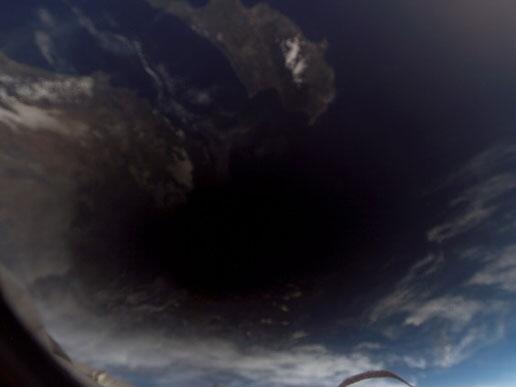
The Shadow of the Moon

Here is a stunning picture of the shadow of the moon on the Earth during yesterday's solar eclipse, taken from the ISS:

Embedded image permalink

However, this one going around is not real, but artwork by a Japanese artist from 2009:

Embedded image permalink

Sunday, November 03, 2013

Obama Taunts Cuccinelli on Mann and Climate

President Obama, campaigning in Virginia for Terry McAuliffe, gives a shout out to Michael Mann:
"It doesn't create jobs when you go after scientists, and you try to offer your own alternative theories of how things work -- (laughter) -- and engage in litigation around stuff that isn't political.  It has to do with what's true.  It has to do with facts.  You don't argue with facts.  (Applause.)"
The race has tightened a little in recent days (ruining the hockey stick), but it still looks like McAuliffe is going to win easily. A few points of that win may well be due to Cuccinelli's campaign against Mann and climate science, which is a win (for both) no matter how you look at it.


“I’ll show you who is responsible, right here”

During the government shutdown, Darrell Issa, chairman of the House Oversight and Government Reform, held a hearing to berate Jonathan Jarvis, the head of the National Park Service, for closing Washington D.C. monuments. (Jarvis said the furloughs hit all but 12 of the 300 park service employees who usually work on the Mall.) At the hearing, Democrat Peter DeFazio demonstrated to Issa who was actually responible for the closure:
“I’ll show you who is responsible, right here,” said Rep. Peter DeFazio of Oregon, the top Democrat on the House Natural Resources, after whipping out a mirror and holding it up to the Republican lawmakers.

“If you want to spend your time here dissecting individual decisions about what monuments are open and which are closed, let me save you some time,” DeFazio told the GOP members. “The national park system is surprisingly part of our national government, which you shut down.”
DeFazio is the rep from southern Oregon who has defeated climate change denier Art Robinson -- twice.

Friday, November 01, 2013

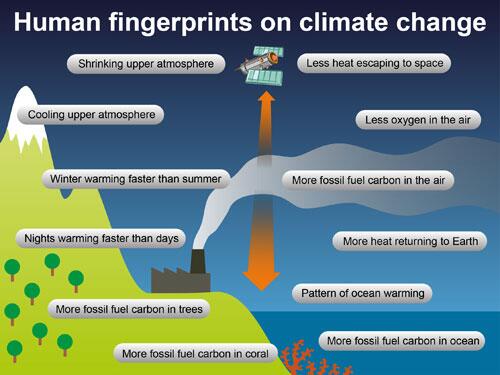
The AGW Evidence in One Picture

Here is a useful picture that lists, all in one place, the evidence for anthropogenic climate change. From John Cook's twitter feed:

Embedded image permalink

SkS has the details here.

Wednesday, October 30, 2013

GISS: Southern Hemisphere is Warmest Ever

One reason last month's GISTEMP was so high is that the Southern Hemisphere was its warmest ever: +0.85°C above the 1951-1980 baseline.

That shattered the previous SH record of +0.79°C in August 1996.

===
By the way, 81% of the southern hemisphere's surface is ocean, whereas only 61% of the northern hemisphere is. So 57% of the world ocean surface lies in the southern hemisphere.

Only about 11% of the world's population lives in the southern hemisphere, meaning the NH has 8.1 times the population of the SH and 3.9 times the population density. You can see why the Nazis went there to hide.

Article: Climate Change Denial and Support for Geoengineering

I have an article up at the Yale Forum on Climate Change and the Media:
"Strange Bedfellows? Climate Change Denial and Support for Geoengineering."

Tuesday, October 29, 2013

GISS: September Tied for Warmest

GISS measured a September global temperature anomaly of +0.74°C, tied with 2005 for the warmest September, and the 12th-warmest of any month going back to 1895.

17-year warming is 0.16°C. The 30-year change is 0.52°C.

The Polar Portal, and More

Some things I've noticed lately:

EOS has an article about the Polar Portal, a new site designed to give real-time changes in Arctic ice (which includes Greenland). This is a good idea that I hope to see more of; so much data is out there, but too often on obscure FTP sites with inadequate documentation.

David Keith has a book out titled A Case for Climate Engineering. (I've interviewed him for a couple of my articles; Eli Kintisch wrote a nice profile of Keith for a recent issue of Science.)

John von Neumann's dog was named "Inverse."

By 2018, more than 60% of all jobs in the United States will require at least some college education. (M. McNutt, Science, 10/25/13)

I missed this in September: a PNAS paper found that without the enhanced vegetation growth that has accompanied increasing levels of atmospheric CO2, atmospheric CO2 would be approximately 85 ppm higher than it is today. and the planet would have warmed by an additional 0.3°C.

Monday, October 28, 2013

The Chelyabinsk Meteor as Seen from Space

A space satellite view of last February's Chelyabinsk meteor as (and after) it enters the Earth's atmosphere, from Miller et al, PNAS, Oct 21 2013:


Another view, downward, from other satellites:


Tony Abbott, Doubly Wrong

The new Prime Minister of Australia, Tony Abbott, came to a doubly wrong conclusion when he recently said, “Despite a carbon tax of $37 a ton by 2020, Australia’s domestic emissions were going up, not down. The carbon tax was basically socialism masquerading as environmentalism, and that’s why it’s going to get abolished.”

The socialism, of course, is that given to polluters who pollute for free, paying no damage costs for ruining the Commons now and far into the future while they pocket the profits.

Beyond this, Australia has seen GHG reductions. From this April:
"Australia's greenhouse gas emissions from electricity generation have fallen to a 10-year low as coal-fired power slumped to its lowest level in a decade, a new report says..... At the same time, the share of renewable energy in the National Electricity Market (NEM) has soared beyond 12 per cent and looks set to continue rising..... In its latest quarterly emissions outlook, energy and carbon research firm RepuTex found coal power made up 74.8 per cent of the NEM in the three months ended in March - its lowest point in 10 years.... As a result, Australia's CO2 emissions were driven down to a ten-year low, he said."

China's Renewable Energy

Environmentally, China has to run hard just to stay in place:
China’s faltering progress on air quality resembles its record on carbon dioxide. Those emissions have risen by about 8 percent a year since 2007 and increased from nearly 14 percent of global emissions in 2000 to 27 percent in 2011.

This is in spite of China’s enormous investments to decarbonize its energy system. In less than 10 years it has built the world’s largest wind power capacity, with plans to triple it by 2020. Its hydropower capacity, also the largest in the world, is expected to triple from 2005 to 2020, and its nuclear capacity will multiply at least sixfold over that same period. And China is increasing imports and production of natural gas, the cleanest fossil fuel.

-- Chris P. Nielsen and Mun S. Ho, "Clearing the Air in China," NY Times 10/25/13, who estimate that a $10/ton tax on carbon dioxide in China would prevent as many as 89,000 premature deaths a year from pollution by 2020 (because it would incent a shift from coal), and improve crop productivity.

Saturday, October 26, 2013

What Everyone is Ignoring

Government’s hand has long shaped and subsidized health-care markets, for example, in Medicare and Medicaid (which dominate how medical care is organized and delivered in America, even for care that falls outside their reach), or the requirement that hospitals treat urgent care needs of indigents.

But perhaps the most consequential subsidy is rarely mentioned or even noticed: Government for decades has directly subsidized individuals’ costs of employer-based health care, to the tune of roughly $250 billion every year – sums far greater than the annual costs of the subsidized insurance coverage provisions of the Affordable Care Act.

-- Edward Kleinbard, “The huge health-care subsidy everyone is ignoring,” Washington Post, October 15, 2013

The Price We Pay

Paul Krugman, Why is Obamacare so Complicated?:
So Konczal is right to say that the implementation problems aren’t revealing problems with the idea of social insurance; they’re revealing the price we pay for insisting on keeping insurance companies in the mix, when they serve little useful purpose.

So does this mean that liberals should have insisted on single-payer or nothing? No. Single-payer wasn’t going to happen — partly because of the insurance lobby’s power, partly because voters wouldn’t have gone for a system that took away their existing coverage and replaced it with the unknown. Yes, Obamacare is a somewhat awkward kludge, but if that’s what it took to cover the uninsured, so be it.

And although the botched rollout is infuriating — count me among those who believe that liberals best serve their own cause by admitting that, not trying to cover for the botch — the odds remain high that this will work, and make America a much better place.

Counting on the ACA

WaPo letter to the editor:
E.J. Dionne Jr. rightly urged us all to “Take a deep breath” [op-ed, Oct. 24] in the face of the “staggeringly complex task” of launching the Web site for the Affordable Care Act.

I’ve heard it said that, if all the battleships launched in World War II had waited until they were fully equipped for battle, none would have left port. Anyone who thinks a massive computer program can be launched without major glitches lives in a fantasy world. Every businessman knows that creating new Web sites, even modest ones, entails complex programming whose bugs take time to eliminate. It took years for Social Security and Medicare to run smoothly.

Despite all the political capital Republicans have spent trashing Obamacare, I fear that Republicans will be left with egg on their face once the administration applies its massive resources to getting the system up to speed.

Richard L. McCloud, Reston
I am counting dearly on the ACA. I am a self-employed person who cannot purchase insurance at any price due to pre-existing conditions.

I paid for my own health insurance for several years after I turned freelance, thanks to COBRA. By June 2002 it cost me $292/month, which didn't include prescription coverage.

In 2003 I moved to Ogunquit, Maine for the winter, and my premiums doubled overnight. I couldn't afford that, and dropped the coverage I had.

I haven't had insurance since, except for a few months in Oregon when I qualified for the Oregon Health Plan. Unless you are destitute, which I am not, you can't qualify. I've had the dreaded "pre-existing" conditions since I was 23, and stumbled backward onto my butt when I was playing squash. I broke my tailbone, and eventually had to have it removed surgercially, but it has hurt ever since. And that's just the start of it. I am too complicated to be profitable to any insurance company. Does that mean I'm supposed to go without health insurance for the rest of my life?

If Obamacare fails, I simply don't know what I will do. I have never felt more involved and dependent on a legislative effort than I have for the ACA.

It's not a perfect law. I could get ironed out, if the Republicans gave a shit. But they do not.

Friday, October 25, 2013

Another Big Earthquake off Japan


-------- Original Message --------
Subject: 2013-10-25 17:10:16 UPDATED: (M7.3) OFF THE EAST COAST OF HONSHU, JAPAN 37.2 144.7 (2b02a)
Date: Fri, 25 Oct 2013 17:24:27 +0000 (UTC)
From: ens@ens.usgs.gov (USGS ENS)
Reply-To: <ens@ens.usgs.gov>
To:


Globe with Earthquake Location

M7.3 - OFF THE EAST COAST OF HONSHU, JAPAN

Preliminary Earthquake Report
Magnitude 7.3
Date-Time
  • 25 Oct 2013 17:10:16 UTC
  • 26 Oct 2013 03:10:17 near epicenter
  • 25 Oct 2013 09:10:16 standard time in your timezone
Location 37.194N 144.663E
Depth 10 km
Distances
  • 325 km (201 mi) ESE of Ishinomaki, Japan
  • 326 km (202 mi) E of Namie, Japan
  • 331 km (205 mi) SE of Ofunato, Japan
  • 333 km (206 mi) ESE of Yamoto, Japan
  • 475 km (294 mi) ENE of Tokyo, Japan
Location Uncertainty Horizontal: 0.0 km; Vertical 1.9 km
Parameters Nph = 100; Dmin = 551.1 km; Rmss = 1.37 seconds; Gp = 36°
Version = 1
Event ID us c000kn4n ***This event supersedes event AT00mv8id4.

For updates, maps, and technical information, see: Event Page or USGS Earthquake Hazards Program
National Earthquake Information Center
U.S. Geological Survey
http://earthquake.usgs.gov/regional/neic/

"...no alternative to continuing to struggle"

all the invisible events make the history of that time hard to write. And all the events continued to occur against the most intense resistance of time, material, and human recalcitrance—human fear, in fact, seizing with a desperate grip various imagined props out of the past that were somehow felt to hold the world together. Because of this, there is still and always the risk of utter failure and mad gibbering extinction. There is no alternative to continuing to struggle.

     - Kim Stanley Robinson, last paragraph, 2312

Singer: I Don't Like Saying They're Fraudulent, But...

Fred Singer, in an interview in the San Diego Union Tribune, says he doesn't like to call the IPCC "fraudulent," but they're "fraudulent":
Q: How are policy makers, journalists and the public, who are not scientists, supposed to filter out who’s right and who’s wrong?

Singer: The IPCC has a way of ignoring inconvenient facts. It’s actually fraudulent but we don’t like to use that term, not because we’re scared of being sued but because all it does it get the other side’s back up.
Singer also says "there has been no rise in temperature for some 17 years," which is downright false: HadCRUT4 shows 0.11 ± 0.06 °C of warming over the last 17.0 years (uncertainty is 2σ calculated via OLS). GISS data has it at 0.15 ± 0.06 °C.

Of course, it's also false because it ignores the strong ocean warming over that time.

There's also this bit of obfuscation:
Singer: Well, it depends on where you start. If you start from the last ice age, 18,000 years ago, it certainly is much warmer. If you start 1,000 years ago, from the medieval climate warming, then it’s slightly cooler. If you start from the (Middle) Ice Age or let’s say around 1700 or so, then it is definitely warmer. So it has been warming. The earth is warming, not steadily, but in jumps.
When historians of the year 2200 write the history of climate change, is anyone going to come out worse than Fred Singer?

Thursday, October 24, 2013

Federal Spending, and Science

It's never a bad time to post a good graph, this one from this week's Science:


The budget approved last week sets discretionary spending at $986 B, with defense spending $518 B of that, leaving $468 B for civilian programs (which includes spending on science).

One interesting quote from the article:


Wednesday, October 23, 2013

Cuccinelli Losing to a Hockey Stick

A Rasmussen Report polls for the Virginia Governor's race now has Terry McAuliffe up 50-33 over Ken Cuccinelli, the highest margin yet.

I couldn't find a completely up-to-date graph, but here is one from September. By now the blue line is even higher on the right.... Does McAuliffe's trend sorta look like a hockey stick to you? Isn't that ironic....

Virginia RCP VAGOV 96